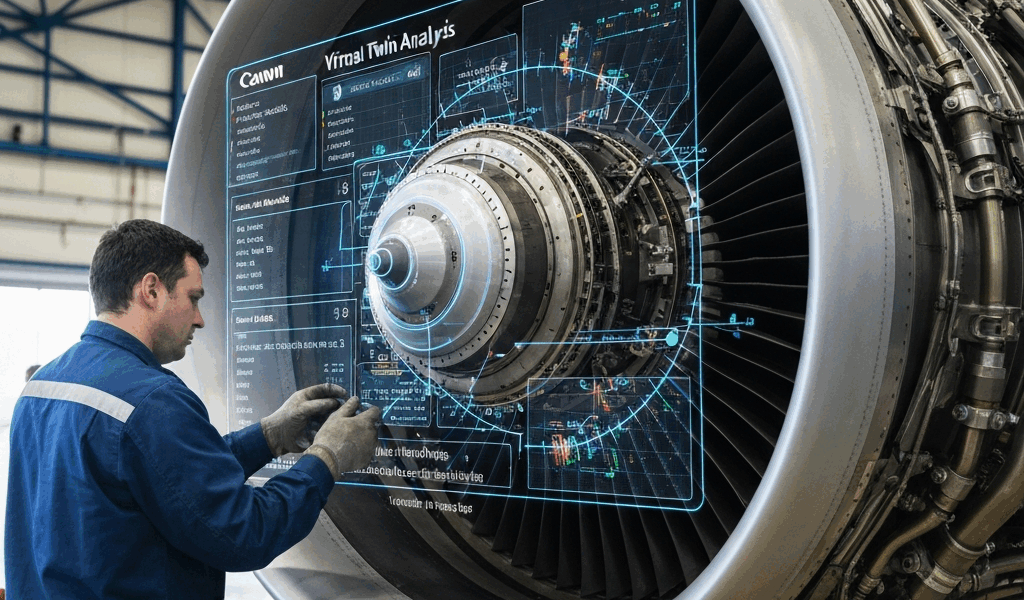
Somewhere in a server room, a Rolls-Royce Trent XWB engine is running. Not a physical engine bolted to an Airbus A350 wing — a virtual one, built from sensor data streaming off an actual engine cruising at 38,000 feet over the Atlantic. Every temperature reading, every vibration frequency, every pressure fluctuation feeds into this digital copy in real time. When the virtual engine shows early signs of bearing wear, maintenance crews on the ground already know about it before the flight lands.
That virtual engine is a digital twin, and it is quietly transforming how airlines keep their aircraft flying.
What a Digital Twin Actually Is
A digital twin is not a 3D model sitting in a CAD program. It is a living, continuously updated simulation of a physical asset that mirrors its real-world counterpart in near real time. The “twin” part is literal — every sensor reading, every operational parameter, every environmental condition the physical engine or airframe experiences gets reflected in the digital version.
Rolls-Royce pioneered this approach with their IntelligentEngine platform. They install onboard sensors and satellite connectivity on physical engines. Those sensors collect data points — vibration amplitude at specific frequencies, exhaust gas temperatures, oil pressure trends, compressor blade clearances — and beam them continuously to ground-based servers where the digital twin lives.
The twin then runs that data through machine learning models trained on the operational history of the entire fleet. It is not just comparing your engine to itself last week. It is comparing your engine to every other engine of the same type across every airline operating it, under every combination of climate, altitude, and flight cycle pattern. That fleet-wide context is what makes the predictions useful rather than just interesting.
The distinction from a static model matters. A 3D rendering of an engine can show you where parts are located. A digital twin can tell you that the high-pressure turbine in this specific engine, serial number TXWB-4471, is degrading 12% faster than the fleet average and will likely need intervention within the next 300 flight cycles. That specificity changes maintenance from a calendar-based activity to a condition-based one.
How Airlines Use Digital Twins for Maintenance
Traditional aircraft maintenance follows prescribed intervals. Every 500 hours, check this. Every 2,000 cycles, inspect that. Every six years, tear the whole thing down and rebuild it. This approach works — commercial aviation has an outstanding safety record — but it is inherently inefficient. Some components get replaced well before they need it. Others develop problems between scheduled checks.
Digital twins flip this model. Instead of asking “has this part reached its scheduled interval?” the system asks “is this part actually showing signs of degradation?” The difference saves airlines millions in unnecessary part replacements and, more importantly, catches developing issues that scheduled maintenance would miss.
Rolls-Royce’s platform serves more than 50,000 users worldwide who rely on digital twin data for maintenance decisions. The system continuously monitors engine health indicators and flags anomalies. A subtle shift in vibration frequency at a specific compressor stage might indicate foreign object damage that has not yet affected performance. Without the twin, that damage would go undetected until the next borescope inspection, potentially weeks or months away.
Airbus has expanded the concept beyond engines to the entire aircraft lifecycle. Their digital twin framework covers design, manufacturing, testing, and in-service operations. During the design phase, the twin simulates how structural components will fatigue under different flight profiles. During operations, it tracks actual loads against those predictions and adjusts maintenance requirements based on how the specific airframe has actually been used — a short-haul aircraft doing eight cycles a day ages differently than a long-haul one doing one cycle daily, even if they have the same number of flight hours.
Real Examples of Digital Twins Saving Flights
Lufthansa Technik reported a 60% reduction in engine inspection time after implementing digital twin technology for their MRO operations. That number sounds dramatic, but the mechanism is straightforward: instead of disassembling an engine and inspecting every component according to the manual, technicians arrive knowing exactly which areas the digital twin has flagged as needing attention. They go directly to the problem zones and verify what the data already told them. The result is faster turnaround, less labor, and aircraft returning to service days earlier than under the traditional process.
Component life extension is another measurable outcome. When a part is scheduled for replacement at 10,000 cycles but its digital twin shows no degradation trend, airlines can petition the manufacturer for a life extension on that specific serial number. This happens more often than you might expect. Operating conditions vary enormously — an engine operating primarily in clean, dry air over the Pacific accumulates less wear than one flying short hops through sandy, humid environments in the Middle East. The twin captures that difference and quantifies it.
Unscheduled maintenance events — the ones that strand passengers and cost airlines anywhere from $10,000 to $150,000 per hour of delay — are where digital twins deliver the most visible impact. GE Aviation’s digital twin platform monitors more than 40,000 engines and claims to reduce unscheduled removals by identifying degradation trends weeks before they would cause an in-service failure. An engine that gets pulled proactively during a scheduled overnight maintenance window costs a fraction of one that fails during pushback at a hub airport during peak operations.
The Technology Stack Behind Aviation Digital Twins
Building a digital twin starts with sensors. Modern jet engines carry hundreds of them — measuring temperatures at multiple turbine stages, vibration at bearing locations, oil system pressures, fuel flow rates, and bleed air parameters. The Rolls-Royce Trent XWB generates approximately 1 terabyte of data per flight. Multiply that across a fleet of 300 aircraft, each flying twice daily, and you begin to understand the data infrastructure required.
Getting that data off the aircraft and into the twin requires satellite connectivity for long-haul operations and ACARS (Aircraft Communications Addressing and Reporting System) for shorter messages. Some parameters stream in near real time. Others are downloaded in bulk when the aircraft reaches a gate equipped with broadband data links. The twin does not need every parameter in real time — some analyses run on batched data that updates after each flight.
On the analytics side, machine learning models do the heavy lifting. They compare incoming sensor data against fleet-wide baselines, looking for deviations that match known failure precursor patterns. The models train on historical maintenance records, previous failure events, and manufacturer-supplied degradation curves. When the model detects a pattern that preceded a bearing failure in 15 other engines of the same type, it raises a flag — even if the current engine shows no obvious symptoms yet.
Cloud infrastructure from AWS, Azure, and specialized aviation platforms like Palantir Foundry handles the compute and storage requirements. Processing terabytes of sensor data against fleet-wide models is not something that runs on a laptop. Airlines either build their own platforms or subscribe to OEM-provided services. Rolls-Royce and GE both offer their digital twin capabilities as a service, bundled with engine maintenance contracts — which gives them an incentive to make the predictions as accurate as possible, since they are often financially responsible for unscheduled events under power-by-the-hour agreements.
Where Digital Twins Are Headed in Aviation
Current digital twins mostly focus on engines and high-value rotating components. The next step is full-airframe twins that model structural fatigue, corrosion progression, and system-wide interactions. Boeing and Airbus are both working on airframe-level twins that would track stress accumulation in individual structural elements — wing spars, fuselage frames, landing gear attachment points — based on actual flight loads rather than assumed average loads.
Integration with autonomous systems is another growth area. As collaborative combat aircraft (CCAs) and unmanned cargo operations move toward production, digital twins become essential for managing fleets of vehicles that do not have a human pilot monitoring gauges. The twin becomes the pilot’s instrument panel, except it runs continuously on the ground and can monitor an entire fleet simultaneously.
Fleet-wide optimization represents the ultimate evolution. Instead of optimizing individual aircraft in isolation, future systems will model the entire fleet as a single entity, making decisions about which aircraft to assign to which routes based on their individual health profiles, maintenance windows, and predicted remaining component life. An aircraft whose digital twin shows elevated engine wear gets assigned to shorter, less demanding routes while the healthier one takes the 14-hour transpacific flight.
The technology has already proven its value at the component level. Expanding it to the full aircraft and then to the full fleet is an engineering scaling problem, not a conceptual one. The data exists. The models work. What remains is building the infrastructure to connect them all — and convincing airlines that the upfront investment pays for itself. Based on the numbers Lufthansa Technik, Rolls-Royce, and GE are publishing, that argument gets easier every year.




Stay in the loop
Get the latest aviate ai updates delivered to your inbox.