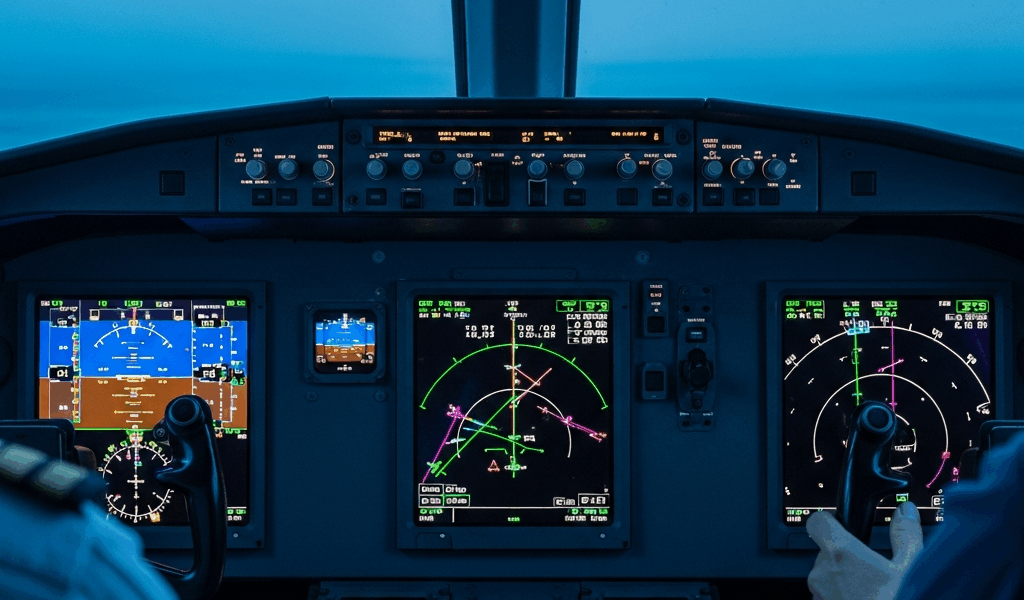
What AI Copilot Actually Means on a Real Flight Deck
AI copilot coverage has gotten complicated with all the hype and misinformation flying around. Most articles use “copilot” and “autopilot” interchangeably. That’s a problem. They’re not the same thing — not even close.
Traditional autopilot — the kind keeping aircraft level since the 1950s — is a dumb machine in the best sense. It follows pre-programmed instructions. Hold altitude. Track this heading. Maintain speed. Sensors feed data to actuators, actuators move control surfaces, and the aircraft does what you told it to do. No learning. No adaptation. Beautiful in its simplicity, honestly.
AI copilot systems are different. They observe. They reason. They pull from dozens of data sources simultaneously — not just the altimeter and compass, but weather radar, traffic data, fuel burn curves, ATC clearances, engine performance telemetry, historical patterns from thousands of similar flights. Then they make recommendations. Sometimes corrections happen automatically. And critically, they know when to hand control back.
Probably should have opened with this section, honestly. The distinction determines everything that follows — what these systems can actually do, what they should do, and what they absolutely should not do.
Let’s be clear on what AI copilots are not. They’re not replacing captains. They’re not autonomous aircraft flying themselves without oversight. The FAA, EASA, and every other civil aviation authority on Earth has made that plain — humans remain accountable and in command. What these systems do is augment the crew. Handle routine tasks. Flag anomalies faster than a human can detect them. Free up mental bandwidth for decisions that actually matter.
This article includes affiliate links. We may earn a commission at no extra cost to you.
The Systems Doing the Heavy Lifting Right Now
Three platforms dominate the modern cockpit: Honeywell’s Anthem system, Garmin’s G5000 integrated flight deck, and Boeing’s Flight Management System with its latest autothrottle logic. None of these is purely “AI” in the machine-learning-neural-network sense. But they all use adaptive algorithms that learn from real-time data — making decisions that go far beyond rigid automation.
Honeywell Anthem — The Workhorse
Installed on newer regional jets and increasingly on large transport aircraft, Anthem bundles traditional autopilot functionality with what Honeywell calls “intelligent flight management.” Standard tasks: maintaining altitude within 50 feet, tracking lateral navigation to within a quarter-mile, managing descent profiles. But it also monitors engine parameters in real time. Detect a deviation in fuel burn or turbine temperature suggesting a developing issue, and it alerts the crew before anything becomes critical.
Anthem works directly with the aircraft’s Engine Indication and Crew Alert System — EICAS, for short. It’s reading dozens of signals per second, looking for patterns. A single anomaly might just be noise. But when fuel flow starts creeping up, exhaust gas temperature rises slightly, and vibration increases in a specific harmonic band? That combination triggers an alert. Pilots still diagnose and decide, but they’re responding to a signal they might not have caught until things got genuinely bad.
Garmin G5000 — The Details Matter
Found in larger turboprops and some business jets, the G5000 is a fully integrated glass cockpit. Its version of AI assistance focuses on autothrottle management and envelope protection. Feed it a target altitude, a desired descent rate, current atmospheric conditions — it calculates power settings that get you there while optimizing fuel burn. It also learns from deviations. If the actual aircraft burns fuel slower than the published table suggests, the G5000 incorporates that feedback into future planning. That’s what makes it endearing to pilots who fly it regularly.
The system also protects the aircraft from leaving its safe operating envelope. Pitch too steeply in a climb and autothrottle logic reduces power or noses the aircraft down — preventing a stall without you asking for the intervention. Don’t take that for granted. Plenty of incidents happened before this existed.
Boeing FMS and Adaptive Routing
The Flight Management System on Boeing 777s, 787s, and the newest 737 MAX aircraft goes deeper. It continuously monitors upper-level winds, jet stream position, convective weather. Every 15 minutes during cruise, it recalculates the optimal flight path. If moving 200 miles north shaves 12 minutes off the flight while avoiding headwinds, it proposes a deviation to ATC. The crew approves or declines — but the FMS makes the analysis that would take a human crew 20 minutes of chart study.
Real example: a 777 on a trans-Pacific routing saved nearly 900 gallons of fuel — almost $3,000 at today’s prices — because the FMS detected a favorable wind pattern 6,000 feet higher and coordinated a level-off adjustment with air traffic control. That was a single flight. Multiply that across a fleet.
How the AI Reads the Plane and the World Around It
This is where the technical substance lives. Worth understanding if you want to grasp why these systems actually work.
Every sensor on a modern aircraft streams data to a central avionics hub. Pitot tubes measure airspeed. Inertial measurement units track acceleration and rotation. Thermocouples in the engines report temperature. Fuel quantity probes report burn rate. Collectively, these generate roughly 10,000 data points per second on a large transport aircraft. Ten thousand. Per second.
The AI system performs sensor fusion — cross-referencing redundant inputs to detect which sensors are reliable and which are drifting. Left pitot tube reports 250 knots, right pitot reports 248, inertial system confirms 249? The system trusts the consensus and flags the outlier. It’s not guessing. It’s triangulating truth from independent measurements simultaneously.
External data flows in constantly too. The aircraft receives ADS-B signals from nearby traffic — precise position and altitude of other aircraft within roughly 200 nautical miles. Weather radar paints precipitation and turbulence ahead. But the system also ingests data from the ground: satellite imagery, SIGMET reports, wind aloft data from aircraft already ahead on the same route.
Synthesizing this sounds straightforward in text. In execution, it’s a choreography. The system weighs freshness against certainty. Satellite data might be two hours old but spatially precise. A report from a jet 300 miles ahead is newer but represents conditions the aircraft hasn’t reached yet. The algorithm assigns confidence scores and makes decisions accordingly — constantly, quietly, in the background.
Then it acts or advises. Maybe the FMS automatically adjusts heading 15 degrees to avoid forecast turbulence. Maybe it highlights a weather cell on the crew’s display with a confidence score attached. The boundary between automatic action and advisory gets set by certification standards and — importantly — by pilot preference. Every major airline configures these systems differently based on their own training culture.
Where AI Assists and Where Pilots Still Take Over
I’m not going to oversell what these systems can do. That’s how trust gets broken.
AI copilot systems are superb at steady-state operations. Cruising at 41,000 feet in smooth air? The system owns it — monitoring engine parameters, trimming fuel flow, watching the inertial navigation system drift and correcting course. The crew monitors the monitors. That’s genuinely how it works.
But the moment things get weird, the pilots take back priority.
Unusual attitudes — nose-down spirals, wing-stall conditions — demand immediate human intervention. Recovery depends on context the system might not have. Is the aircraft descending into terrain or diving away from a collision alert? The pilot knows. The system guesses. That’s a meaningful difference at 400 knots.
Conflicting sensor data triggers manual override too. A few years back, a regional jet had a faulty angle-of-attack sensor feeding garbage data to the flight control computer. The autothrottle started hunting — overshooting power settings rhythmically. The flight crew manually disconnected the autothrottle and flew by hand, confirming airspeed against pitot-static instruments and visual indications. The AI system didn’t fail — it did exactly what it was programmed to do with bad inputs. The pilots succeeded because they recognized the input was bad. Don’t make my mistake of thinking those two things mean the same thing.
ATC instructions that break the programmed flight plan also cause handoff. Air traffic control says “descend now, cleared to 6,000 feet for traffic.” The FMS has a descent profile beginning 50 miles ahead at a different altitude. The pilot manually overrides and descends immediately. The FMS stays active for navigation, but the pilot owns the vertical profile from that moment forward.
This is not a weakness. It’s the entire point. The system expands the crew’s capability and situational awareness. It does not replace judgment — and it was never designed to.
What the Next Five Years Looks Like for AI in the Cockpit
Speculation is fun but misleading, so let’s stick to programs already funded and in active test phases.
Frustrated by cargo aviation’s reliance on expensive pilot crews for short-haul routes, Reliable Robotics began flight-testing autonomous Cessna Caravans retrofitted with electronic flight control systems back in 2021. Their AI stack handles taxi, takeoff, cruise, and landing without a pilot onboard. These are slow cargo flights in established corridors with pre-approved routes and minimal traffic conflict. It’s not a 777 crossing the North Atlantic — but it’s not nothing, either.
DARPA’s ACE program — Agile Combat Employment — is pushing autonomous decision-making in military jets. Threat assessment, tactical routing, dynamic mission replanning. Some of that filtering down to commercial platforms will take years. Certification bodies are still writing the rulebook, and that process doesn’t move fast.
Realistically, here’s what happens in the next five years. AI copilot systems become more predictive. Instead of reacting to a detected anomaly, they forecast it. Engine health monitoring shifts from condition-based to predictive — the system flags that a specific bearing will likely fail within 200 flight hours, before it becomes an incident. Fuel optimization goes hyperlocal, calculating burn profiles for specific runway elevation, ambient temperature, and weight distribution in real time rather than using published tables.
The big one: crew workload modeling. Systems like Honeywell Anthem will monitor fatigue, attention, and cognitive load in the flight crew and actively redistribute tasks. High workload moment? The system steps back, lets autopilot manage more. Low workload cruise? The system steps forward with more advisory intelligence. I’m apparently someone who finds this the most interesting development in the pipeline, and Anthem’s roadmap is the one worth watching while legacy FMS updates never quite deliver.
But single-pilot commercial operations? Autonomous wide-body transports? Those are five-plus-year problems — and they’re not merely technical. They’re regulatory, insurance, and cultural. The FAA is not certifying a 787 to cross the Pacific with zero crew until the system has proven itself across thousands of scenarios humans haven’t imagined yet. That’s not pessimism. That’s just how aviation safety works.
So, without further ado, here’s the bottom line: what we have right now is already remarkable. AI copilot systems in today’s commercial jets augment the crew in ways that improve safety, reduce fatigue, optimize fuel, and make long flights more manageable for everyone in the cockpit. That’s not the future. That’s today — and it’s worth understanding how it actually works before the next wave arrives.


Stay in the loop
Get the latest aviate ai updates delivered to your inbox.