Your flight is delayed, but your phone knew 45 minutes before the gate agent did. That gap between what the algorithm sees and what the departure board shows is shrinking every year, and it is reshaping how airlines manage hundreds of thousands of flights daily.
Airlines have been throwing data at delay prediction for decades. What changed is the sheer volume of variables that machine learning can process simultaneously — weather fronts forming 800 miles away, a maintenance flag on the inbound aircraft, crew duty limits about to expire, and three other flights competing for the same gate. No human dispatcher juggles all of that in real time. The algorithms do.
How AI Predicts Your Flight Will Be Late
At the core, delay prediction AI works by ingesting enormous datasets and identifying patterns that reliably precede disruptions. The models train on years of historical operations data — every departure, every arrival, every recorded delay cause — and then apply what they learned to live conditions.
The most widely used approach is a class of algorithms called ensemble methods, with Random Forest leading the pack. Think of it as polling hundreds of decision trees, each trained on a slightly different slice of the data, and taking the majority vote on whether a flight will depart on time. It is not glamorous, but it is remarkably effective at handling the messy, interconnected variables that drive airline operations.
Here is what the model actually sees when it evaluates your 3:15 PM departure from O’Hare:
- Weather at origin and destination — not just current conditions, but forecast data for the arrival window
- Inbound aircraft status — is the plane that becomes your flight running late from its previous leg?
- Airport congestion — how many other movements are competing for runways and gates at that hour?
- Crew scheduling — are pilots and flight attendants approaching duty time limits that would require a swap?
- Historical patterns — this specific route, on this day of the week, at this time of year, has a track record the model can reference
- Cascading delay chains — a late arrival in Dallas can ripple through to a departure in Denver three legs later
The models weigh these inputs differently depending on conditions. During summer thunderstorm season, weather dominates everything. On a clear Tuesday morning in February, the biggest risk factor might be an aging aircraft with a maintenance history that flags higher odds of a gate return.
Which Airlines Already Use Delay Prediction AI
This is not theoretical. Major carriers have deployed AI-driven prediction systems and published measurable results.
Alaska Airlines launched a program called Flyways that uses machine learning to optimize routing decisions in real time. During a six-month trial, the system saved 480,000 gallons of jet fuel by identifying more efficient paths that accounted for predicted delays and congestion. That fuel savings translates directly into fewer flights sitting on taxiways burning Jet-A while waiting for a gap in the departure sequence.
British Airways integrated AI-powered flight planning across its operations and reported saving up to 100,000 tons of fuel in a single year — roughly $10 million in cost reductions. Their system does not just predict delays; it uses delay probability to adjust fuel loads. If the model sees a high likelihood of holding patterns at Heathrow, it loads extra fuel for that specific flight rather than applying a blanket fuel buffer to every departure.
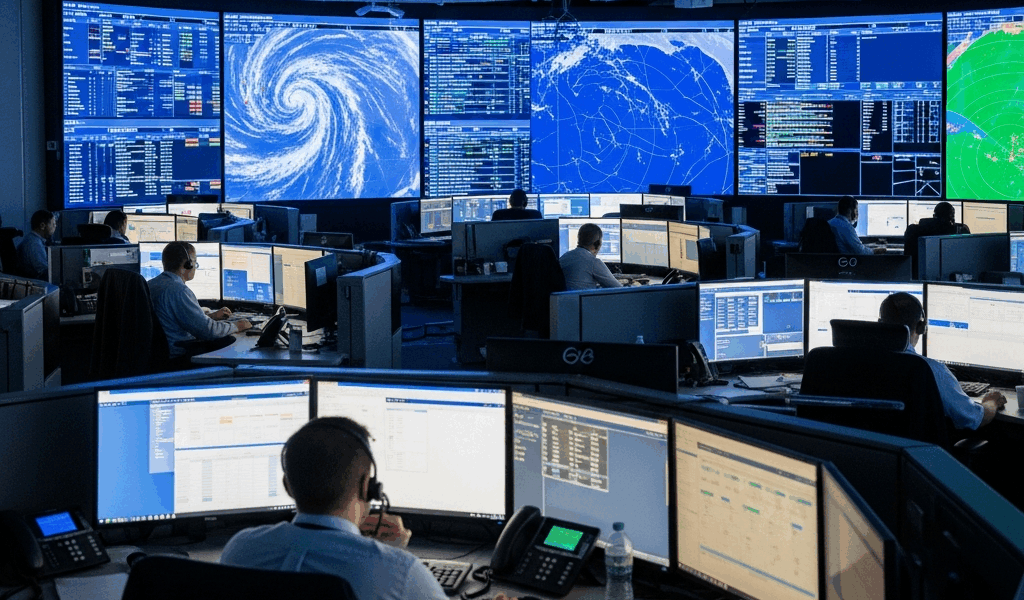
Delta Air Lines operates one of the most sophisticated operations centers in the industry, where AI models feed real-time delay predictions to dispatchers. Delta has invested heavily in decision-support tools that flag potential disruptions hours before they cascade. Their approach treats delay prediction not as a standalone feature but as one input in a broader operational optimization system that also handles rebooking, crew repositioning, and gate assignments.
Smaller carriers are getting into the game too. Regional airlines partnering with companies like Cirium and OpenAirlines access cloud-based prediction platforms without building the infrastructure in-house. OpenAirlines’ SkyBreathe platform claims airlines using its AI-driven recommendations achieve up to 5% fuel savings through smarter operational decisions informed by delay and congestion forecasts.
The Data Behind Every Prediction
Weather is the single biggest driver of flight delays in the United States, responsible for roughly 30% of all disruptions according to FAA data. That makes meteorological data the most heavily weighted input in almost every prediction model. But raw weather data is not enough — the models need it translated into operational impact. A 15-knot crosswind at LaGuardia means something very different than the same wind at Denver International, because runway configurations and aircraft types vary.
Airport congestion data comes from FAA traffic flow management systems and real-time ADS-B feeds. The models learn that certain airports hit capacity walls at predictable times. Newark at 5 PM on a Friday in July is a different animal than the same airport on a Wednesday morning in October. These patterns are consistent enough across years that even relatively simple models pick them up.
Aircraft type matters more than most passengers realize. Some fleets have higher mechanical reliability rates than others. A 737-800 with 30,000 cycles on the airframe carries different delay risk than a factory-fresh 737 MAX 8 with 2,000 cycles. The models see this in maintenance records and factor it into the probability.
Random Forest remains the dominant algorithm for a practical reason: it handles missing data gracefully. In the real world, not every variable is available for every flight at prediction time. A crew scheduling system might be slow to update, or a weather sensor might be down. Random Forest degrades gracefully when some inputs are absent, which matters enormously in production systems that need to run 24 hours a day without failing.
How Accurate Is AI at Predicting Delays
Recent peer-reviewed research puts the best models at 90% to 97% accuracy on binary delay/no-delay classification. A 2024 study published in Scientific Reports achieved 90% accuracy using a hybrid approach that combined Random Forest with oversampling techniques to handle the class imbalance problem — most flights actually depart on time, so the model needs extra training on delayed flights to learn what disruption looks like.
That 90-97% range sounds impressive, and it is, but there are important caveats. Most of these accuracy figures come from predicting whether a delay will happen, not predicting exactly how long it will last. Telling you your flight has an 85% chance of a delay is useful. Telling you it will be exactly 47 minutes late is a much harder problem that current models solve less reliably.
The models also struggle with rare, high-impact events. A freak mechanical failure, a security incident, or a sudden air traffic control staffing shortage does not appear often enough in training data for the algorithm to learn the pattern. These black-swan disruptions account for a small percentage of all delays but a disproportionate share of the longest, most painful ones.
Cascading delays remain the hardest scenario to predict accurately. When a single disruption at a hub airport sets off a chain reaction that ripples through dozens of connections, the models face a combinatorial explosion of possible outcomes. Some airlines address this by running simulations — hundreds of Monte Carlo iterations that model different cascading scenarios and assign probabilities to each.
What This Means for Passengers
The consumer side of delay prediction has already arrived, even if most travelers do not realize they are using it. Apps like Flighty aggregate multiple data sources — ADS-B aircraft tracking, FAA ground delay programs, historical route performance, and weather data — to give passengers delay estimates that often beat the airline’s own posted information.
Flighty’s advantage is that it tracks the physical aircraft assigned to your flight. If that plane is running 40 minutes late arriving from its previous city, the app shows you that delay before the airline has officially acknowledged it. The airline’s system might still show “on time” because the dispatcher is hoping to make up time on a faster turn. The tracking app just reports what the ADS-B data says.
Behind the scenes, airlines are using prediction data for crew scheduling — pre-positioning reserve crews at airports where the model shows elevated delay risk, rather than scrambling after the disruption hits. They are adjusting fuel loads flight-by-flight instead of using flat percentage buffers. And some carriers have started testing proactive rebooking, where passengers on flights flagged as high-probability delays receive alternative itinerary options before the delay is even announced.
The next frontier is integration with air traffic control. NASA and the FAA have been testing Traffic Flow Management systems that incorporate airline delay predictions into airspace planning decisions. If the system knows that 30 flights scheduled into Chicago between 4 PM and 6 PM are each carrying a 60% delay probability due to an approaching weather system, it can implement ground delay programs earlier and more precisely — reducing the time spent circling in holding patterns and burning fuel.
For now, the practical takeaway for travelers is straightforward: track your aircraft, not your flight number. The plane tells you more than the status board. And if multiple data sources agree that your departure is at risk, trust them — book that later connection while seats are still available.



Stay in the loop
Get the latest aviate ai updates delivered to your inbox.