
So when someone asks me about Collins Avionics — or Collins Aerospace, as they’re known now — I try to cut through the noise and talk about what they actually make and why it matters. I’ve spent time around aircraft equipped with Collins gear, and while I’m not an avionics tech by trade, I’ve picked up enough to have informed opinions. Some strong ones, honestly.
A Quick Background
Collins has been in the avionics game for decades. They’re now part of Collins Aerospace under the RTX (formerly Raytheon Technologies) umbrella, which means they’ve got deep pockets and a massive R&D operation. They build avionics for both commercial and military aircraft, and their equipment shows up in everything from regional turboprops to fifth-generation fighters.
Communication Systems
This is one of Collins’ bread-and-butter areas. They make VHF and HF radios, satellite communication systems, and data link technologies. The big deal here isn’t just that the radios work — lots of radios work — it’s that their systems integrate well together. A pilot can switch between VHF, HF, and SATCOM without fumbling through different interfaces. That matters when you’re over the North Atlantic with no VHF coverage and need to relay a position report.
I talked to a 767 captain once who said switching from an older comms suite to Collins was like going from a flip phone to a smartphone. Maybe a slight exaggeration, but the point about user experience was well taken.
Navigation Systems
Collins builds GPS receivers, inertial navigation systems (INS), and multi-mode receivers (MMR). The MMR is particularly interesting because it handles ILS, VOR, GPS, and GLS approaches all in one box. Fewer boxes in the avionics bay means less weight, less wiring, and fewer things to fail.
The accuracy of their INS units is legitimately impressive. These things can track an aircraft’s position without any external input — no GPS, no radio navaids — just by measuring accelerations and rotations. Of course, they drift over time, which is why they’re paired with GPS, but as a backup they’re hard to beat.
Flight Management Systems
The FMS is where Collins really shines, in my opinion. Their flight management systems pull together navigation, performance calculations, and guidance into a single interface. Pilots program their route, and the FMS handles the lateral and vertical navigation, fuel predictions, and can even compute the most fuel-efficient altitude and speed.
Instead of manually computing top-of-descent points or step-climb altitudes, the FMS does it. Not perfectly every time, and experienced crews definitely override it when conditions warrant, but as a baseline tool it’s excellent.
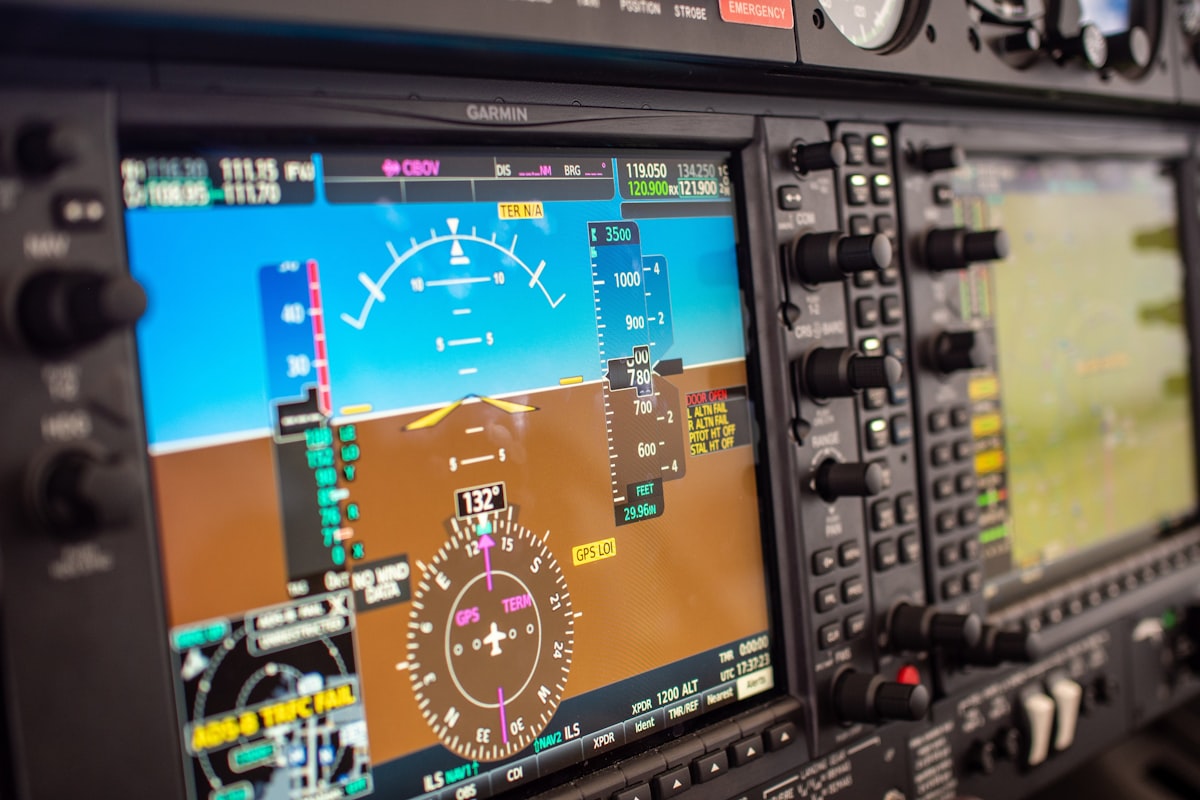
Synthetic Vision and Heads-Up Displays
Two innovations I want to highlight specifically. Synthetic vision systems (SVS) create a 3D representation of the terrain ahead on the cockpit display. Imagine flying an approach into Aspen at night — mountains on three sides, a short runway, and maybe some weather. SVS gives you a picture of what’s out there even when you can’t see it with your eyes. It’s not a replacement for instrument procedures, but it adds a layer of situational awareness that can genuinely save lives.
Heads-up displays (HUD) are the other big one. Collins’ HUDs project speed, altitude, heading, and flight path information onto a transparent combiner glass in front of the pilot. The pilot can monitor instruments while keeping their eyes looking outside. Some airlines now require HUD for low-visibility approaches, and Collins is one of the main suppliers. I’ve watched approaches in a sim with and without HUD, and the difference in pilot confidence is noticeable.
Military Side of Things
Collins has a major presence in military aviation. Their ruggedized comms and nav systems are built to handle extreme conditions — temperature swings, vibration, electronic warfare environments. Their electronic warfare systems handle threat detection and countermeasures, which is about as high-stakes as avionics get.
They’re also involved in UAV mission systems. The technology that lets a remote operator precisely control an unmanned aircraft from thousands of miles away relies on incredibly reliable data links and nav systems. Collins is a key supplier in that space.
What They Do for Airlines
On the commercial side, it goes beyond just the cockpit. Collins makes in-flight entertainment systems and cabin management systems that control lighting, temperature, and other passenger-facing amenities. It’s a different market from their flight-deck equipment, but it makes sense as a business move — they’re already on the aircraft, so why not extend into the cabin?
Their avionics appear across many commercial aircraft types. Boeing, Airbus, Embraer, Bombardier — Collins has relationships with all of them. When an airline is outfitting a new fleet, Collins is almost always in the conversation.
Regulation and Certification
Avionics have to meet FAA and EASA standards, obviously. Collins maintains certifications under DO-178 for software and DO-254 for hardware, which are the industry standards for airborne systems. Getting and keeping these certifications is expensive and time-consuming, but it’s what lets airlines and pilots trust that the equipment will perform as advertised.
Industry Partnerships
Collins doesn’t operate in a vacuum. They work with other avionics manufacturers, airlines, and research institutions. These partnerships matter because modern avionics are so integrated that no single company makes every component. Your Collins FMS might be talking to a Honeywell radar and a Thales autopilot. Making all of that work together reliably is a genuine engineering challenge.
What’s Coming Next
AI and machine learning are the obvious next frontier. Imagine an FMS that doesn’t just follow a programmed route but actively adapts to real-time conditions — weather changes, traffic, turbulence reports — and adjusts the flight path for efficiency and comfort. Collins is investing in this.
There’s also the push toward greener aviation. More efficient avionics that reduce power consumption, optimized flight profiles that burn less fuel, and systems that support sustainable aviation fuel operations. It’s incremental stuff, not headline-grabbing, but it adds up across thousands of flights per day.
Training and Support
One thing I’ll give Collins credit for is their training infrastructure. They run programs covering everything from basic operation to advanced troubleshooting. For maintenance crews, good training means faster turnaround on squawks and fewer aircraft sitting idle. Collins also provides solid technical support — phone, on-site, and increasingly remote diagnostics.
The Broader Picture
Collins Avionics — or Collins Aerospace, whatever we’re calling them this week — is one of those companies that most passengers never think about but that plays a massive role in making air travel work. Their equipment is on a huge variety of aircraft serving airlines, militaries, and private operators worldwide. They’re not the only game in town, but they’re consistently one of the biggest and, from what I’ve seen, one of the more reliable options out there.




Stay in the loop
Get the latest aviate ai updates delivered to your inbox.