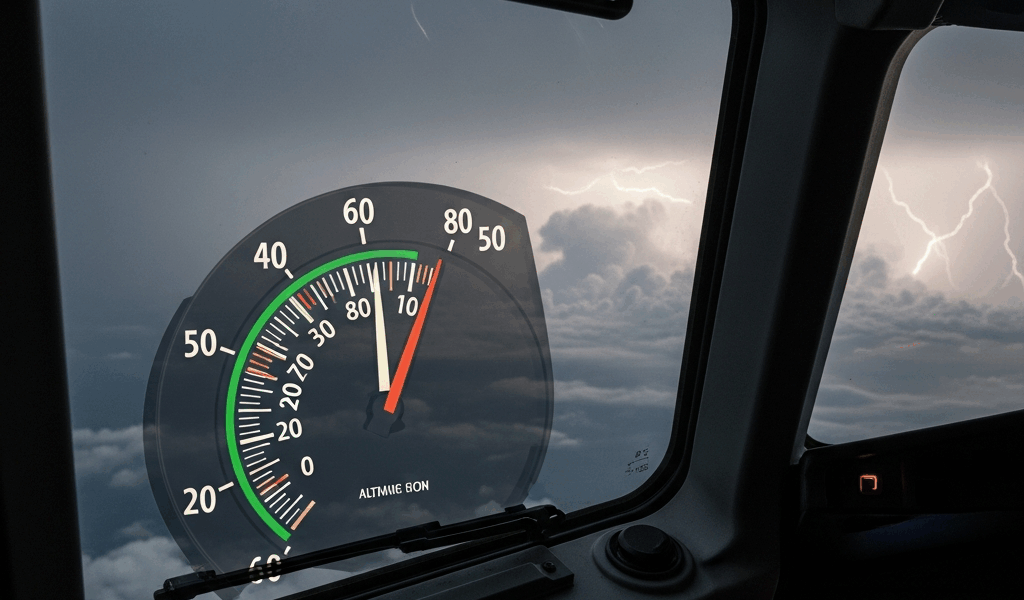
Why Pilots Fear Microburst Windshear on Final Approach
Microburst windshear on final approach has gotten complicated with all the misconceptions flying around — pilots who’ve never encountered one think it’s just a bad gust. It isn’t. I’ve spent enough time in crew lounges talking to captains and first officers to know this scenario sits right alongside engine failure and sudden decompression as the one that makes your stomach drop in the simulator. Not because it’s common. Because it’s ruthless. Under a minute. That’s all a microburst needs to strip 20 to 50 knots from your airspeed, slam you down at 1,500 feet per minute, and turn your approach briefing into a liability. The instruments lie. Your instincts betray you.
That single lapse — dropping the nose to recover 10 knots — kills altitude you simply cannot get back. Understanding why this scenario terrifies experienced pilots requires understanding the aerodynamic sequence, what the instruments actually show, and the cold reality that the correct recovery procedure violates every landing instinct you’ve built over a thousand flight hours.
What a Microburst Actually Does to Your Aircraft
But what is a microburst, really? In essence, it’s a column of sinking air — roughly 2,000 to 4,000 meters in diameter — spawned by thunderstorm downdrafts. But it’s much more than that. It’s a trap with three doors, and you walk through all of them in under 60 seconds.
On a 3-degree glideslope at 500 feet AGL, you’re already committed. Descending. Slowing to flap speeds. The microburst doesn’t wait for you to notice it.
Phase One — The Headwind Increase. You hit the leading edge. Suddenly there’s a strong headwind — your airspeed jumps 15 to 30 knots and you haven’t touched anything. The glideslope indicator climbs. You’re reading “too high.” Your brain says descend, so you nudge the power back or ease forward on the yoke. Don’t. That airspeed spike is fake — the headwind is doing the work, not actual energy stored in the aircraft. That’s the trap door opening.
Phase Two — The Core Downdraft. Seconds later, the downdraft arrives. Vertical speed swings from a normal -300 fpm to -1,500 fpm or worse. Altitude disappears. The airspeed, artificially high ten seconds ago, starts falling because you’re sinking faster than thrust can pull you forward. The glideslope needle, which was high, drops below center. You pitch up to chase it. Airspeed keeps falling. You’re now 400 feet AGL, dropping at 1,500 fpm, watching the airspeed tape unwind backward.
Phase Three — The Tailwind Escape. Here’s where it turns lethal. The microburst, having sunk and spread outward, now hits you from behind — 20 to 40 knots of tailwind. The relative wind keeping you aloft disappears. An aircraft that needs 140 knots to fly is suddenly generating maybe 110 knots of actual airflow over the wings. Lift quits. Sink rate spikes. You’re at 200 feet.
The whole sequence unfolds before most pilots consciously register that anything abnormal is happening. Conflicting instrument readings stack up faster than you can sort them. That’s what makes microburst windshear endearing to no one — and terrifying to everyone who understands it.
What Your Instruments Show Before You Know You’re in One
Probably should have opened with this section, honestly — because recognition is the entire ballgame. Catch it early and you go around with a story to tell. Miss it and the sequence runs to completion.
Unexplained Airspeed Increase on Final. You’re stabilized at 2,000 feet, holding 150 knots indicated, when the airspeed tape jumps to 165 or 170. Nothing changed — not pitch, not power. On modern glass cockpits like the 737 MAX or A350, check the airspeed trend vector immediately. A stable approach points that vector downward. If it suddenly flattens or climbs while you’re descending and the throttle hasn’t moved, something external is happening. That’s your first clue.
Glideslope Deviation That Ignores Pitch Input. Standard ILS approach, glideslope needle starts climbing — you’re high. You pitch up 2 to 3 degrees. Needle keeps climbing. Ten seconds later, it bottoms out and you’re low. Pitch up again. That oscillation — high, then suddenly low, not responding to inputs — is a hard, unmistakable clue. Write it on your brain.
Vertical Speed Exceeding -1,500 fpm. Most approaches target -300 to -500 fpm. When the core downdraft hits, the vertical speed tape goes negative hard and fast. At -1,500 fpm you’re burning through altitude at 25 feet per second. At 500 feet AGL, that’s 20 seconds to ground contact. Stop flying the approach. Start flying the escape.
Windshear Warnings. The Airbus A320 integrates weather radar with the inertial reference unit to detect microburst signatures — you get a visual and aural “WINDSHEAR” alert on the primary flight display. Boeing uses autopilot input data and inertial measurements, generating a “WINDSHEAR” aural alert plus a red warning box on the PFD. These systems work. But they are not early-warning systems. They fire when you’re already inside the encounter, typically between 500 and 200 feet AGL. By that point you’re behind the curve. Your scan pattern has to catch the early indicators first — the airspeed trend spike, the oscillating glideslope, the vertical speed surge. Don’t wait for the box to turn red.
The Go-Around Recovery Technique Step by Step
The windshear escape maneuver is terrain avoidance. Full stop. It is not a normal go-around. If you execute a normal go-around — retract flaps on schedule, accelerate to climb speed, then climb — you will not survive. The sequence below has to happen fast and it has to happen right.
- Announce “Windshear Go-Around.” Say it out loud. Get ATC off your plate immediately. Don’t ask permission. Don’t explain. Tell them you’re climbing and you’re off the approach. One sentence and move on.
- Select Full Takeoff Thrust. Throttles to the firewall. On a 737, that’s 100% N1. On an A320 with FADEC, push the thrust levers to TOGA — Takeoff/Go-Around — one firm push. Do this simultaneously with the next step, not before or after.
- Pitch to Escape Attitude — 15 to 20 Degrees Nose Up. This is aggressive. Target the 15-degree mark on the attitude indicator. Most pilots underpitch this and run out of energy. Commit to it. Airspeed will drop further before it recovers — accept that. Pitch attitude saves you here, not airspeed.
- Leave the Flaps Alone. Normal go-around pulls flaps up immediately to cut drag. Not here. Boeing guidance says leave flaps in landing configuration until 1,500 feet AGL. Airbus allows retraction to 5 degrees at 700 feet AGL, provided you have a positive rate of climb. I’m apparently conservative on this one, and the Boeing way works for me while early retraction never has. Leave them extended — it’s faster in practice than the books suggest.
- Do Not Chase Airspeed. This is the hardest part. Airspeed will bleed to 100 or 110 knots. The stick shaker may activate — that column buffet warning of an approaching stall. Do not lower the nose. Hold the escape attitude. Don’t make my mistake. The airspeed is secondary. Once you exit the microburst core, the wind shift reverses, relative airflow returns, and airspeed recovers on its own. Hold the attitude and trust the process.
- Maintain Escape Attitude Until You Have Positive Rate of Climb and Altitude Clearance. Positive rate means the VSI shows a climb. Altitude clearance means no terrain or obstacles ahead on departure. Both conditions met — then, and only then, transition to a normal climb profile.
From decision to stable positive climb: under 15 seconds. Hesitation kills. Half-inputs kill. Wrong sequencing kills. So, without further ado — practice this until it’s reflex, not thought.
Historical Accidents That Define the Training Standard
Delta Flight 191 was a Lockheed L-1011 tri-jet, inbound to Dallas-Fort Worth International Airport. August 2, 1985. The crew flew an approach through convective weather south of the airport. A microburst generated a 40-knot headwind-to-tailwind shift in under a minute. The aircraft was at 1,200 feet when the encounter began.
Frustrated by a glideslope that wouldn’t behave and airspeed readings that made no sense, the crew attempted to manage the descent conventionally — chasing airspeed, chasing glideslope — using every technique that works perfectly in every other situation. None of it worked. By the time they understood what was actually happening, the ground was closer than recovery required. The L-1011 struck terrain short of the runway. 137 people died. 29 survived.
That was 1985. Within a year, the FAA mandated windshear training and ground-based warning systems for all commercial operators. This new standard took hold over the following years and eventually evolved into the escape maneuver procedure that pilots know and drill today — full thrust, 15-degree pitch attitude, flaps extended, airspeed secondary. Every pilot trained after 1986 practices it multiple times during type rating and recurrent simulator sessions.
Eastern Flight 66 crashed at JFK in 1975. Also microburst windshear — but the term didn’t exist yet in common aviation vocabulary. The industry called it a freak event and moved on. That’s what makes Delta 191 the defining case. The industry needed a name for the phenomenon, a standardized recovery, and a training mandate. It took 137 deaths in Dallas to make all three happen.
How to Avoid the Situation Before You’re In It
Recovery works. But avoidance is better. Every single time. The escape maneuver is damage control — not a strategy.
Check PIREPs Below 1,000 Feet AGL. Before descent, pull the ATIS and AWOS. Ask approach control if preceding aircraft reported anything on final. One pilot’s PIREP — “windshear go-around, 400 feet, 30-knot loss” — is worth more than any forecast model. I’ve diverted dozens of approaches on a single report. Don’t make the mistake of thinking it’s cleared up just because the frequency went quiet.
Know Microburst Weather. Microbursts breed in strong convective activity — thunderstorms with virga, which is precipitation evaporating before it reaches the ground, and a large temperature-dewpoint spread. More than 15 to 20 degrees Celsius between temperature and dewpoint on the surface observation? The atmosphere is primed. A TAF showing isolated thunderstorms and convection in that environment isn’t just a weather advisory. It’s a conversation starter about whether this approach is necessary right now.
Set a Go-Around Trigger Before Descent. First, you should decide your threshold before you’re in the moment — at least if you want the decision made calmly and rationally rather than at 800 feet with your hands full. Something concrete: “If approach reports windshear below 500 feet or the aircraft ahead calls a go-around, I’m taking vectors and holding.” Microbursts might be the best option to wait out, as the encounter requires you to be above it, not through it. That is because they’re narrow and transient — the lethal wind shift at 1,000 feet AGL can be completely gone in 5 to 10 minutes. A ten-minute hold beats a windshear encounter at 200 feet. Not a close call.
The training exists. The procedure works. But the best procedure is the one that sits unused in the memory of a pilot who never needed it.



Stay in the loop
Get the latest aviate ai updates delivered to your inbox.