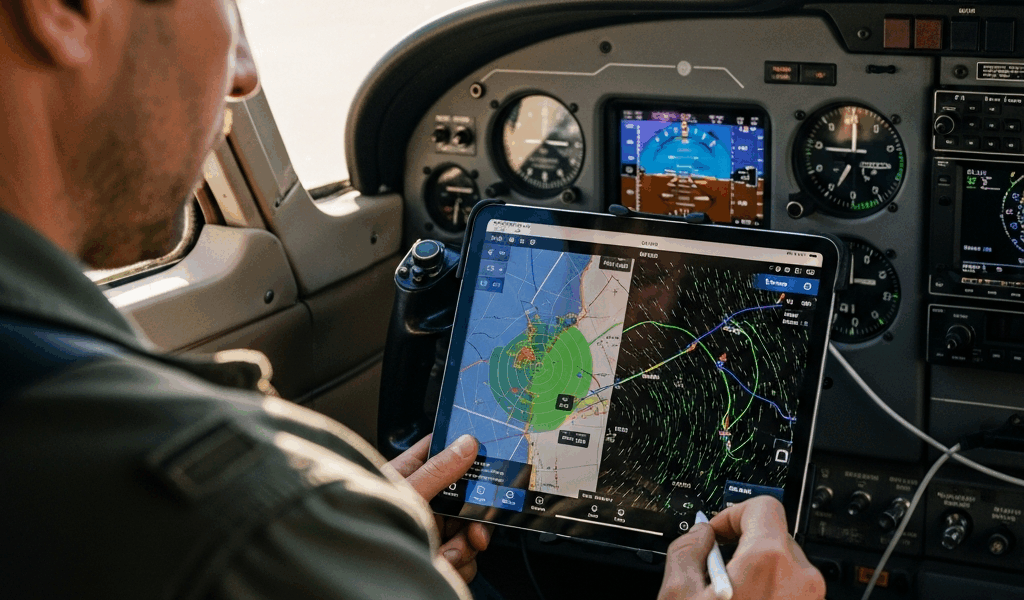
You are sitting in the FBO with a sectional chart spread across the table, your iPad open to ForeFlight on a pilot kneeboard, and a METAR that looks like someone dropped a Scrabble bag. You pull up ChatGPT and type: “Translate this METAR for me — KORD 311751Z 32015G28KT 1SM +SN FG OVC005 M08/M10 A2978 RMK AO2.” Fifteen seconds later, you get a clean summary: winds 320 at 15, gusting 28, visibility one mile in heavy snow and fog, overcast at 500, temp minus 8, altimeter 29.78. Not a replacement for your weather brief. But a fast sanity check before you pull up the official TAF.
This article includes affiliate links. We may earn a commission at no extra cost to you.
AI tools have started showing up in pilot workflows, and the honest truth is that some uses are genuinely helpful while others will get you in trouble if you trust them without verification. Here is where they actually work and where you need to keep your guard up.
Route Planning and Weather Briefings
ChatGPT and specialized tools like PilotGPT can consolidate preflight information into a single readable briefing. Feed it your departure, destination, and aircraft type, and it will pull together a summary that covers expected weather, relevant NOTAMs, preferred altitudes based on winds aloft, and suggested routing. PilotGPT goes further — it is trained on over 500 aircraft models and works offline, which matters when you are at a grass strip with spotty cell coverage.
The practical value is speed. Instead of cross-referencing four different sources to build your mental picture of the flight, the AI assembles a draft briefing in seconds. You still verify every piece against official sources — 1800wxbrief.com, the AWC, your EFB — but having a consolidated starting point saves ten minutes of tab-switching during preflight.
The critical limitation: the free version of ChatGPT has a knowledge cutoff and no real-time internet access. It cannot tell you about the TFR that went active two hours ago or the runway closure NOTAM issued this morning. If you are using ChatGPT for route planning, you are getting a template, not a live briefing. PilotGPT partially addresses this by integrating real-time data feeds, but you should always confirm against official sources before you file.
Weight and Balance Calculations
Weight and balance is one of those tasks that AI handles well because it is fundamentally mathematical. Give ChatGPT your aircraft type, fuel load, passenger weights, and baggage distribution, and it will run the numbers. PilotGPT, which is trained on specific aircraft performance data, can produce W&B calculations tailored to your exact model — useful for complex loading scenarios like a Cessna 210 with full fuel and four adults where you are right up against the aft CG limit.
Where pilots need to stay careful: the calculation is only as good as the inputs. If you tell the AI your passengers weigh 170 pounds each and they actually weigh 210, the math will be correct and the airplane will still be out of CG. AI does not weigh your passengers for you. It also may not know about supplemental type certificates or modifications that changed your aircraft’s empty weight or datum. Always cross-reference against your actual weight and balance sheet — the one with your specific aircraft’s data, not a generic model.
That said, for a quick “can I make this trip with this load?” check before you start loading the airplane, AI tools save a meaningful amount of mental math. Especially useful for flight instructors running multiple students through the same aircraft on different fuel loads throughout the day.
Decoding Weather Reports and NOTAMs
This is where AI tools genuinely shine. Raw METAR and TAF data is compressed and abbreviation-heavy by design — great for data efficiency, less great for the weekend VFR pilot who flies twice a month and cannot remember whether BKN means broken or overcast. ChatGPT translates these reports into plain English reliably and quickly.
It handles complex weather strings well: multi-layer cloud reports, variable wind directions, remarks section codes, and conditional forecasts in TAFs. Ask it to explain what “FM312000 28012KT P6SM SCT040 BKN080” means in a TAF and it will tell you that from 2000Z on the 31st, expect winds 280 at 12, visibility better than 6 miles, scattered at 4000 and broken at 8000.
NOTAMs are even more useful to decode with AI. The NOTAM system is notoriously dense. A string like “!FDC 6/2934 ZAU IL ROUTE ZAU CHICAGO ARTCC SPECIAL NOTICE TEMPORARY FLIGHT RESTRICTION” is easier to parse when the AI breaks it down into location, effective dates, and what is actually restricted. Student pilots and rusty certificate holders benefit the most here. Experienced pilots already read METARs like sentences, but if you are building fluency, having a translation tool beside you accelerates the learning process without creating a crutch — you still see the raw data and start recognizing patterns.
Study and Test Prep
ChatGPT makes a surprisingly effective study partner for written exams. It can generate practice questions in the style of FAA knowledge tests, explain the reasoning behind correct answers, and clarify regulatory language that reads like it was written by a committee of lawyers — because it was.
Aviation GPT, a specialized ChatGPT variant, is built specifically for this. It handles questions about FARs, AIM procedures, aerodynamic principles, and aircraft systems with more consistency than vanilla ChatGPT because its training data is weighted toward aviation content.
Where it works best: understanding concepts rather than memorizing facts. If you do not understand why adverse yaw happens during a turn, ChatGPT can explain the differential lift and drag on the wings in three different ways until one clicks. If you are confused about when you need an IFR alternate, it can walk through the 1-2-3 rule with examples. It is patient in a way that a ground school instructor at 9 PM on a Thursday night might not be.
Where it falls short: trick questions. The FAA written exam is full of them — questions where two answers sound right but one is technically more correct based on a specific regulatory definition. ChatGPT sometimes picks the common-sense answer rather than the FAA-specific one. Use it to learn the concepts, then use an FAA-approved test prep bank (Sheppard Air, Sporty’s, ASA) for the actual question practice.
What AI Gets Wrong and Why Pilots Must Verify
AI hallucination is a real problem in aviation contexts and the consequences are different than in most other fields. If ChatGPT hallucinates a recipe ingredient, dinner tastes bad. If it hallucinates a radio frequency, you are transmitting on the wrong channel in controlled airspace.
Documented failure modes that pilots have encountered:
- Wrong frequencies. ChatGPT has generated plausible but incorrect tower, approach, and center frequencies. They are formatted correctly and sound right — but they are wrong. Always verify against the Chart Supplement or your EFB.
- Outdated procedures. Instrument approach procedures change. Airspace reclassifications happen. The AI’s training data has a cutoff, and it will confidently describe a procedure that was amended six months ago.
- Incorrect airspace classifications. Asking “what class of airspace is above XYZ airport?” can produce wrong answers, especially for airports that sit under complex airspace shelves or in areas where MOAs and restricted areas overlap.
- Performance data errors. AI can confuse variants of the same aircraft. A Cessna 172S and a 172R have different useful loads and fuel capacities. The AI might give you numbers for the wrong variant without flagging the difference.
The FAA has not approved any AI tool as an official flight planning or weather briefing resource. That is not likely to change soon. AI tools are supplementary — useful for convenience, comprehension, and speed — but they do not replace official sources, and no examiner or FSDO inspector will accept “ChatGPT told me” as an explanation for a regulatory deviation.
The right way to use these tools: treat them like a copilot who is knowledgeable but might be wrong. Cross-check everything that affects safety of flight against an authoritative source. Use them freely for learning, comprehension, and the tedious calculation work that does not change based on real-time conditions. And keep a healthy skepticism about any output that sounds confident but that you cannot independently verify.



Stay in the loop
Get the latest aviate ai updates delivered to your inbox.