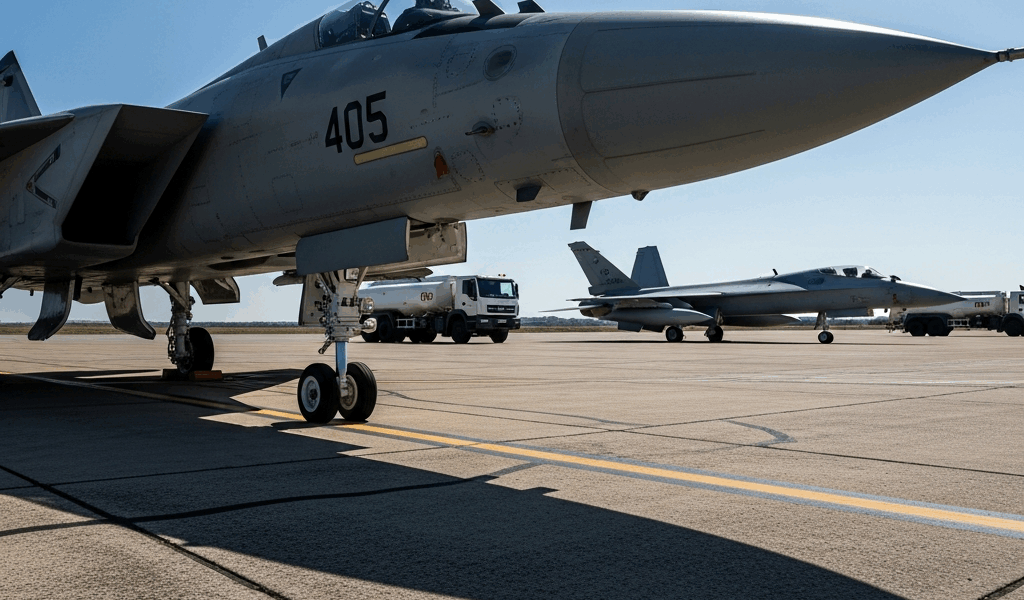
The Verdict Up Front
The F-15EX vs F/A-18E/F Super Hornet debate has gotten complicated with all the procurement noise and budget speculation flying around. As someone who has spent considerable time digging through defense acquisition documents, contractor briefings, and operational reports, I learned everything there is to know about this matchup heading into 2025 and 2026. Today, I will share it all with you.
This article includes affiliate links. We may earn a commission at no extra cost to you.
But here’s the answer before we go any further: the F-15EX wins on raw performance and payload for Air Force high-end warfighting — and it isn’t particularly close. The Super Hornet wins on carrier integration and cost-per-flight-hour for the Navy’s current operational reality. Two genuinely different verdicts for two genuinely different missions.
The single number that anchors everything: the F-15EX carries up to 29,500 lbs of payload. The Super Hornet carries approximately 17,750 lbs. That’s not a rounding difference. That’s a different class of aircraft doing a different class of work.
Speed, Range and Payload — Where the Numbers Diverge
The F-15EX hits Mach 2.5. The F/A-18E/F tops out at Mach 1.8. Both figures carry caveats — operational profiles, fuel states, loadout configurations — but the gap is real. It reflects a fundamental difference in airframe design philosophy. The Eagle was built to go fast and carry heavy things far. The Hornet was built to fit on a ship.
Combat radius is where the Super Hornet has drawn criticism since the 1990s, and that criticism has never fully gone away. Unrefueled, the F/A-18E/F manages approximately 450 nautical miles. The F-15EX, running conformal fuel tanks, reaches roughly 1,000 nautical miles. That Super Hornet range figure gets called the “Rhino problem” — Rhino being the Naval aviator nickname for the platform — and the Navy has spent decades working around it with tanker support rather than solving it outright.
The MQ-25 Stingray is the current answer. An unmanned tanker designed specifically to extend Super Hornet legs. That program is still maturing, which is a polite way of saying the range problem isn’t solved yet.
On missiles: the F-15EX can carry up to 12 air-to-air missiles simultaneously. Twelve. That’s a flying magazine. The Super Hornet operates with a much smaller loadout — constrained by wing stations and the physical geometry of carrier flight deck operations. In a high-end air superiority engagement in a contested theater, that difference in magazine depth matters in ways that are genuinely hard to paper over with talking points about pilot training or network integration.
The F/A-18F two-seat variant deserves a separate mention. It’s the platform that spawned the EA-18G Growler — the Navy’s dedicated electronic attack aircraft. That’s not a minor footnote. The Growler is one of the most operationally relevant aircraft in the entire U.S. inventory right now, and it exists because the Super Hornet airframe was adaptable enough to absorb that mission. The F-15EX has no equivalent in that specific role. That’s what makes the Super Hornet’s lineage endearing to the naval aviation community.
2025 and 2026 Procurement — Who Is Actually Buying What
Probably should have opened with this section, honestly. Most comparison articles skip procurement entirely, and skipping it gives you an incomplete picture. So, without further ado, let’s dive in.
Boeing holds the F-15EX production contract — originally scoped at up to 144 aircraft, with 98 jets as the more firm baseline number. The FY2025 budget included requests for additional EX airframes. The Air Force has been explicit about the mission: replace aging F-15C/D Eagles at Air National Guard bases. Specific ANG units flying legacy Eagles — including the 142nd Wing out of Portland and the 104th Fighter Wing at Barnes — are in line for that transition. This is not a paper program. Metal is being cut. Aircraft are being delivered.
The Super Hornet situation looks different. Navy FY2026 budget signals point toward reduced Super Hornet procurement as the F/A-XX next-generation carrier aircraft program accelerates. The Navy isn’t walking away from Super Hornets overnight — the carrier fleet depends on them — but the procurement runway is shortening. New-buy Super Hornets at roughly $67 million to $70 million per unit become harder to justify when the service is simultaneously funding their eventual replacement.
The F-15EX runs approximately $87 million to $100 million per aircraft depending on configuration and production lot. That $20–30 million delta per airframe adds up fast across a buy of 80 or 90 jets. For budget-constrained services — and both the Air Force and Navy are operating under real fiscal pressure in FY2025 and FY2026 — that cost difference influences decisions even when the capability case favors the more expensive platform.
Here’s a dynamic that almost nobody writes about: both aircraft are Boeing products — and for the definitive account of how American stealth and fighter programs actually get built from the inside, Skunk Works by Ben Rich remains essential reading. The F-15EX comes out of Boeing’s St. Louis facility. The Super Hornet comes out of the same St. Louis facility. Boeing is effectively competing against itself for defense budget dollars, congressional support, and production line sustainability. That’s an awkward internal competition — one that shapes how Boeing lobbies, which programs get prioritized for engineering resources, and how the company manages risk if one line slows down.
Radar and Avionics — APG-82 vs APG-79
But what is the real difference between these radar systems? In essence, it’s aperture size. But it’s much more than that.
The F-15EX carries the APG-82(V)1 AESA radar. The Super Hornet carries the APG-79. Both are active electronically scanned array systems. Both represent genuine upgrades over the mechanically scanned radars they replaced, and both have been continuously improved through software updates across the past decade or so.
The F-15EX has a larger nose section — it’s a bigger aircraft — and that physical space allows for a larger radar aperture. Larger aperture translates to longer detection range and more simultaneous track capacity. This isn’t marketing language. It’s physics. The APG-79 in the Super Hornet is a capable system, but it’s operating inside tighter dimensional constraints that the APG-82 simply doesn’t face.
The Eagle Passive/Active Warning Survivability System — EPAWSS — deserves a specific callout on the F-15EX side. This electronic warfare upgrade closes a gap that existed in the Eagle’s defensive suite for years. Legacy F-15s were widely acknowledged to have weaker EW capabilities compared to the F/A-18E/F, which benefited from Growler-lineage thinking in its electronic systems. EPAWSS addresses that meaningfully. It doesn’t eliminate the gap entirely, but it’s a real improvement — not a PowerPoint improvement.
One thing worth being direct about, because a lot of coverage fudges this: neither aircraft is low-observable. Neither the F-15EX nor the Super Hornet has meaningful radar cross-section reduction built into its design. They are fourth-generation airframes with upgraded sensors and weapons. Against a peer adversary running modern integrated air defense systems, both aircraft carry real survivability risk that fifth-generation stealth platforms are specifically designed to reduce. Don’t make my mistake of glossing over that distinction when comparing operational utility — it matters enormously depending on the threat environment.
Which Platform Makes Sense in 2025 — and Which Is Living on Borrowed Time
The F-15EX is the right aircraft for Air Force theater air superiority and long-range strike where runway access exists. It carries more, flies farther, goes faster, and hits harder than any fourth-generation platform in the U.S. inventory. For Air National Guard units replacing aging C/D models — some of those airframes are pushing 40-plus years of service — the EX isn’t a compromise. It’s a genuine capability upgrade with a production line that’s actually running in St. Louis right now.
The Super Hornet is indispensable for carrier strike groups through the late 2020s. Full stop. There is no other option. The F-35C is in service but not in numbers sufficient to replace Super Hornets across the carrier air wing. F/A-XX — the program meant to actually succeed the Hornet — is not fielding before 2030 at the earliest. The most optimistic estimates place F/A-XX initial operational capability somewhere in the early-to-mid 2030s. Until then, the Super Hornet flies every deployment.
I’m apparently someone who finds clean competitive matchups deeply unsatisfying, and this comparison works for me precisely because it resists a clean answer while other surface-level breakdowns never quite capture the nuance. The F-15EX wins on performance. Wins on payload. Has a clearer procurement future heading into 2025 and 2026. The Super Hornet isn’t losing to the F-15EX — they don’t actually compete for the same roles. The Super Hornet is losing to time and to its own successor program. That’s a meaningfully different problem, and honestly, it’s the real story behind this matchup right now.




Stay in the loop
Get the latest aviate ai updates delivered to your inbox.