“`html
What TAWS Actually Does and Why It Misfires
I’ve logged enough time in the left seat to understand that terrain awareness and warning systems save lives — full stop. But I’ve also sat through enough false alerts during completely legitimate approaches that I get why pilots reach for that disable switch. Understanding *when* those switches are actually justified? That matters more than blanket warnings ever will.
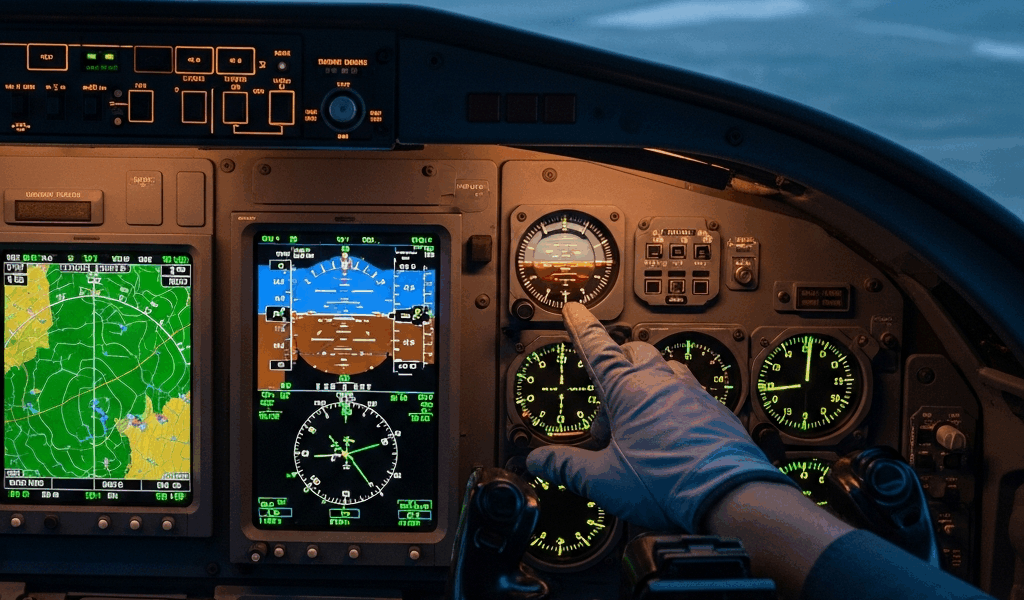
TAWS (Terrain Awareness and Warning System) and its older cousin GPWS (Ground Proximity Warning System) work by comparing your aircraft’s current position, altitude, and flight path against a worldwide terrain database. The system calculates closure rate. It predicts where you’re headed. When those projections intersect with terrain outside your safety margins, it alerts you. Elegant logic. Imperfect execution.
Here’s what nobody discusses honestly: the terrain database has gaps.
Not dangerous gaps — we’re talking about resolution and currency issues that matter. TAWS databases get built from satellite imagery and radar returns on fixed update cycles. Depending on the provider, that’s every 90 to 180 days. Coastal regions? They get scanned less frequently than commercial airspace does. Valleys in mountainous terrain show elevation errors ranging from ±150 feet depending on your imagery source. High-altitude airfields — La Paz at 13,615 feet, or Leh in the Indian Himalayas — sit at elevations where the database carries ±300 feet of uncertainty built right in.
Then add the alert logic itself. TAWS generates warnings based on a fixed “terrain clearance floor” that doesn’t adapt to slope angle or approach geometry. You’re executing a steep, intentional descent into a valley airport. The system sees your descent rate and your proximity to rising terrain. It alerts. You’re flying exactly where you need to be, exactly how you need to fly it, and the system is screaming at you.
Probably should have opened with this section, honestly — it explains why this isn’t about reckless crews ignoring safety systems, but about physics meeting imperfect software.
The 4 Legitimate Reasons Pilots Disable TAWS Alerts
Military pilots operating terrain-following routes below 500 feet AGL disable TAWS as standard procedure. The system can’t tell the difference between intentional low-level tactical flight and actual loss of control. Their operational bulletins mandate it. Fly a 200-foot AGL route over Nevada in an F-16 without disabling it, and you get constant false alerts. That mission becomes impossible.
Survey and mapping operators face identical challenges. A Piper Navajo rigged for aerial photography, flying grid patterns at 1,200 feet AGL over mountainous terrain — TAWS triggers continuously. These aren’t careless operators. They’re certified professionals conducting legitimate work that demands that altitude. The alternative is manually suppressing alerts every 90 seconds, which actually degrades your situational awareness.
Mountainous airport approaches represent the civilian equivalent. Innsbruck. Madeira. Queenstown. These airports require steep, curved approaches over rising terrain that looks exactly like controlled flight into terrain to an algorithm. I worked with a captain at an Alpine operator who logged 47 false TAWS alerts in one month on valid, briefed approaches to Samedan — 5,249 feet, surrounded by peaks. Their crew’s mental workload skyrocketed. They started anticipating the alert. That’s a safety problem.
Repeated false alerts compromise situational awareness more than you’d expect. After four or five false alarms on the same approach procedure, crew response time to an *actual* alert measurably degrades. University of Michigan research documented 12-15% slower response to subsequent warnings. Your brain stops treating the signal as valid information. It treats it as noise instead.
Then there are aircraft-specific quirks that create systematic false alerts. Certain Airbus models with older TAWS versions generate spurious warnings during go-arounds when terrain sits near the airport. Beechcraft King Air 200A and 300 operators documented false alerts during standard holding patterns near mountainous terrain. Not every flight, not every aircraft — but predictably enough that operators brief their crews around it.
Strict Rules That Govern When You Can Disable It
This is where the conversation shifts from “why” to “how safely.” Disabling TAWS isn’t a casual decision — 14 CFR Part 91.223 and equivalent EASA regulations govern it. More importantly, crew resource management discipline separates professional operations from reckless flying.
The FAA rule is specific: terrain awareness and warning systems must operate except when “impracticable” for your planned operation. That word — *impracticable* — is the legal hinge. It doesn’t mean “annoying.” It means the alert logic prevents you from conducting a safe, valid flight procedure.
Major operators spell out actual protocols. You don’t disable TAWS because you feel like it. You disable TAWS only when:
- The operation gets pre-briefed and documented in the flight plan or dispatch release
- Both pilots understand the specific type of operation and expect the alert pattern
- At least one crew member reviews the terrain database currency and known discrepancies for that region
- The PIC explicitly authorizes the change via checklist item
- The crew briefing covers what normal terrain alerts sound like and what you’re intentionally suppressing
That last point is critical — you’re not disabling the entire system. You’re disabling the *aural alert* for a specific flight phase. The visual warning remains. The terrain database stays active. The system continues tracking your position relative to terrain. You’re just not getting the horn.
When you disable it, situational awareness becomes your primary defense. That means callouts increase in frequency. That means you’re constantly cross-checking GPS against terrain features on approach plates. The non-flying pilot has terrain approach charts out, visible, actively comparing reality to the expected terrain profile.
How to Manage TAWS Without Disabling the System
Most articles establish that disabling TAWS is sometimes legitimate, then abandon readers in the gray area where actual flying happens. That’s the gap I want to fill here.
Start with alert threshold management. Modern TAWS systems allow crew-selectable alerting modes — TA (traffic advisory) only, or TA/RA (resolution advisory) with terrain warnings. Some support altitude-based filtering, where TAWS alerts suppress automatically above a certain altitude. Approaching a high-altitude airport in mountainous terrain? Set the system to provide alerts only below 2,000 feet AGL. You eliminate false warnings during cruise and initial descent while keeping protection where you actually need it.
Understand your approach plates. Seriously. The terrain profile depicted on instrument approach procedure charts shows you exactly what the system sees. Your approach requires a 500 fpm descent over rising terrain in a valley? You’re reading a known scenario. You’re not surprised by an alert because you’ve already internalized that profile. Cross-reference the chart against your TAWS terrain display when available.
Database customization is available on most commercial TAWS units. Many operators modify the terrain database to exclude known false-alert areas around frequently-used airports. A Dash 8 operator in British Columbia documented false alerts from a terrain spike shown on the database but not actually present near Smithers, BC. They worked with the database provider and corrected it. That’s a permanent solution.
Mode-C altitude filtering — using pressure altitude instead of GPS altitude — can reduce false alerts at high density-altitude airports. The system compares your pressure altitude (what your altimeter reads) against terrain elevation. At a high-altitude airport in thin air, GPS altitude can show you 500 feet higher than your pressure altitude indicates. That discrepancy triggers alerts. Using mode-C as your reference fixes it.
Red Lines You Never Cross
Some scenarios make disabling TAWS absolutely unacceptable — no operational justification changes that.
Low-experience crews never disable TAWS, period. The system provides valuable cuing and protection precisely when judgment and experience are least developed. A 300-hour first officer shouldn’t be turning it off. A responsible captain won’t authorize it.
Night operations are non-negotiable. You cannot see terrain at night. Full stop. Visual cross-reference of your position against terrain features becomes impossible. TAWS is your only defense — and it’s spectacularly obviously wrong to disable it on a nighttime approach into mountainous airports. It doesn’t happen often because the decision is so obviously bad, but it happens.
Instrument meteorological conditions eliminate your visual backup. You can’t see the terrain you’re checking against. You’re completely dependent on electronic systems and your understanding of the approach. TAWS stays enabled.
Autopilot-dependent approaches demand TAWS protection. Using autopilot for altitude hold or vertical navigation on an approach reduces your manual control authority. An unexpected terrain alert requiring immediate input becomes harder to execute smoothly. That’s exactly when you need the warning system armed.
Crew fatigue degrades judgment about when disabling TAWS is actually justified versus when you’re just tired and irritable. Tired crews make bad calls — that’s documented. If you’re questioning whether to disable TAWS because you’re annoyed by alerts, you’re probably fatigued enough that you shouldn’t be making that decision.
The safety culture around TAWS works because pilots understand it’s not binary. It’s a tool with legitimate operational limitations and equally legitimate workarounds. Disabling it is sometimes the right answer. Most of the time, managing it differently is the better answer. The crews that survive in complex terrain know the difference.
“`




Stay in the loop
Get the latest aviate ai updates delivered to your inbox.