What a Runway Excursion Actually Is
Runway safety has gotten complicated with all the technical noise flying around. But the core concept is almost brutally simple: a runway excursion happens when an aircraft departs the paved surface during takeoff or landing. The plane leaves where it’s supposed to be. That’s the whole thing.
Most people lump all off-runway events into one messy category — pilots don’t. There are two distinct types, and the difference genuinely matters. A veer-off is lateral departure, meaning the aircraft drifts sideways off the runway during the landing or takeoff roll. An overrun is longitudinal — the plane runs clean off the end, either the departure end (rare) or the landing end (far more common). Both qualify as runway excursions. Both are serious. Flight Safety Foundation data puts runway excursions among the top five fatal accident categories worldwide, accounting for roughly 6–10% of all commercial aviation accidents depending on the year and region you’re looking at.
But what is the real cost of not understanding this? In essence, it’s the difference between being a survivor and becoming a statistic. Understanding what causes excursions — and how pilots respond in real time — is that line.
The Three Most Common Causes
Wet or Contaminated Runway Surface
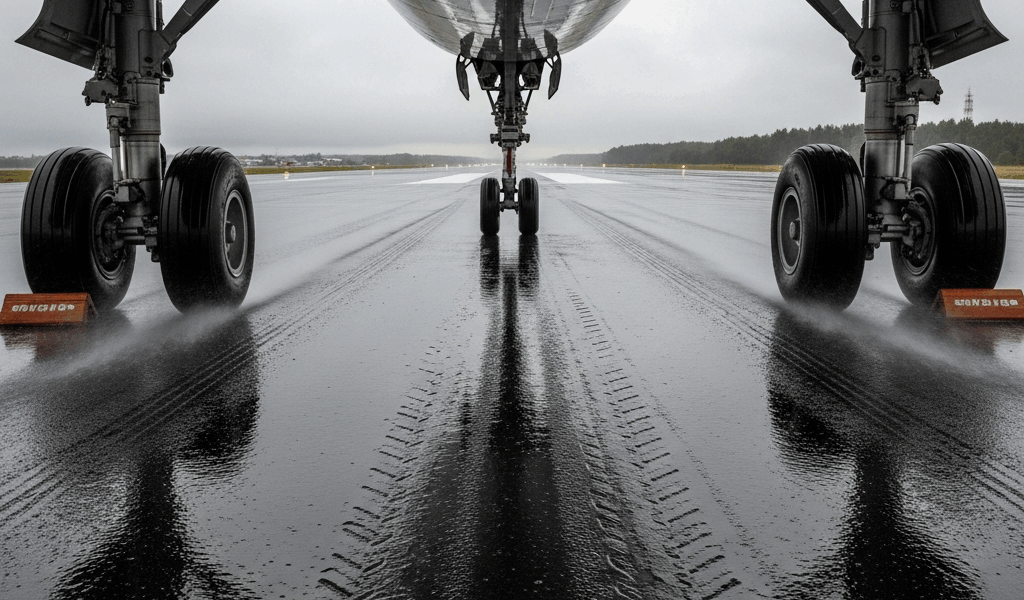
Water on a runway doesn’t just make things slippery in some casual, everyday sense. It triggers hydroplaning — a condition where the aircraft tire loses ground contact entirely because water pressure builds beneath it faster than the tire can displace it. Physics takes over. Friction essentially disappears.
Hydroplaning speed isn’t a mystery number. It’s calculated at roughly 8.6 times the square root of tire pressure in PSI. A commercial aircraft tire running at 200 PSI starts hydroplaning around 121 knots. Below that threshold, you’re fine. Above it, you’re skating.
Here’s what I didn’t fully appreciate until I spent serious time in accident reports: pilots don’t always know the runway is wet before touchdown. ATIS reports lag behind actual conditions. A crew descending through rain sees water streaking the windscreen but can’t see a 2–3mm film of standing water pooling on the surface from altitude. They calculate stopping distance for dry pavement. They land on something closer to ice. The deceleration they planned for simply doesn’t materialize.
Contamination goes well beyond standing water, too. Slush, compacted snow, rubber deposits from thousands of previous landings, even algae growth — all of it hammers the effective braking friction coefficient. Dry concrete sits around 0.5. Wet runway drops that to 0.15–0.25. Standing water or slush can push it as low as 0.08. That’s not a minor degradation. That’s a completely different airplane performance envelope.
Improper Airspeed on Approach
Landing too fast is deceptively, almost embarrassingly common. A pilot misjudges descent rate, carries extra speed across the threshold, and touches down 4,000 feet into a runway instead of in the first 1,000 feet where the math actually works.
The physics are brutal and unforgiving. Landing distance required scales with the square of airspeed — not linearly, squared. A 737-800 touching down at 140 knots in dry conditions needs roughly 4,500 feet to stop. Land that same aircraft at 155 knots — just 15 knots fast, barely noticeable to a fatigued crew — and you need approximately 5,800 feet. That’s 1,300 extra feet consumed by a small speed error. On a 5,500-foot runway, that math isn’t a problem. It’s a catastrophe.
Wind shear on final approach compounds everything. A solid headwind component that vanishes at 200 feet AGL robs lift instantly — the pilot either adds power or accepts a sink rate that eats runway. Heavy iron like the Boeing 777 or Airbus A350 operates in narrow speed windows. Too slow and you’re stalling. Too fast and you’ve blown the touchdown zone in seconds. There’s no good option once you’re inside that 200-foot window with the wrong energy state.
Crosswind Misjudgment
Every aircraft has a published crosswind limit. The Boeing 737 is certified to 33 knots. The Airbus A320 is 38 knots. Those are absolute maximums — numbers validated by trained test pilots in certification flights under controlled conditions. Most operators set their own operational limits lower, usually 25–30 knots, because line pilots flying scheduled routes don’t have the same margin for error. That’s not an insult. It’s just reality.
What I’ve learned digging through accident analysis is that crews often misjudge the crosswind component because they anchor on the reported wind direction without properly converting it to the runway heading. Wind from 180 degrees at 20 knots sounds manageable sitting in the flight deck. But landing on Runway 09, that’s nearly a full 20-knot crosswind. Some pilots don’t run that mental conversion in real time. They’re descending believing the crosswind component is 8 knots when it’s actually sitting at 19 knots. Don’t make that mistake.
Once crosswind exceeds limits, directional control degrades fast. The aircraft drifts off centerline. Aileron and rudder inputs fight the drift, but inertia resists correction. And now you’re committed — a go-around from 500 feet AGL in a known strong crosswind means climbing away from a runway while the same force that’s pushing you sideways is still very much present. That’s a different kind of bad.
How Brake and Thrust Reverser Failures Make It Worse
A single cause — wet surface, fast approach, crosswind alone — doesn’t always trigger an excursion by itself. Layer in a degraded braking system, though, and you’ve crossed from a close call into the accident category.
Asymmetric Thrust Reverser Deployment
Modern jets lean heavily on thrust reversers to kill forward momentum after touchdown. If one reverser deploys partially or unevenly, you get asymmetric reverse thrust — and the airplane yaws hard toward the weaker engine. Both the 737 and A320 have documented this failure mode. One engine producing 40% reverse thrust while the other pushes 80% creates a yaw moment the pilot must immediately counter with rudder.
Here’s the problem. At 60–80 knots on the landing roll, control authority is already bleeding away by the second. The aircraft is slowing, so control surfaces are biting less and less air. If that reverser failure hits after main gear touchdown, correcting the yaw while simultaneously losing airspeed is a razor’s edge — overcorrect and you veer off the side; undercorrect and you accept an asymmetric roll that loads one main gear dangerously close to structural limits.
Anti-Skid System Failure
The anti-skid system exists to prevent wheels from locking under hard braking. A locked wheel doesn’t roll — it slides — and sliding means zero friction. Modern aircraft use wheel-speed sensors and solenoid valves that pulse brake pressure automatically, keeping wheels right at the edge of skidding without actually locking. It’s elegant engineering, and crews don’t really think about it until it’s gone.
When anti-skid fails, pilots must hand-modulate brake pressure themselves and avoid locking the wheels manually. That’s physically demanding under normal conditions. During an emergency — fighting crosswind, managing asymmetric reverse thrust, scanning for runway remaining — it becomes cognitively overwhelming. You’re asking a crew to perform a precision manual task while simultaneously managing several other urgent threats.
I’m apparently not the only one who finds this alarming: a 737 with inoperative anti-skid on a wet runway needs nearly double the landing distance of a fully functional aircraft. That figure isn’t an estimate — it’s documented in Boeing’s own performance manuals and confirmed in accident reports. Double. The distance.
What Pilots Do When They Realize They Won’t Stop
Probably should have opened with this section, honestly. The recovery decision tree is where real airmanship actually lives.
Picture this: touched down, nose dropping, and you’re already 4,000 feet into a 6,000-foot runway. The deceleration feels wrong — too soft, too slow. The mental math runs automatically: at this rate, I need 5,200 feet total. I have 2,000 feet left. I’m short by 1,200 feet.
The first move is maximum braking technique — and I mean technique, not just mashing the pedal. That’s amateur hour. Maximum braking means:
- Full wheel brakes immediately after main gear touchdown
- Reverse thrust at full authority — assuming it’s available and not asymmetric
- Spoilers and speed brakes fully deployed to kill lift and push weight onto the wheels
- Flap extension to the next notch if the aircraft’s configuration allows it
You execute all of that in roughly three seconds. It’s not a checklist you work through sequentially — it’s a simultaneous action set, a single compressed motor response that trained pilots drill until it’s automatic.
With 2,000 feet remaining and the aircraft still rolling at 40 knots, you’re looking at departing the end. Now the second decision lands: attempt a high-speed turn onto a taxiway, or stay straight?
Turning at speed is genuinely dangerous. Banking while braking can overload one main gear and trigger a collapse. But running straight off the end at 20 knots into rough terrain can collapse the gear too — or worse, flip the aircraft entirely. Most pilots take the straight path. The consequences are marginally better. Marginally.
The go-around decision has a hard threshold — typically above 50 feet AGL on approach or within the first 500 feet of landing roll. Below 50 feet, the aircraft has bled so much energy and altitude that climbing away while the original problem (crosswind, wind shear, contamination) is still actively present is statistically more dangerous than accepting the landing and managing the overrun. Decades of accident data back this up. Late go-arounds initiated from 30 feet have killed more crews than committing to a marginal landing and managing the stop. The mental sequence becomes: Am I stopping? No. Can I safely go around? Below 50 feet, no. Manage the overshoot. Straight ahead. Full braking. Brace if terrain is rough.
How AI and Predictive Tools Are Changing Runway Safety
This is where the actual accident risk reduction is happening right now. Real-time runway surface condition data fed into machine learning models is changing the calculus before crews ever cross the threshold.
Modern airports deploy friction measurement devices — the ASFT (Airport Surface Friction Tester) and μ-meters being the most common — that measure actual surface friction coefficients at regular intervals throughout the day. That data flows directly into flight planning systems. A dispatch office sees that Runway 09 at Denver is reporting a friction coefficient of 0.32 (wet, degraded) against a required 0.40 for maximum landing weight. The system flags it automatically. Crews get notified. Aircraft get planned to lighter landing weights, or they divert. That whole chain runs without anyone picking up a phone.
The next layer is predictive. Machine learning models ingest real-time weather radar data, current runway conditions, aircraft weight, crosswind components, and historical excursion rates for that specific runway and aircraft type combination. The system calculates excursion risk in real time during descent. Risk exceeds 8–10%? The system alerts the flight crew and dispatch simultaneously — recommending a different runway, an alternate airport, or a weight reduction before landing.
Some operators are already experimenting with AI-assisted go-around advisories. The system monitors descent rate, airspeed decay, and crosswind magnitude throughout the approach. If the trajectory indicates a probable overrun or veer-off, a cautionary alert fires at 500 feet. Not a command — the crew still decides. But it gives them a final data-driven decision point at a moment when human judgment can be quietly compromised by ten hours of fatigue, low fuel reserves, and the psychological pull of just getting the airplane on the ground.
It doesn’t replace the pilot. It just removes the blind spots. Runway excursions are survivable events. They’re not uncontrollable spirals. They’re also, more often than not, preventable ones. That’s exactly where AI earns its place in this problem.
n



Stay in the loop
Get the latest aviate ai updates delivered to your inbox.