“`html
How Pitot Tube Icing Happens Mid-Flight
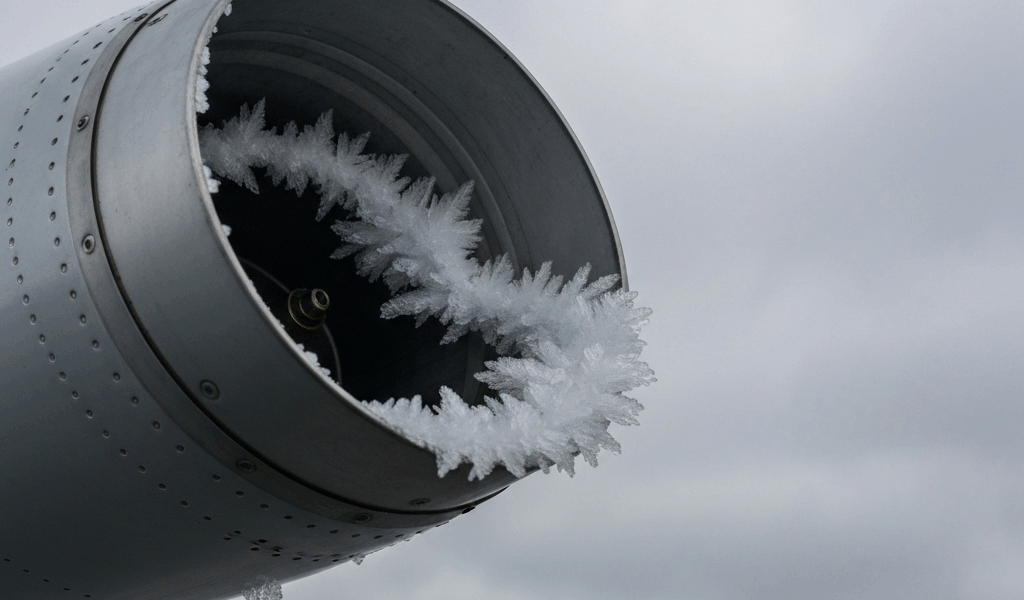
I spent three years flying regional turboprops before I understood why pitot tube icing felt like a betrayal by physics itself. Supercooled water droplets—liquid water existing below 0°C—strike the pitot tube and freeze on contact. That ice blocks the opening measuring ram air pressure, and suddenly your airspeed indicator becomes useless.
Here’s what makes this endearing to us pilots: icing severity peaks in a narrow temperature band. Roughly -10°C to -30°C. This matters because it’s where supercooled droplets exist most abundantly. Fly colder than -30°C and you’re actually safer — most water has already frozen into ice crystals that bounce off rather than accumulate. Climb above freezing and the problem disappears entirely. But that sweet spot in the middle? That’s where regional carriers spend half their time, especially during descent into lower altitudes on winter approaches.
The pitot heater element is supposed to prevent this. It’s a simple electrical resistor wrapped around the probe tip, designed to keep the surface a few degrees above 0°C. But here’s what I learned the hard way: the heater isn’t always on. Many aircraft require manual activation. Plenty of pilots forget. Others assume it’s automatic. Add in electrical system degradation — a failing alternator, loose connector, or burnt relay — and you’ve got a pitot heater that draws current but produces no heat. You won’t know until ice blocks the tube.
Cruise altitude compounds the risk significantly. At 22,000 feet over the upper Midwest in February, you’re surrounded by moisture-laden clouds with outside air temperatures hovering at -25°C. The pitot tube samples the environment constantly, and supercooled droplets accumulate faster than you’d expect. Twenty minutes of flight through moderate icing deposits enough to reduce pitot pressure accuracy by 10-15 knots. Thirty minutes and you’ve got full blockage.
What You’ll See on the Panel When It Fails
Pitot tube failure never announces itself cleanly. Instead you get cascade symptoms that make you question your own flying — your instruments, your hands, everything.
First, the airspeed indicator goes erratic. Not gently climbing or descending — erratic. It oscillates wildly or locks at an arbitrary value. I watched mine swing from 140 knots to 80 knots back to 145, all while level and trimmed. The stall warning horn doesn’t sound because the system hasn’t calculated an actual stall condition yet. You’re not stalling. Your airspeed measurement is just lying to you.
If your aircraft has an altitude alerting system tied to airspeed computation, that fails next. Some aircraft calculate vertical speed using pitol pressure differentials. The vertical speed indicator becomes unreliable or frozen. Your altitude alert — that annunciator warning you’re approaching a selected altitude — may trigger falsely or not trigger at all.
Autopilot disconnection follows within seconds on most modern aircraft. The automation detects inconsistent airspeed signals and cuts itself out rather than risk flying the wrong attitude. You’re hand-flying immediately, sometimes without realizing automation has departed. Many pilots report the sudden pitch-up or roll from autopilot disconnect as the moment they knew something catastrophic was happening — that lurch you feel in your stomach.
Some glass cockpit systems show you a red X over the airspeed tape. Others simply freeze the last valid reading. Probably should have opened with this section, honestly — knowing what to expect psychologically matters as much as the technical fix. When you see that erratic needle, you don’t panic if you’ve already seen it in training.
Immediate Recovery Steps Pilots Take
You’ve got airspeed failure. Your immediate actions in the cockpit follow a strict sequence — no improvising.
Cross-check altitude and vertical speed with your backup instruments. If you’re flying an older turboprop, you have a standby airspeed indicator — mechanical, unpowered, completely independent. Glance at it first. If the standby reads normal and the primary is erratic, you’ve confirmed pitot failure. Modern aircraft with Garmin G1000 glass cockpits show airspeed from multiple sources; compare them. If one source reads invalid while others agree, you’re flying on the valid data.
Switch pitot heat to ON immediately. Use the high setting if your aircraft offers it. This addresses the root cause directly. In my experience, reactivating pitot heat resolves about 70% of in-flight icing encounters within 90 seconds. The ice melts, ram pressure equilibrates, and your airspeed reads normally again. You’ll feel foolish if you forgot to switch it on in the first place — I have.
Request descent to warmer air next. Tell ATC you need a lower altitude, specifically targeting air warmer than -5°C if you can determine it from ATIS or weather reports. A 3,000-foot descent can move you out of the icing layer entirely. This isn’t always possible in congested airspace or if weather extends to the surface, but it’s your next tactical action after pitot heat activation.
Level your wings. Icing isn’t your only problem now — you’re hand-flying an aircraft with unreliable airspeed. Bank angle directly affects stall speed; the steeper you bank, the faster you must fly to avoid stalling. Level flight with a 0-degree bank is your safest configuration. Maintain wings level, keep pitch stable, and use a descent rate you can sustain at your current power setting.
Brief your crew or passenger on the situation immediately. Tell them what failed, what you’re doing, and what you expect next. If you’re operating single-pilot, at least vocalize your decision process. Flying alone with system failures is where accidents happen — silence creates isolation.
Your decision point arrives next: do you declare an emergency or request radar vectors? If pitot heat restored airspeed, you’re probably fine requesting normal handling. If it didn’t work within two minutes, declare the emergency now. Controllers will vector you to the nearest suitable airport, give you priority, and prepare emergency services. Some pilots hesitate here, embarrassed or doubting the severity. Don’t. Pitch instruments and accurate airspeed are fundamental to keeping the aircraft in the sky.
Prevention and Cockpit Resource Management
Prevention starts with briefing. Before entering known or forecast icing, you activate pitot heat proactively. Not when you see ice on the windscreen. Not when turbulence arrives. Beforehand, when conditions are predictable.
Monitor pitot heat electrical draw during flight. The ammeter on your panel will show a current spike when pitot heating engages — you’ll see it jump 25-35 amps. If you activate it and the ammeter doesn’t move, the heater circuit is broken. You now know you’re vulnerable and can adjust your strategy — descend immediately, request vectors around the weather, or divert. Catching this pre-failure gives you options.
Backup procedures if your pitot system is compromised: many aircraft have alternate airspeed sources. Recognize your aircraft’s design. Turboprops often carry standby airspeed indicators. Transport-category jets have triple-redundant systems. Regional turboprops from the 1990s? Often just one pitot tube and one system. Know your aircraft’s failure modes before you need them.
CRM briefing on instrument failure protocol means everyone on the flight deck knows the priority. If you’re the captain, tell your first officer explicitly: “If I lose airspeed, I’m hand-flying. Monitor altitude and descent rate. Keep ATC informed.” If you’re single-pilot, record your actions or speak them aloud to embed them in your muscle memory.
Why Pitot Tube Design Still Has Gaps
Modern aircraft use heated pitot probes made from materials that shed ice more effectively. Stainless steel tips with higher heat output. Some aircraft employ dual heated probes positioned to measure from slightly different angles, creating redundancy. These designs are better. They’re not perfect.
Older aircraft and many regional operators still fly with single-pitot systems from the 1970s and 1980s — heated, yes, but designed in an era when in-flight icing encounters were expected less frequently. Regional carriers accept this risk because replacing pitot systems across aging fleets costs millions. Operators train pilots to manage failure rather than eliminate it.
Electrical system limitations constrain pitot heater design significantly. The heater draws 20-40 amps continuously. Older airframes with 60-amp alternators notice this drain. During other electrical loads — deicing boots, cabin heating, avionics startup — pitot heater amperage competes for reserve capacity. Some older airframes simply lack the electrical generation to run pitot heat reliably at high altitude where icing risk peaks and electrical system efficiency drops.
You can’t eliminate pitot icing through design alone. You prevent it through activation, awareness, and accurate briefing. That is because this system failure remains relevant after six decades of aviation — it requires the pilot to remember, to activate, to monitor. Physics and engineering can only do so much. The rest is human diligence.
“`



Stay in the loop
Get the latest aviate ai updates delivered to your inbox.