What Angle of Attack Sensors Actually Measure
Angle of attack — AOA for short — represents the angle between your aircraft’s chord line and the relative wind direction. It’s not pitch attitude. It’s definitely not airspeed. Those two numbers can look perfectly normal while your wing is approaching a stall, and that’s exactly where angle of attack sensors live.
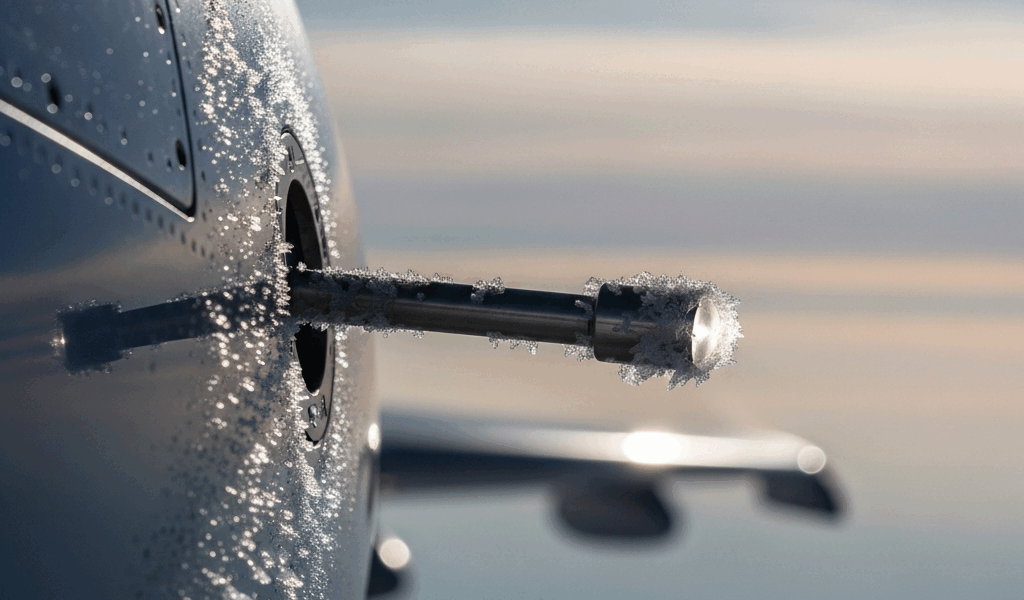
The AOA probe — mounted on the fuselage or wing — measures the actual aerodynamic angle directly. It tells you whether the airflow over your wing is flowing smoothly or about to separate. Your airspeed indicator cannot do this. Your altitude tape cannot do this. Only the AOA sensor sees the stall coming.
Modern angle of attack systems feed data to stall warning computers, which generate aural alerts and visual indications before the wing quits flying. In an aircraft like the Boeing 737 MAX, the AOA vane became critical to automated trim logic — and when those sensors failed, they sent false data upstream that killed warning systems designed to prevent exactly that kind of failure. Probably should have opened with that section, honestly, because it explains why we’re all obsessing over sensor reliability right now.
The sensor itself is remarkably simple: a hinged vane with potentiometric or capacitive electrical measurement. As angle of attack changes, the vane moves. That movement generates a voltage signal proportional to the actual AOA. The computer reads that voltage, compares it against known stall angles for your weight and configuration, and either goes silent or screams at you. When the voltage signal becomes unreliable — not because aerodynamics changed, but because the electrical pathway degraded — the entire stall warning architecture collapses.
Five AOA Failure Modes That Trigger False Stall Warnings
Moisture and Ice Contamination Inside the Probe
Water intrusion into the AOA probe happens slowly. Condensation accumulates during overnight parking. Morning flights show normal readings because the sensor is still warm from the previous day’s flights. But as altitude increases and temperatures drop, residual moisture freezes. The vane sticks. The electrical connection corrodes. The signal lags behind actual changes.
Pilot observation: The stall warning activates at an airspeed 15–20 knots higher than normal, or chatters intermittently during descent. The warning comes early. Sometimes it goes away if you increase speed, which shouldn’t happen in normal operations.
Failure signature: Noisy, inconsistent readings that spike randomly rather than tracking smoothly with pitch inputs. The indicator shows oscillations of 3–4 degrees AOA when the actual angle is stable.
Blocked or Partially Obstructed Sensing Port
Insects, debris, paint overspray, or bird strike damage can partially obstruct the vane. The obstruction doesn’t prevent movement entirely — it creates friction and restricts the vane’s range. Most dangerous scenario: the vane hits its mechanical stop at 25 degrees AOA instead of 35 degrees.
Pilot observation: Stall warning activates at a much higher airspeed than expected. On approach, the warning fires off at 80 knots when you’re normally at 60. You pitch down to clear it, but it doesn’t respond to normal stall recovery inputs.
Failure signature: The AOA indicator maxes out prematurely. If your system shows a maximum reading of 25 degrees when aerodynamics demand 35 degrees to actually stall, the warning triggers early and won’t clear until you accelerate significantly.
Loose or Corroded Electrical Connector
The connector at the base of the AOA probe experiences vibration, thermal cycling, and moisture exposure constantly. A connector that’s finger-tight instead of properly torqued creates intermittent contact. Salt spray near coastal bases — I’m thinking Miami, San Diego, places like that — accelerates corrosion in aluminum connectors faster than you’d expect.
Pilot observation: The stall warning activates and deactivates randomly, sometimes multiple times during a single descent. The indication jumps between normal and alarming with no correlation to actual pitch changes.
Failure signature: Rapid voltage fluctuations, zero-volt readings that recover suddenly, or stuck analog readings that don’t move despite clear pitch attitude changes. Some aircraft log this as a “nuisance trip” in the flight data.
Software Calibration Drift in the Stall Warning Computer
The stall warning computer stores a reference AOA value that represents your aircraft’s stall angle under current weight and configuration conditions. If this value drifts — usually due to software bugs or failed firmware updates — the computer triggers warnings at the wrong aerodynamic angle.
Pilot observation: Stall warnings appear in stable cruise flight, or the warning becomes noticeably more sensitive than it was before scheduled maintenance.
Failure signature: Consistent false warnings at specific attitudes or altitudes, rather than random spikes. The problem persists across multiple flights and doesn’t correlate with weather.
Display Unit Failure or Internal Wiring Damage
The analog or digital display that shows your AOA reading operates independently from the stall warning computer. A failed display doesn’t prevent warnings, but it prevents you from seeing what AOA value is being fed to that computer. You lose situational awareness of whether the sensor is reading reasonable numbers.
Pilot observation: Stall warning activates, but the AOA display shows nothing, zeros out, or displays a value that makes no physical sense at your current pitch attitude.
Failure signature: No needle movement, blank screen, or readings that contradict your aircraft’s pitch attitude indicator. At cruise with 5 degrees nose-up pitch, the AOA display shows 25 degrees — impossible.
How Pilots Detect a Failing AOA Sensor in Real Time
Cross-check comes first. Compare your AOA indicator reading against your pitch attitude from the attitude indicator. At a given pitch angle in stable flight, your AOA should be predictable. A mismatch is your first warning that something’s wrong.
Step one: Look at the stall warning timing. In your aircraft at your weight, the stall warning should activate at a known airspeed during approach — typically 1.3 times VSO (stall speed in landing configuration). If that warning activates 10 knots early, your AOA sensor is probably reading high. If it never activates even as airspeed bleeds off, the sensor might read low.
Step two: Verify against speed trend. Your actual airspeed should match the aerodynamic reality your instruments show. If airspeed is stable, altitude is stable, and pitch attitude is stable, but the AOA indicator is climbing toward stall warning, the sensor is lying to you.
Step three: Use backup attitude instruments. Cross-check against the standby attitude indicator, the artificial horizon, even the rate-of-climb needle. If everything else says you’re flying normally but AOA says you’re stalling, trust the backup instruments.
Decision point: At this moment, you switch to hand-flying without reliance on automated stall prevention or AOA-based trim. Pitch control becomes visual and tactile. You fly by feel and pitch attitude. You accept that you’re operating with degraded warning capability and manage speed and altitude margins accordingly.
Maintenance Checks and Preflight Red Flags
The preflight inspection should include a visual walk-around of the AOA probe. Look for cracks in the vane assembly itself — they initiate from stress concentrations and propagate during flight. A hairline crack in the probe body means the sensor is days from electrical failure.
Check the connector. If the connector housing shows any white or green oxidation, the contacts are corroding. The connector should be cleaned and re-seated with documented torque values — typically 2–4 inch-pounds depending on the aircraft type. A loose connector isn’t obvious during visual inspection.
Inspect the area around the sensing port. Debris, paint, or silicone sealant blocking the vane opening is immediately visible. Remove any obstruction before flight.
During functional test, the AOA indicator should move smoothly as you change pitch attitude on the ground. If it lags, sticks, or doesn’t center when level, the sensor or display is failing. Document this. Don’t defer it. AOA system health should be logged in your flight data every mission.
Inspection frequency: Annual at minimum. After any lightning strike, bird strike, or hard landing, inspect the AOA probe immediately.
Recovery Procedures When AOA Data Goes Silent
Faced with a loss of AOA indication during flight, your priority sequence is pitch control first, speed management second, emergency declaration third.
Pitch control becomes purely visual. Your attitude indicator, radio altimeter if equipped, and the horizon outside the window become your primary references. Maintain a pitch attitude that keeps you in level flight or shallow descent. Don’t chase the AOA indicator or stall warning. They’re corrupted. Ignore them.
Speed management relies on your airspeed indicator and engine power settings you know from memory. Reduce power slowly. Increase descent rate gradually. Avoid abrupt control inputs. Stall recognition without instrument feedback demands sensitivity to aircraft behavior — the feel of control response, the sound of the airframe, pitch trim requirements changing. You’re flying the airplane, not the autopilot.
Stall recognition becomes tactile. A real stall has a physical signature: buffeting, control heaviness, pitch drop. If you don’t feel those things, you’re not stalling, regardless of what a failed instrument shows.
When to declare: If you’ve lost AOA and stall warning capability, you’ve lost a critical safety system. Declare to ATC. Request vectors to the nearest suitable airport. Request a lower altitude if weather permits. Accept that you’re operating at reduced safety margins. You’re the limiting factor now, not the airplane.
The decision is resource management. You have working airspeed, working attitude reference, and working engines. You have stall characteristics you’ve memorized through training. You have descent planning and diversion options. A single failed AOA sensor doesn’t disable the aircraft. It disables one warning system. Recognize the difference, and you’ll manage the recovery safely.




Stay in the loop
Get the latest aviate ai updates delivered to your inbox.