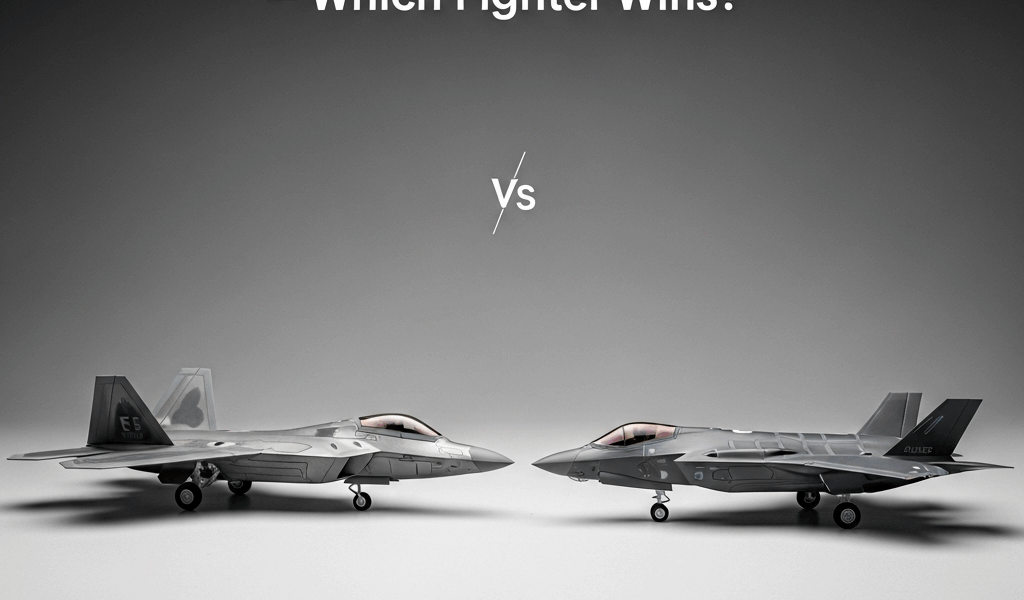
F-22 Raptor vs F-35 Lightning II — Which Fighter Wins?
The F-22 vs F-35 debate has gotten complicated with all the bad takes and spec-sheet arguments flying around. For an embarrassingly long time, I was one of those people shouting about thrust-to-weight ratios at people who probably didn’t deserve it. Don’t make my mistake.
This article includes affiliate links. We may earn a commission at no extra cost to you.
These two jets were never meant to fight each other. Full stop. So let’s actually dig into what makes each one extraordinary — the doctrine, the design philosophy, the ugly industrial decisions (for the full inside story on how Lockheed’s stealth programs were born, Skunk Works by Ben Rich is essential reading) — and yes, what would happen if they somehow ended up in the same fight.
Different Missions, Different Aircraft
Probably should have opened with this section, honestly — because once you get this part, everything else clicks into place.
The F-22 Raptor was born from a Cold War nightmare. The Air Force wanted something that could walk into Soviet-controlled airspace, kill every fighter in the sky, and walk back out — nothing more, nothing less. The ATF program wasn’t shopping for a bomb truck or a sensor platform. It wanted an air superiority fighter that could survive in denied airspace and handle threats solo. Lockheed and Boeing both submitted competing prototypes in 1990, scratching designs on whiteboards in windowless offices in Marietta and Seattle. When the YF-22 beat the YF-23, what the Air Force got was a machine optimized for one job at the exclusion of almost everything else.
But what is the F-35, then? In essence, it’s a multi-role strike fighter built around survivability, sensor fusion, and network integration. But it’s much more than that. The Joint Strike Fighter program asked Lockheed to replace the F-16, the A-10, the F/A-18, and the AV-8B Harrier — across three service branches, three different basing requirements — conventional runways, carrier decks, and short takeoff/vertical landing ships. Lockheed won that contract in 2001, working out of the same Fort Worth facility where F-16s had rolled off the line for decades.
These aren’t competing visions. They’re complementary ones. The F-22 clears the sky. The F-35 then works inside that cleared sky — striking ground targets, distributing battlefield data, acting as a flying sensor node for the entire joint force.
Football analogy, since it helps: the F-22 is your pass rusher — terrifying at one job, not asked to play cornerback. The F-35 is your quarterback — reads the field, manages the whole offense, directs the team. You need both. Swapping one for the other doesn’t improve your roster; it creates a catastrophic gap.
Performance Comparison
Here’s where the raw numbers get genuinely interesting — and where they stop telling the whole story.
Speed and Altitude
The F-22 can supercruise at roughly Mach 1.82 — supersonic without touching the afterburner. That matters. Afterburner burns fuel at a savage rate and produces an infrared signature visible from miles away. Sprinting supersonically while staying thermally quiet and fuel-efficient is a real tactical edge. The F-35 cannot supercruise. Its top speed with afterburner sits around Mach 1.6, which is where the Raptor is just getting warmed up.
Service ceiling for the F-22 runs around 65,000 feet. The F-35A tops out near 50,000 feet. That 15,000-foot gap translates directly into longer missile shots and a geometric advantage in any look-down engagement — the Raptor is shooting downhill while its target is shooting uphill into thinner air.
Thrust Vectoring and Maneuverability
The F-22’s twin Pratt & Whitney F119-PW-100 engines — assembled in a facility in Middletown, Connecticut — produce roughly 35,000 pounds of thrust each with afterburner. They feature two-dimensional thrust vectoring nozzles that deflect up to 20 degrees, which means the Raptor can point its nose at angles of attack that would stall anything flying a conventional design. Anyone who’s watched a Raptor perform the Herbst maneuver at an air show — snapping 180 degrees in what looks physically impossible — has seen what that actually means in practice.
The F-35 runs a single Pratt & Whitney F135-PW-100 producing approximately 43,000 pounds of thrust with afterburner — actually more raw thrust than either F-22 engine individually, which surprises most people when they first hear it. No thrust vectoring, though. Conventional aerodynamic control surfaces only. In a slow-speed turning fight, the Raptor wins. It’s not particularly close.
Sensor Fusion and the Information Advantage
But what is the F-35’s real advantage? In essence, it’s the most connected combat aircraft ever fielded. But it’s much more than that.
The AN/APG-81 AESA radar, combined with the AN/AAQ-37 Distributed Aperture System — six infrared cameras embedded around the aircraft’s skin, installed during final assembly in Fort Worth — and the AN/AAQ-40 EOTS targeting system all feed into a central fusion engine. The pilot’s helmet, a $400,000 piece of equipment called the Gen III HMDS built by Rockwell Collins in Cedar Rapids, Iowa, projects that fused picture directly onto the visor. The pilot can literally look through the floor of the aircraft and see what’s below.
More critically, the F-35 shares that picture. Link 16, MADL — Multifunction Advanced Data Link — and TTNT networking let it act as a sensor node, pushing targeting data to other aircraft, ships, and ground forces in real time. One F-35 locking a target can hand that solution to an F-22, a destroyer, or a B-2 without transmitting on anything an adversary intercepts easily.
The F-22’s AN/APG-77 AESA radar is one of the finest air-to-air radars ever built — genuinely exceptional. But the Raptor was designed in the early 1990s, before network-centric warfare was fully worked out, and its data-sharing has always been the known soft spot. Upgrades have helped. The F-35 still operates in a fundamentally more connected way.
Why the US Stopped Building F-22s
187 F-22s were built. Production ended in 2011 — a decision the Air Force has publicly regretted at least a half-dozen times since.
Frustrated by cost overruns and a threat environment that looked nothing like the Soviet air armies the Raptor was designed to fight, Secretary of Defense Robert Gates made the call to cap production at 187 aircraft in 2009, redirecting money toward the F-35 and toward ground forces actually fighting in Helmand Province and Anbar. The unit flyaway cost had ballooned from roughly $150 million to over $330 million per aircraft once development costs were factored in across a smaller-than-planned production run.
Gates wasn’t wrong about the strategic moment. He was wrong about how long that moment would last.
China’s J-20 program was already underway in Chengdu. Russia’s Su-57 was in development outside Moscow. This new competitive reality took off several years later and eventually evolved into the peer threat environment strategists know and wrestle with today. The production tooling for the F-22 line was subsequently destroyed — a cost-saving measure — making any restart prohibitively expensive. Current estimates put the bill at $50 billion or more before a single new Raptor would roll out of Marietta.
That’s the lesson I walked away from after years studying this program. Short-term savings calculations in defense procurement have a way of becoming catastrophically expensive strategic liabilities a decade down the road. The gap between what the existing fleet can do and what a hypothetical new production run would deliver has only widened — manufacturing techniques have changed, supply chains have shifted, and the workforce that built the original 187 has mostly retired.
Which Would Win in a Dogfight
Intrigued by firsthand pilot accounts from Red Flag exercises, I spent considerable time tracking down actual data on simulated engagements. What I found confirmed the doctrine — and complicated the clean answer most people want.
In close-in visual range combat — guns, AIM-9X Sidewinders, angles-of-attack games under 10,000 feet — the F-22 wins. Consistently. The thrust vectoring advantage at low speeds is decisive, and pilots who’ve discussed exercise results in Aviation Week and in congressional testimony make no bones about it. An F-22 pilot who gets an adversary into a slow-speed turning engagement has essentially already won before anyone fires.
But here’s the thing. Modern air combat almost never involves dogfighting.
The AIM-120D AMRAAM reaches out past 100 nautical miles on high-altitude shots. The AIM-174B — the air-launched SM-6 — pushes effective range considerably further. Beyond Visual Range combat is the dominant paradigm now. Engagements are decided by who detected whom first, who had the better firing solution, and who was harder to track. In that environment, the F-35’s sensor fusion and network connectivity become the decisive factors — not turning radius.
An F-35 that sees an adversary at 80 miles — using its own radar, passive infrared sensors, and targeting data passed from an E-7A Wedgetail orbiting 200 miles away — and launches an AMRAAM before that adversary’s radar warning receiver even chirps has won the fight. The dogfight that follows is a failure mode, not a design case.
The F-22 understands this too. Its low observable signature and supercruise exist to give it the first shot in a BVR engagement. Both aircraft are optimized for kill chains that end before visual range. The difference is that the F-35 shares what it sees in ways the Raptor cannot readily match — making it a more effective node in a networked kill web that spans aircraft, ships, and submarines.
Put both jets into a contested airspace scenario — a Taiwan Strait contingency, say, against fifth-generation adversary fighters and advanced surface-to-air missile networks — and the honest answer is that you want both, doing exactly what they were designed to do. F-22s sweeping ahead, using speed and stealth to engage adversary fighters at range. F-35s following, striking targets, jamming emissions, distributing the sensor picture to the fleet, handing targeting solutions to standoff weapons launched from platforms hundreds of miles away.
While you won’t need to choose between them in any realistic planning scenario, you will need a handful of serious strategic arguments for why the current fleet mix is dangerously imbalanced. The right question was never “which one wins.” The right question is “how do these two aircraft make each other more lethal” — and that answer is considerably more interesting than any spec sheet ever printed.
The Air Force needs both. It has 187 of one and is trying to build over 1,700 of the other. That imbalance — born from a budget decision made during a brief, anomalous window when the threat environment looked manageable — is the real story here. Not which airframe beats the other in a knife fight, but what the fleet mix tells us about the choices we made, and what it costs when we get those choices catastrophically wrong.


Stay in the loop
Get the latest aviate ai updates delivered to your inbox.