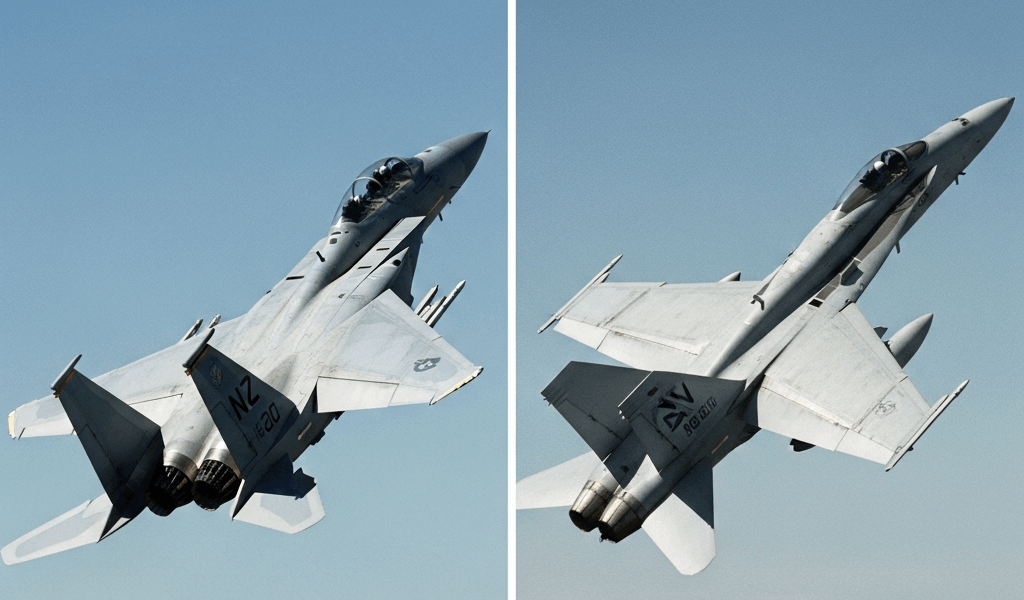
The central difference between the F-15 and F/A-18 is where and how they were designed to fight. The F-15 family is a land-based Air Force platform built around speed, range, payload, and air superiority. The F/A-18 family is a Navy and Marine Corps multirole platform designed to operate from aircraft carriers as well as land bases. The F-15 generally has the advantage in maximum speed and payload; the F/A-18 is the only one of the two designed for arrested carrier landings.
There is no single “F-15 versus F-18” specification. F-15A/C air-superiority aircraft, the two-seat F-15E Strike Eagle, and the current F-15EX are different variants. The original F/A-18A-D Hornet and the larger F/A-18E/F Super Hornet are also distinct aircraft families despite their shared name. This comparison separates those generations and uses current F-15EX and Super Hornet figures where a modern side-by-side comparison is useful.
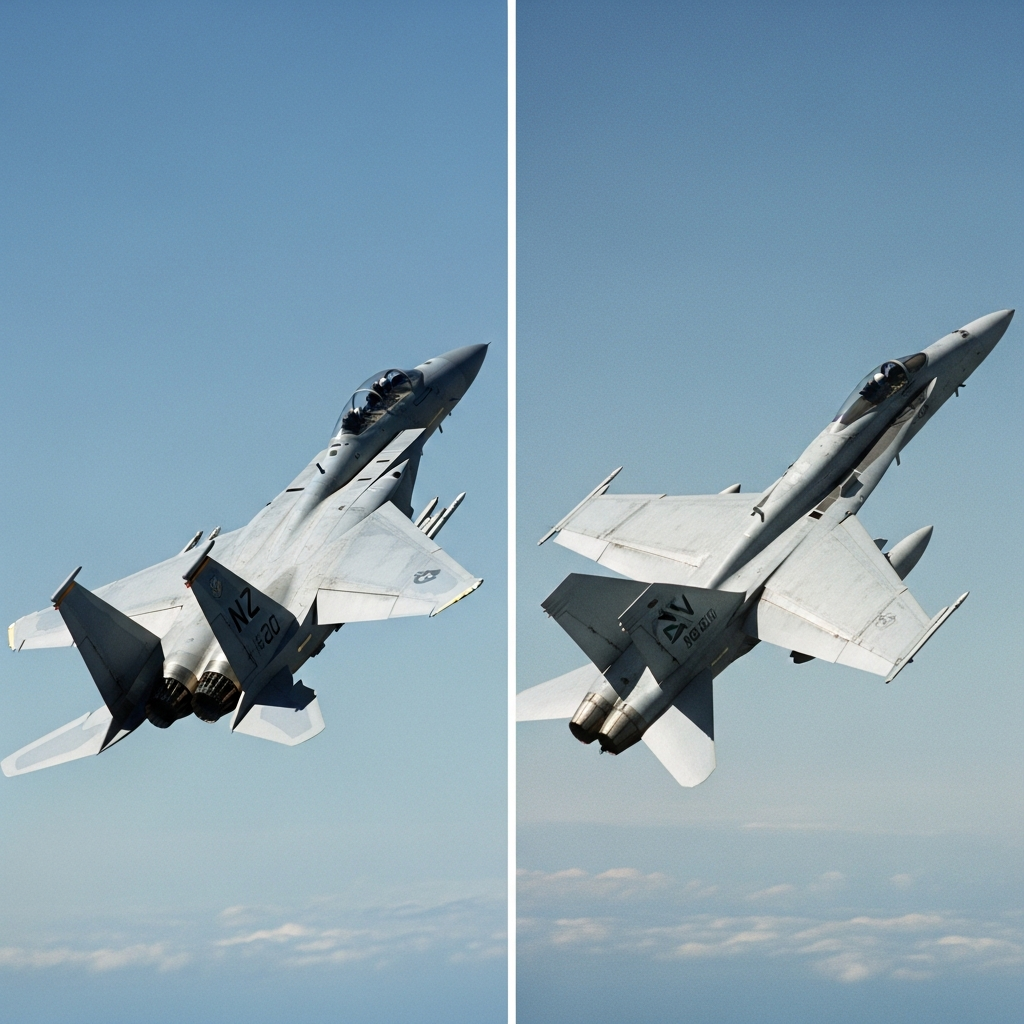
F-15 vs F-18 at a glance
| Characteristic | F-15 family | F/A-18 family |
|---|---|---|
| Primary design emphasis | Land-based air superiority; later strike and multirole variants | Carrier-capable fighter and attack missions |
| Current U.S. production comparison | F-15EX Eagle II | F/A-18E/F Block III Super Hornet |
| Maximum published speed | Mach 2.5 for F-15EX | Mach 1.8+ for Super Hornet |
| Maximum takeoff weight | 81,000 lb for F-15EX | 66,000 lb for Super Hornet |
| Published payload figure | 29,500 lb for F-15EX | Configuration-dependent; 11 weapon stations are commonly cited for Super Hornet |
| Carrier operations | No | Yes |
| Single/two-seat versions | Varies by model; F-15EX has two seats | F/A-18E has one seat; F/A-18F has two |
| Current key strength | Speed, range, large weapons capacity, and open-system growth | Carrier integration, multirole flexibility, networking, and fleet commonality |
These are public manufacturer and service figures, not a simulation of a combat engagement. Actual range, acceleration, payload, sensor performance, and survivability depend on fuel, weapons, altitude, mission profile, support assets, software, tactics, and information that is not fully public.
Why the F-15 and F/A-18 were built differently
F-15: air superiority first
The Air Force developed the original F-15 Eagle as a dedicated air-superiority fighter. The design emphasized acceleration, climb performance, radar reach, visibility, and the ability to carry air-to-air weapons without the structural compromises required for carrier use. The first F-15 flew in 1972, and operational F-15A/B deliveries began in the 1970s.
The family later expanded. The F-15E Strike Eagle added a two-person crew, conformal fuel tanks, sensors, and a major air-to-ground role while retaining air-to-air capability. The F-15EX is the latest U.S. Air Force version, with digital fly-by-wire controls, a modern cockpit, open mission systems, AESA radar, and the Eagle Passive/Active Warning and Survivability System.
F/A-18: fighter and attack missions from a carrier
The F/A-18 designation reflects its combined fighter and attack roles. Carrier operation requires reinforced landing gear, an arresting hook, corrosion protection, folding wings on relevant variants, low-speed approach handling, and compatibility with catapult launches and the tightly managed carrier deck. Those requirements add weight and constrain the design, but they let a carrier air wing operate without access to a nearby land base.
The original F/A-18A-D Hornet entered service before the F/A-18E/F Super Hornet. NAVAIR describes the Super Hornet as substantially larger than its predecessor, with greater range and lower maintenance demands despite the size increase. The E is the single-seat model and the F is the two-seat model.
Current variant comparison: F-15EX vs F/A-18E/F
Speed and altitude
Boeing lists the F-15EX at Mach 2.5 with a 50,000-foot ceiling. NAVAIR lists the Super Hornet at Mach 1.8+ and a ceiling above 50,000 feet. Maximum speed favors the F-15EX, but maximum-speed figures are not typical combat cruise speeds and may require a particular altitude, loadout, and flight condition.
That speed advantage supports rapid intercepts and high-energy air-to-air tactics. The Super Hornet’s design instead balances performance with controllability at carrier approach speeds and the structural demands of repeated launches and arrested landings.
Size and weight
The F-15EX is 63.8 feet long with a 42.8-foot wingspan and an 81,000-pound maximum takeoff weight. NAVAIR lists the Super Hornet at 60.3 feet long, 44.9 feet across, and a 66,000-pound maximum takeoff gross weight. The Super Hornet’s folded-wing configuration is important aboard ship even though its unfolded span is slightly greater.
Payload and weapons capacity
Boeing publishes a 29,500-pound payload capacity for the F-15EX and says it can accommodate up to 12 AIM-120 AMRAAMs or a mix of larger weapons. This is one reason the F-15EX is often described as a weapons-carrying complement to aircraft that prioritize low observability.
The Super Hornet has 11 weapon stations and supports air-to-air, air-to-ground, and anti-ship missions as well as external fuel and targeting systems. The right comparison is not simply maximum pounds: carrier bring-back limits, launch weight, tanker duties, mission radius, drag, and safe recovery all shape a naval loadout.
Range
Public range numbers are especially easy to misuse. A ferry range with external tanks is not a combat radius, and a clean-aircraft range is not a strike profile carrying weapons. NAVAIR publishes a 1,275-nautical-mile “combat” range for the Super Hornet in a clean configuration with two AIM-9s and a 1,660-nautical-mile ferry range with three retained external tanks. Those figures should not be compared directly with an F-15 mission radius stated under different assumptions.
In broad design terms, the F-15 family emphasizes fuel, range, and payload from land bases. The Super Hornet trades some of that performance for carrier suitability and can also act as an aerial tanker for other carrier aircraft. Both depend heavily on tanker support for demanding long-range missions.
Sensors and electronic warfare
The F-15EX uses the AN/APG-82(V)1 AESA radar and EPAWSS, with an open mission systems architecture intended to speed future integration. The Super Hornet’s Block III improvements include a 10,000-flight-hour service-life objective, an advanced cockpit, networking upgrades, and reduced radar-signature measures. Specific detection ranges, electronic-warfare effectiveness, and operational tactics are sensitive and cannot be settled reliably from brochure specifications.
The EA-18G Growler is based on the two-seat Super Hornet airframe but is a separate electronic-attack aircraft. Its mission does not make every F/A-18F a Growler.
Which aircraft is better for each mission?
Land-based air defense and long-range weapons carriage: F-15
For a land-based force that values speed, a large radar aperture, long-range carriage, and numerous air-to-air weapons, the F-15EX has the clearer design advantage. It can launch from established runways and does not carry the structural features needed for arrested carrier recovery.
Carrier-based multirole operations: F/A-18
The F/A-18E/F wins any requirement that includes conventional U.S. carrier launch and recovery because the F-15 is not carrier-qualified. The Super Hornet can perform fleet defense, strike, close air support, forward air controller airborne missions, and aerial tanking within the carrier air wing.
Deep land-based strike: depends on the exact variant and support package
An F-15E or F-15EX can carry a heavier load over a land-based mission and is designed for long-range strike. A Super Hornet can deliver precision weapons from a carrier positioned at sea. Geography, tanker availability, basing permission, threat systems, weapons, and escort or electronic-attack support matter more than a simple aircraft-versus-aircraft label.
Close-range dogfight: no responsible paper winner
The F-15 has strong thrust, acceleration, and energy performance. The Super Hornet is known for controllability at high angle of attack. But a real engagement depends on variant, weapons, fuel, altitude, initial geometry, sensors, pilot training, rules of engagement, offboard information, and supporting aircraft. Public specifications cannot prove a universal dogfight winner.
Production and service status in 2026
The F-15EX is in production for the U.S. Air Force. Boeing’s 2024 annual report said the company was under contract for F-15EX Lots 2 through 5 totaling 72 aircraft at that time.
The claim that U.S. Super Hornet production ended in 2024 is incorrect. Boeing and the Navy signed a contract in 2024 for 17 additional Block III Super Hornets, carrying new-build production into early 2027. Separately, the Service Life Modification program upgrades and extends aircraft already in the fleet. NAVAIR describes the Super Hornet as the backbone and workhorse of the carrier air wing, with Block III extending service life and capability.
For a tighter comparison focused only on the newest versions, see our F-15EX versus F/A-18E/F Super Hornet guide.
Frequently asked questions
Is the F-15 faster than the F-18?
Yes, based on published maximum speeds for current variants. Boeing lists the F-15EX at Mach 2.5, while NAVAIR lists the F/A-18E/F at Mach 1.8+. Those maximums do not describe every loadout or combat condition.
Can an F-15 land on an aircraft carrier?
No operational U.S. F-15 variant is designed or qualified for routine carrier launches and arrested landings. The F/A-18 family was built for carrier operations.
Is the F-18 called the Hornet or Super Hornet?
The F/A-18A-D models are commonly called Hornets. The larger F/A-18E/F models are Super Hornets. Treating them as the same airframe produces inaccurate size, range, and performance comparisons.
Which carries more weapons?
The F-15EX has the larger published maximum payload and greater air-to-air missile capacity. Actual operational loads for either aircraft depend on mission, fuel, drag, compatible stations, recovery limits, and weapons availability.
Did Super Hornet production end?
No. A 2024 Navy contract for 17 additional Block III aircraft extended new-build production into early 2027. Modification work on existing Super Hornets also continues.
Verdict
The F-15 and F/A-18 are not substitutes designed around the same operating environment. The F-15 is the stronger choice when land-based speed, range, and heavy weapons carriage lead the requirement. The F/A-18 is the correct choice when carrier suitability and naval multirole integration are essential. Any claim that one is universally “better” ignores the mission, variant, support network, and basing constraints that determined why both families exist.


Stay in the loop
Get the latest aviate ai updates delivered to your inbox.