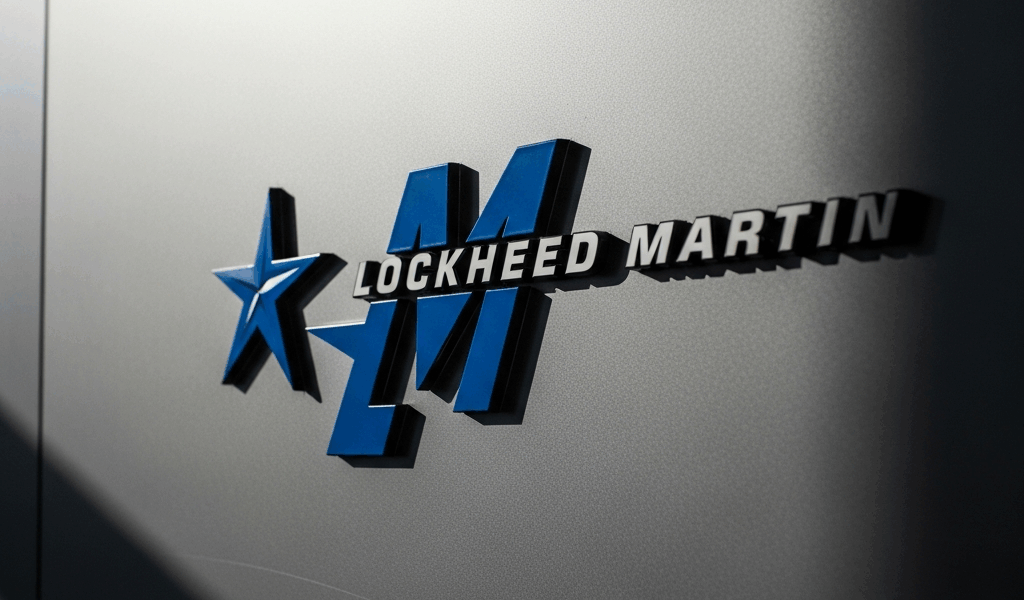
What Does the Lockheed Martin Logo Mean? The Story Behind the Star
The Lockheed Martin logo meaning is something I spent embarrassingly little time thinking about until I was standing in front of a full-scale F-22 Raptor at an air show in Marietta, Georgia, staring at the tail fin. That bold blue star — clean, geometric, unmistakable — was stamped onto a machine worth roughly $143 million. I remember thinking: somebody made a deliberate decision about that shape. Somebody sat in a conference room and argued for it. That thought stuck with me long after the show ended, and eventually I went looking for the full story.
What I found was more layered than I expected. The logo isn’t just a star. It’s a compressed history of two rival aerospace giants, a billion-dollar merger, and a design philosophy rooted in the oldest navigation technology humans ever used.
The Star and the Merger
To understand the logo, you have to go back to March 15, 1995. That’s the date Lockheed Corporation and Martin Marietta officially completed their merger, creating what was at the time the largest defense contractor in the world. The combined entity — Lockheed Martin Corporation — needed an identity that could represent both companies without erasing either one.
This is harder than it sounds. Lockheed had been building aircraft since 1912. The Skunk Works division, based out of Palmdale, California, gave the world the U-2 spy plane, the SR-71 Blackbird, and the F-117 Nighthawk. That name carried weight in every air force procurement office on the planet. Martin Marietta, meanwhile, had its own extraordinary legacy — Titan rockets, Viking Mars landers, and some of the most sophisticated satellite systems ever deployed. These weren’t two equal companies merging in any sentimental sense. They were two distinct cultures with distinct engineering traditions.
The design team tasked with creating the new corporate identity chose a single star as the centerpiece. Not a stylized aircraft silhouette. Not a rocket. A star — specifically a five-pointed star rendered in clean, deep blue with a precise geometric cutout through its center, creating a kind of negative-space window. The full wordmark pairs that star with “Lockheed Martin” in a bold, custom typeface that feels authoritative without being aggressive.
Probably should have opened with this section, honestly — because this merger context is the whole ballgame. Without knowing that two massive, proud aerospace companies had to be folded into a single visual identity in 1995, the star looks like a generic corporate symbol. With that context, it reads like a carefully negotiated peace treaty expressed in graphic design.
The blue is a specific shade — close to what designers would call a federal or aerospace blue, reminiscent of both the U.S. Air Force roundel and the deep color of space. It wasn’t chosen casually. Defense contractors spend considerable resources on brand perception, and in 1995 that shade of blue was doing a lot of work: trustworthy, technical, American, and sky-adjacent all at once.
What the Star Symbol Represents
Lockheed Martin has been fairly consistent about the symbolism they attach to the star. The company’s official position frames it around three concepts — navigation, guidance, and aspiration. That might sound like marketing language, and to some extent it is. But dig into each of those ideas and there’s real substance underneath.
Navigation — The Oldest Technology in the Room
Before GPS, before inertial navigation systems, before radar, people found their way using stars. Specifically, they used a single star — Polaris, the North Star — as a fixed reference point. Mariners crossed oceans with it. Armies moved at night by it. The star as a navigation symbol predates written history. For a company whose products include the GPS satellite constellation, precision-guided munitions, and the navigation systems aboard commercial aircraft worldwide, anchoring the logo in that ancient symbol is not accidental.
Lockheed Martin’s involvement in GPS infrastructure is something most people don’t fully register. The satellites themselves, the ground control systems, the receivers embedded in weapons — the company’s fingerprints are all over the technology that now tells your phone where you parked your car. A star on their logo isn’t just poetic. It’s literally descriptive.
Guidance — The Cutout and What It Means
The geometric cutout through the center of the star is the detail most logo analyses skip over. It’s not decorative. That open space creates a sense of direction — a sightline through the star, like an aim point or a targeting reticle. Whether that was the explicit intent during the 1995 design process, I can’t say with certainty. But the visual effect is there. The star doesn’t just sit on the page. It points somewhere.
For a defense company whose business is, in significant part, guided weapons systems — Hellfire missiles, JASSM cruise missiles, THAAD interceptors — that sense of precision and directionality embedded in the logo symbol resonates. It’s a visual language that speaks to engineers before it speaks to anyone else.
Aspiration — The Space Connection
Martin Marietta built the external tank for the Space Shuttle. Every single one of the 135 Shuttle missions flew with a tank bearing that company’s engineering work. When Lockheed Martin emerged from the merger, it inherited that legacy. Stars, in the context of space exploration, are destinations — not just navigation tools. The aspiration framing acknowledges that the company’s ambitions extend beyond Earth’s atmosphere, which in 1995 was commercially significant and remains so today with programs like Orion and various classified satellite platforms.
How the Logo Has Changed Over the Years
Fascinated by this history, I went back through the visual archives of both predecessor companies. The evolution is genuinely interesting, and it shows how corporate identity in aerospace shifted from literal to abstract over about eighty years.
Early Lockheed — Aircraft as Identity
The original Lockheed Aircraft Company logos from the 1920s and 1930s were straightforwardly literal. Wings. Aircraft silhouettes. The classic “winged star” motif that appeared in various forms through the mid-century period was a direct representation of what the company made. There was a red-and-white color scheme in some eras, a kind of aviation-age aesthetic that you’d recognize from vintage airline posters. Nothing subtle about it.
By the postwar period, Lockheed had settled into a wordmark-heavy identity. The company name carried enough weight on its own. The Skunk Works’ famous skunk mascot — a cartoon figure created by Al Capp’s Li’l Abner comic strip and adopted by Kelly Johnson’s team in 1943 — became one of the most recognized secondary marks in aerospace, even though it never appeared in formal corporate branding. It lived on patches and building plaques and the occasional aircraft nose art.
Martin Marietta — Corporate Blue Arrives
Martin Marietta’s visual identity through the 1970s and 1980s leaned heavily into structured, geometric design. The company’s logos from that period reflect the broader corporate design trends of the era — clean sans-serif type, geometric shapes, that institutional seriousness that post-Apollo aerospace companies cultivated deliberately. They weren’t trying to sell excitement. They were trying to win government contracts, and their branding reflected that audience.
I made the mistake early in my research of assuming Martin Marietta’s identity had been entirely absorbed into Lockheed’s during the merger. It hadn’t. The star symbol, by most accounts, owes more to Martin Marietta’s geometric, space-focused design language than to Lockheed’s more aviation-rooted visual history. That’s a detail that gets lost in the narrative where Lockheed is assumed to be the dominant partner simply because its name comes first.
The 1995 Logo and Subsequent Refinements
Driven by the need to present a unified face to government clients almost immediately after the merger closed, the design team moved quickly. The 1995 logo established the core elements that survive today — the blue star, the wordmark, the overall composition. What has changed since then is largely refinement rather than reinvention.
The typeface has been cleaned up. The blue has been standardized more precisely across digital and print applications — something that matters considerably more in a world where the logo appears on websites, aircraft liveries, missile system documentation, and 200-foot trade show banners simultaneously. The star itself has remained essentially unchanged. That speaks to how well the original design solved the problem it was given.
Compare that stability to competitors like Boeing, which has gone through more visible identity shifts, or Raytheon, which rebranded completely when it merged with United Technologies in 2020. Lockheed Martin has stayed with its 1995 star through nearly three decades of enormous change — wars, government shutdowns, new aircraft programs, cancelled aircraft programs, and a defense market that barely resembles what it looked like when the merger closed.
The star endures. That’s not nothing. In corporate design, longevity is its own form of meaning — proof that the symbol was strong enough to survive the company it represents growing into something its founders couldn’t have fully imagined.




Stay in the loop
Get the latest aviate ai updates delivered to your inbox.