Inside the B-2 Spirit Cockpit — What Pilots See and Do
The B-2 bomber cockpit has gotten complicated with all the mythology flying around. You’ve seen the photos — wide, low canopy, two helmeted silhouettes glowing against a wall of screens. Official. Impressive. Vague. What actually happens inside that cockpit — what those two crew members are reading, touching, and deciding in real time — gets almost no serious treatment outside classified briefing rooms. I’ve spent years digging through declassified documents, congressional testimony transcripts, pilot interviews, and aviation trade publications stretching back to the Spirit’s first flight in July 1989. For the companion story of how stealth technology was actually invented at Lockheed’s secret facility, Skunk Works by Ben Rich covers everything from the U-2 through the F-117 that preceded the B-2. What follows is the most complete open-source picture of that cockpit I could build.
This article includes affiliate links. We may earn a commission at no extra cost to you.
Fair warning up front: some of this feels like reading around a locked door. Northrop Grumman, the Air Force, and the pilots themselves stay careful about public statements. But there’s more accessible information than most coverage admits — and the gap between “classified” and “discussed openly at AFA symposiums” is genuinely wider than you’d expect.
The B-2 Cockpit Layout — Two Crew, No Backseaters
Probably should have opened with this section, honestly, because the first thing that surprises people isn’t the technology — it’s the headcount.
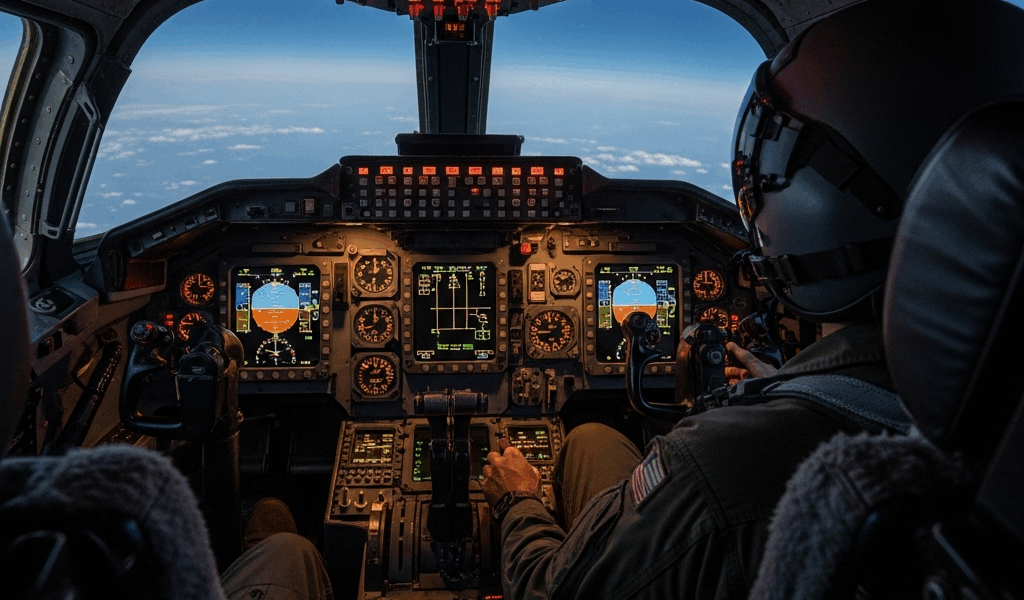
The B-2 Spirit carries exactly two people: a pilot — the aircraft commander — and a mission commander. They sit side by side in a cockpit spanning roughly 10 feet across internally, ejection seats offset slightly so shoulders don’t fight for the same space. Both face forward. No tandem arrangement, no WSO tucked behind the pilot the way you’d find in an F-15E or older strike platforms. Two people, side by side, running a 172-foot wingspan strategic bomber capable of carrying 40,000 pounds of ordnance across intercontinental ranges on a single sortie.
That wasn’t a cost-cutting shortcut — it was a deliberate design philosophy. The side-by-side layout draws from deep bomber heritage. The B-52 flew with six crew members. The B-1B carries four. Each generation tried to push crew requirements down as automation absorbed more of the cognitive burden. The B-2 hit two-person operation by concentrating enormous processing capacity into its integrated avionics suite, then designing the mission systems so one person could genuinely manage weapons, navigation, communications, and threat response while the other flew the airplane.
The division of labor breaks down cleanly on paper. The pilot in the left seat handles aircraft control and flight management. The mission commander on the right owns weapons employment, sensor management, and the communications load. In practice — mid-sortie, over defended territory — those roles blur constantly. Both crew members are fully qualified pilots. Both can fly the airplane. It’s less “pilot and assistant” and more two surgeons sharing the same operating room, each trusted to act independently when the situation demands it.
Crew rest is a real operational consideration on the B-2 in ways that almost never apply to tactical aircraft. Missions routinely run past 30 hours with aerial refueling. The cockpit includes a small rest area behind the crew stations — barely a bunk, honestly, more of an expensive horizontal shelf — plus a toilet and provisions for food. A pilot who flew multiple operational sorties described it in a 2014 Air Force Magazine interview as “camping in a very expensive tent.” While one crew member rests, the other manages the aircraft alone, typically over ocean stretches where traffic and threat density stay low enough to allow it.
What the Screens and Controls Look Like
Here’s where open-source information gets genuinely interesting — and where most popular coverage gets lazy.
Northrop Grumman publicly described the B-2’s cockpit as “all-glass” when the aircraft entered service in the mid-1990s. That was notable at the time. The F-117 Nighthawk, for comparison, still relied on conventional analog gauges alongside its digital displays. The Spirit was built from the beginning around multi-function displays — no analog fallback philosophy baked into the panel design.
Each crew station features four primary MFDs arranged in a two-by-two grid, each screen measuring approximately 6 by 6 inches in the original configuration. Don’t make my mistake of assuming these were touchscreens — they weren’t. Crew members managed them through bezel buttons surrounding each display and a cursor control device, essentially a trackball, for selecting menu items, designating targets, and navigating system pages. The center console between the seats handles communications controls, fuel management, and the defensive management system.
Those original displays got substantially upgraded under the Extremely High Frequency satellite communications program, then again under the DMS-M — Defensive Management System Modernization — effort. Northrop also began the Cockpit Modernization Program by the mid-2010s, replacing the original screens with higher-resolution color displays running improved processing hardware. Exact current-generation specifications aren’t public, but a 2018 Air Force budget document listed the program at approximately $96 million across the full fleet of 20 aircraft — which gives you a sense of what “modernization” means at this level.
The flight management system deserves its own moment. The B-2 runs a highly integrated FMS combining GPS navigation, inertial navigation using ring-laser gyroscopes, terrain-referenced navigation, and astro-inertial navigation — that last one using star-tracking sensors to correct position drift during long ocean transits where GPS might be degraded or actively jammed. The astro-inertial system descends from technology originally developed for the SR-71 Blackbird — Lockheed’s LN-20 was the Blackbird variant — with the B-2 using an evolved version of that underlying concept. The specific contractor and model number for the current system haven’t been publicly confirmed.
Engine controls run through four throttle levers for the four General Electric F118-GE-100 turbofans, arranged as two pairs — each pair controlling engines on the same wing side. The F118 puts out 17,300 pounds of thrust per engine, no afterburner. The airplane is built for range and altitude efficiency, not speed. Pilots who’ve discussed the throttle feel publicly describe it as conventional — the exotic exterior doesn’t translate to exotic handling inputs at the crew station, apparently.
One system that gets discussed more openly than you’d expect — the autopilot and auto-throttle integration. The B-2 is notoriously demanding to fly manually in certain regimes. A flying wing with no vertical tail surfaces means the flight control computers are making continuous, tiny corrections to the elevons and drag split flaps just to maintain stable flight. Pilots have described hand-flying the B-2 through turbulence as an experience that builds humility fast. The flight control system — a quadruplex digital fly-by-wire setup — isn’t optional equipment. It’s structurally necessary to keeping the aircraft in the air.
Flying a B-2 — What Former Pilots Have Said
As someone who spent a long time chasing down every public pilot interview, airshow talk, and retirement speech where former Spirit crews said something specific about the flying experience, I learned everything there is to know about how the B-2 feels from the inside — at least everything unclassified.
But what is that experience, really? In essence, it’s a study in deliberate familiarity. But it’s much more than that.
Colonel Bryan Tice — B-2 pilot, later operations group commander at Whiteman AFB — described the aircraft in a 2016 Defense News interview as “deceptively conventional in the cockpit once you get past the visual.” Northrop’s engineers worked hard to make the crew interface feel familiar to pilots transitioning from other aircraft, specifically the B-1B Lancer, which supplied many early B-2 crews. The goal was reducing cognitive load on the new airplane so crews could actually focus on mission complexity rather than fighting unfamiliar controls.
That said, approach and landing get reliably described as demanding. One retired pilot — speaking at an EAA AirVenture forum in 2019, careful not to attribute specifics to classified systems — described the sight picture on final approach as “unlike anything in the inventory — you’re looking over this enormous curved surface and the runway appears in a way your brain has to learn to trust.” The aircraft touches down at around 140 knots, fairly conventional for a large platform, but the visual experience of landing something shaped like a giant stealth arrowhead apparently requires genuine mental adjustment.
Aerial refueling gets mentioned repeatedly as a workload spike. The B-2 takes fuel from a boom-equipped tanker — KC-135s and KC-10s historically, KC-46As now entering the rotation. The receptacle sits on the upper fuselage behind the cockpit, meaning the pilot flies formation off a tanker they literally cannot see directly, relying on cockpit instrumentation and the boom operator’s voice calls. Night refueling over the Pacific at hour 28 of a 30-plus hour mission, fatigue compounding — multiple pilots describe that as the moment when training discipline matters most. That’s what makes the B-2 endearing to us aviation obsessives — the machine is extraordinary, but the human demands are just as formidable.
I got one assumption wrong for years, and it’s worth correcting. I always figured the B-2’s low-observable requirements created serious cockpit visibility problems — that the pilots were essentially flying partially blind to preserve radar cross-section. The canopy turns out to be surprisingly capable. It uses a gold-film transparency coating — similar in concept to the F-22’s canopy — that reduces radar reflection while filtering UV and IR wavelengths. Forward and lateral visibility is good, according to pilots who’ve discussed it publicly. The real limitation is rearward visibility, which is essentially zero given the aircraft’s shape. That gets managed through camera systems and by accepting an operational reality: the B-2 is not a dogfighter, and nobody is sneaking up behind it in the threat environments it’s designed to penetrate.
How the B-2 Cockpit Compares to the B-21
The B-21 Raider is Northrop Grumman’s follow-on to the Spirit. It represents the kind of generational leap that makes the B-2’s underlying cockpit architecture — even with modernized displays bolted on — look like it belongs in a different era.
Here’s what’s actually public, drawn from Air Force Secretary testimony, official Northrop releases, and the details disclosed around the Raider’s December 2022 rollout at Palmdale.
The B-21 cockpit is built around open architecture — specifically what the Air Force calls an “open mission systems” framework. Software can be updated, upgraded, and reconfigured without the expensive, years-long recertification cycles that plagued B-2 modernization programs. Frustrated by exactly those integration headaches, Northrop and the Air Force designed the B-21 using modular avionics from the start. Adding a new weapon capability to the B-2 meant threading new software through a tightly coupled architecture that touched everything. On the B-21, a new capability should slot in the way an app updates on a phone rather than requiring a full system re-architecture. That’s the theory, anyway.
Display technology in the B-21 almost certainly uses large-format touch-enabled screens — the specific configuration hasn’t been released, but every modern military cockpit program since the F-35 has moved toward large-area displays with touch and voice interface capability. The F-35’s 20-inch panoramic display set the template. B-21 cockpit photos released publicly show a wide instrument panel with what appear to be large integrated display panels — not the discrete MFD grid that defined the B-2.
Crew size for the B-21 is confirmed at two. Same as the B-2. But the Raider is designed to be optionally crewed down the road — meaning the aircraft could eventually operate remotely or with reduced human oversight for specific mission profiles. That’s a significant philosophical shift. The B-2 was always a two-human airplane, architecturally and conceptually. The B-21 is a two-human airplane that’s been deliberately prepared to eventually become something else.
The survivability difference between the two cockpits is also worth noting. The B-21 incorporates decades of low-observable lessons accumulated after the B-2 entered service — canopy design, crew station RF management, sealing around the cockpit area. The B-2 represented the state of the art in 1989. The B-21 represents the state of the art in the 2020s. Those aren’t the same thing.
What doesn’t change across either aircraft is the fundamental human equation — two people, sitting side by side, responsible for one of the most capable weapons systems ever built, making decisions at altitude that carry enormous weight. The screens improve. The software gets smarter. The mission stays identical: penetrate defended airspace, deliver precision effects at strategic range, come home. The pilots who fly these aircraft — whether a B-2 or eventually a B-21 — work inside a cockpit engineered down to its smallest detail to make that mission survivable and executable. That’s worth understanding clearly, even from the outside.




Stay in the loop
Get the latest aviate ai updates delivered to your inbox.