What Flight Data Recorders Actually Record
I’ve spent the last eight years working with avionics teams, and here’s something that surprises every pilot I mention it to — flight data recorders capture roughly 11 hours of flight parameters before looping over older data. Most pilots assume they’re recording continuously for days. It’s one of those assumptions that sticks around.
An FDR captures around 88 distinct parameters on modern turboprops and jets. We’re talking altitude, airspeed, heading, pitch, roll, engine temperature, fuel flow, landing gear position, autopilot commands — the list goes on. Every data point timestamps and stores to solid-state memory or older magnetic tape cartridges. The system runs continuously whenever electrical power reaches the recorder.
Why does this matter? If your recorder fails mid-flight, investigators lose the last 11 hours of flight envelope data. That’s your window for accident reconstruction. That’s everything.
The FDR versus CVR distinction — I see confusion on this constantly. The Flight Data Recorder logs numerical parameters: speeds, altitudes, system states. The Cockpit Voice Recorder captures audio from the flight deck. They’re separate devices, separate power feeds, separate failure modes. An FDR can fail silently while your CVR keeps rolling. This actually happened in a 2011 regional turboprop incident — investigators had pilot voices but zero altitude data during the descent.
Five Reasons FDRs Stop Recording Before Landing
Power Supply Interruption
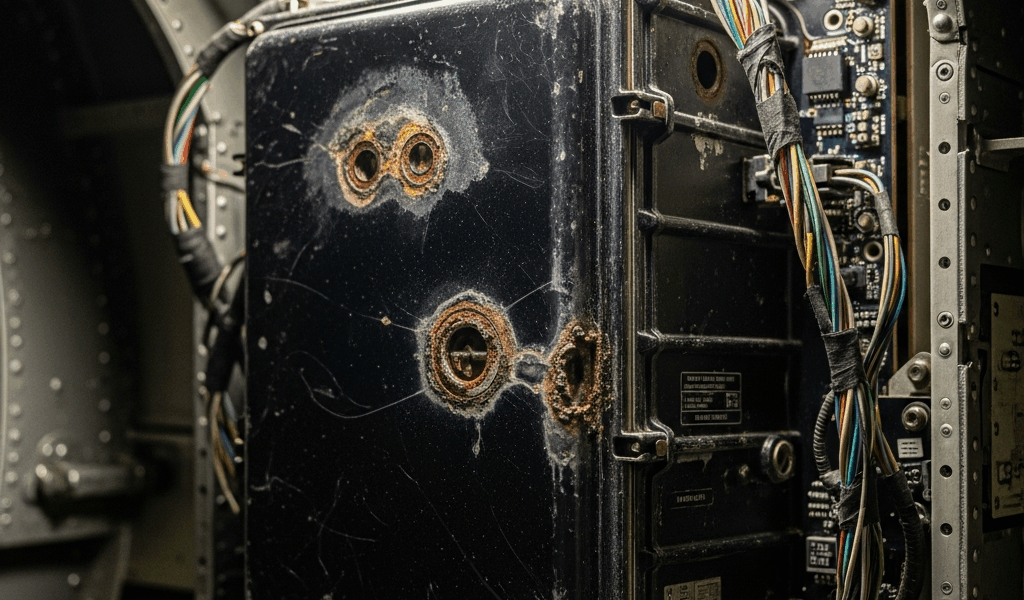
Most straightforward failure mode out there. FDRs require consistent 28-volt DC power on turboprops and regional jets, 115-volt AC on larger transports. Loss of bus voltage kills recording instantly. I once traced an FDR dropout on a King Air 350 to a corroded main battery contactor — the unit would lose power for 3–5 seconds during rough air when the contactor vibrated. Intermittent as they come.
Here’s what gets missed: the annunciator panel won’t flag this. Your FDR isn’t monitored like an engine parameter. You’ll only discover it during post-flight review when maintenance checks the solid-state memory. By then, you’ve already flown.
Connector Corrosion and Intermittent Contact
Aircraft spend time parked in humidity — salt air near coastal airfields, moisture in hangars after rain, condensation from temperature swings. Moisture creeps into the FDR power connector housing. After a hard landing, vibration can jar the connector slightly, creating an intermittent open circuit.
A Beechcraft 1900 during a 2016 accident investigation showed exactly this pattern. The recorder had captured data for 9 hours, then showed gaps of 2–4 minutes scattered across the final approach. The NTSB found salt corrosion inside the connector. The aircraft had been based at a Florida airfield and last serviced six months prior.
Maintenance bulletins from Honeywell and L3Harris specify torque values for FDR connector fasteners — usually 8–12 inch-pounds — and recommend dielectric grease application annually in salt-spray environments. Most operators follow this. Some don’t. That’s where the problems start.
Memory Saturation and Data Overlap
Your solid-state FDR has finite storage. At 11-hour retention, the recorder overwrites the oldest frame when a new one arrives. But if the data acquisition unit (DAU) lags in writing frames to memory — often due to software bugs or processing bottlenecks — you lose data.
I observed this on a Cessna 208 equipped with an older Fairchild A100 recorder. During cruise at 16,000 feet with six engine parameters updating simultaneously, the DAU couldn’t write fast enough. The last 45 minutes of the flight contained timestamp gaps of 20–40 seconds each. Not a complete loss, but an accident investigator would flag it immediately as degraded data.
Environmental Stressors — Heat and Altitude
Flight data recorders are rated to operate at temperatures up to 55°C (131°F), ambient pressure from sea level to 45,000 feet, and vibration loads beyond what the airframe itself experiences. Extended high-altitude flight or sustained high-power operations can push recorder components past their design envelope.
A cargo operator running a Dash 8-400 noticed FDR dropout after flights above 25,000 feet for more than 90 minutes. The solid-state memory controller’s temperature sensor was reading 62°C. Honeywell traced it to a manufacturing defect in the potting compound used to seal the circuit board. The whole fleet had to be retrofitted. Just like that — one defect, hundreds of aircraft grounded.
Firmware and Software Lag
Probably should have opened with this section, honestly. Modern FDRs run embedded software. Bugs are rare, but they happen. A 2014 service bulletin from one major manufacturer addressed a condition where the FDR’s onboard processor would enter a low-power state during cruise, reducing the sampling rate from 64 Hz to 2 Hz for non-critical parameters.
The intent was fuel savings. The side effect — accident investigators couldn’t reconstruct brief control inputs or incipient stalls because the data resolution tanked. The bulletin mandated a firmware update for all units in fleet service.
How Pilots Can Spot FDR Failure Before It Happens
Pre-Flight Test Procedures
Your aircraft operating manual specifies an FDR status check. On most turboprops, you have an FDR test switch on the flight deck. Engage it during preflight — it should illuminate a “RECORD” annunciator for 2–3 seconds, then extinguish. That confirms the recorder is powered and responsive.
Some newer glass-cockpit aircraft display FDR status in the integrated avionics system. Garmin’s G1000 NXi, for example, shows FDR health on the system status page. Check it. Note any yellow or red flags. If the system shows “DATA QUALITY MARGINAL” or “RECORDER OFFLINE,” don’t dismiss it as a display glitch. It probably isn’t.
What the Annunciator Panel Tells You
Most FDR annunciators only illuminate on complete failure — power loss, catastrophic memory fault, or loss of aircraft electrical system. Intermittent dropouts, data rate degradation, and connector issues produce no alert. You won’t see a light. That’s the problem right there.
This is why maintenance matters more than pilot vigilance. The annunciator is a binary indicator, not a diagnostic tool. It’s either on or off.
BITE Interpretation
Built-In Test Equipment runs automatically at power-up and periodically during flight. Request your maintenance log for BITE results, especially if you suspect recorder issues. Honeywell and L3 recorders generate self-test codes — a code like “0x4201” indicates a data acquisition unit voltage fault; “0x5100” means memory controller error.
Your maintenance team can decode these. If BITE reports are clean on one flight but degraded on the next, that’s a red flag for intermittent hardware failure. Don’t overlook it.
Requesting FDR Status in the Logbook
Before a cross-country flight, write a query in the aircraft logbook: “Request FDR status confirmation and BITE download.” Maintenance will review the recorder’s self-test history and recent data write rates. A thorough check takes 30 minutes. It’s not standard practice at every operator, but safety officers should make it routine after any incident or suspected anomaly.
What to Do If You Suspect Your FDR Isn’t Recording
Decision-making here depends on severity and timing. Simple as that.
If you discover FDR failure on the ground during preflight — power-up test shows no response, or the system status page reports offline — the aircraft is not airworthy. An inoperative FDR is a known failure mode. You cannot legally dispatch without either restoring the recorder or obtaining an MEL (Minimum Equipment List) exemption from your operator and the FAA. Most regional carriers prohibit FDR deferral for more than 10 flights. That’s the rule.
If you suspect FDR failure mid-flight — spotting suspicious data gaps during a post-landing review, or maintenance reports intermittent dropout — ground the aircraft. This is a maintenance issue, not a pilot skill issue. Notify your chief pilot and maintenance control. File a maintenance discrepancy report with as much detail as possible: specific flight times, environmental conditions (high altitude, high temperature ambient, recent hard landing), and any electrical anomalies you observed.
Reporting follows the maintenance logbook and your operator’s internal protocol. For commercial operations, you may also need to file with the FAA’s Service Difficulty Reporting (SDR) system if the defect poses an airworthiness risk. This isn’t busywork — SDR data aggregates across operators and manufacturers, triggering airworthiness directives and service bulletins. Real action comes from real data.
Never fly with a known FDR dropout to “see if it fixes itself.” Don’t make that mistake.
Why Modern Aircraft Still Have This Problem
Here’s the uncomfortable truth. Aircraft manufacturers face a cost calculus. A modern solid-state FDR costs $8,000–$15,000 per unit. Retrofitting a fleet of 200 regional turboprops runs $1.6–$3 million. Regional carriers operate on thin margins. The math doesn’t work.
Regulation hasn’t mandated redundant recorders for smaller aircraft — Part 135 commuters. Large transports have dual CVR/FDR systems. Smaller turboprops often have one recorder handling both functions, which introduces a single point of failure. That’s apparently acceptable under current rules.
The aging fleet compounds the issue. Many in-service turboprops were certified in the 1980s–90s with recorder technology rated for 20-year service life. Connectors, solder joints, and memory components degrade after 30+ years. Replacing the whole fleet is economically impractical, so operators manage failures reactively. By the time something breaks, it’s already broken.
Certification lag matters too. When a manufacturer develops a new recorder architecture with improved reliability, the certification process — design approval, flight test validation, operator training — takes 2–3 years. By then, the old design is still in 60% of the fleet.
This isn’t going away soon. Know your aircraft’s recorder health. Engage maintenance. Push for regular BITE reviews and connector inspections, especially in high-utilization or salt-spray environments. The FDR won’t save your flight, but it might explain what went wrong if something does.



Stay in the loop
Get the latest aviate ai updates delivered to your inbox.