“`html
What Gyroscopic Precession Actually Is
Gyroscopic precession has gotten complicated with all the confusion flying around among new pilots. It violates every intuitive expectation about how spinning objects behave. I learned this the hard way during my third dual flight in a Cessna 172 when my instructor asked me to explain why the heading indicator had drifted 15 degrees during a sustained left turn. I had no answer.
But what is gyroscopic precession? In essence, it’s what happens when you apply a force perpendicular to a spinning object—that object doesn’t respond in the direction you pushed it. Instead, it moves 90 degrees ahead in the direction of rotation. A spinning gyroscope doesn’t want to cooperate with your input. But it’s much more than that.
Think of your airplane’s propeller. It’s spinning at roughly 2,400 RPM in cruise—that’s a gyroscope. Now imagine pushing that spinning prop to the right. You’d expect it to tilt right, correct? Instead, it tilts forward or backward depending on the direction of spin and which way you pushed. That perpendicular response to applied force is gyroscopic precession, and it’s baked into every instrument that relies on a spinning disk.
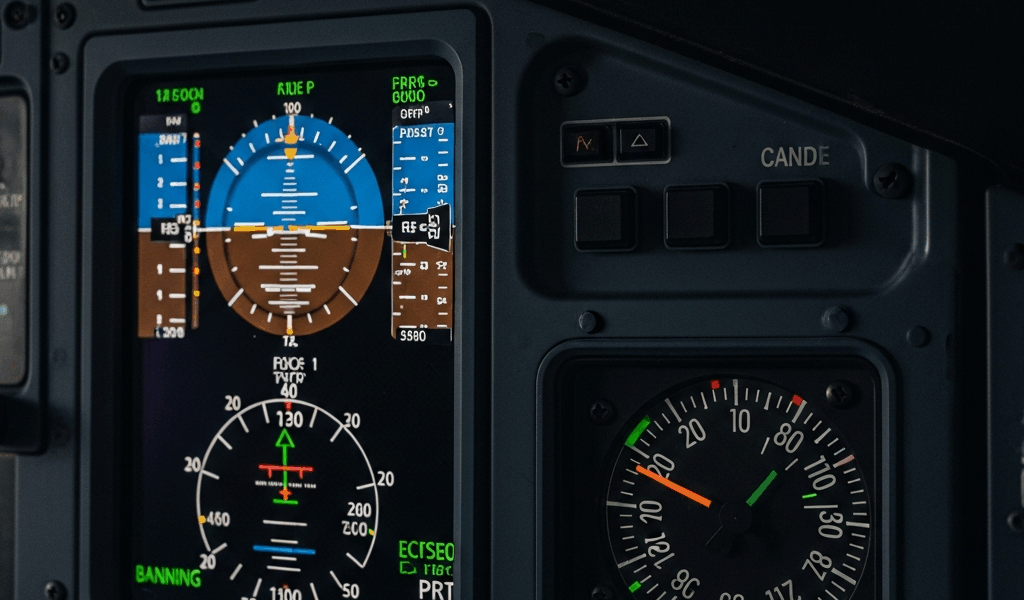
The heading indicator, the turn coordinator, the attitude indicator—all depend on gyroscopes. All three will betray you if you don’t understand precession.
How Precession Breaks Your Heading Indicator
Your heading indicator is supposed to show you where the airplane is pointing. It shouldn’t care about climbs, dives, or turns because it’s mounted vertically on a gimbal system. The spinning rotor inside—usually running around 10,000 to 12,000 RPM—resists tipping. Theoretically, that means stable heading reference for 30 minutes between resets. In reality, precession eats that assumption alive.
Sustained turns expose this immediately. Roll into a left turn at standard rate—3 degrees per second. The heading indicator seems fine for the first 90 degrees of turn. Then you notice it’s drifting. By the time you’ve rolled out, the indicator shows you’re 8 to 12 degrees off from where you actually are. Probably should have opened with this section, honestly—it’s the most aggravating precession problem in training.
Why does this happen? During a turn, the airplane is rotating about a vertical axis. But the heading indicator’s gyro is also spinning horizontally at high speed. That combination of two rotation axes at 90 degrees to each other creates precession. The gyro wants to precess, and there’s no mechanical stop preventing it. Drift accumulates over time.
Crosswind turns are worse — during a left turn with a strong right crosswind, you’re fighting wind correction while managing turn rate. The airplane pitches and rolls slightly as you coordinate aileron and rudder. Each of those inputs adds a secondary rotation axis, stacking precession on top of precession. I once had a heading indicator show 30 degrees of drift during a tight crosswind turn. The thing looked broken until I understood the mechanics.
Typical drift rates run 1 to 3 degrees per minute in older mechanical instruments. Well-maintained vacuum-driven indicators perform better, though. Air data computers and solid-state gyros have largely solved this in newer aircraft, but plenty of 1970s and 1980s trainer aircraft still depend on mechanical gyros that precess predictably.
Why Your Turn Coordinator Lags in Aggressive Climbs
The turn coordinator is sensitive to precession in a different, more visceral way. Unlike the heading indicator, it’s mounted horizontally. During a climb-turn, that horizontal gyro is fighting two forces: the roll rate of the airplane and the pitch rate of the climb. The interaction between those axes triggers precession that delays instrument response.
Roll into a climbing left turn at 500 feet per minute climb and 15 degrees of bank. The turn coordinator should respond instantly to show left turn. Instead, there’s a visible lag—maybe 2 to 3 seconds where the needle sits neutral despite obvious left bank. Then it catches up.
Aggressive climbs amplify this. A 1,000 fpm climb combined with a sharp 20-degree bank turn creates enough gyro precession that the turn coordinator can lag noticeably. Pilots who don’t understand this often over-correct — they see the needle not responding quickly enough and increase back pressure or bank angle, thinking they’re not turning hard enough. The instrument catches up a few seconds later, and suddenly they’re steeper than intended.
I watched a student pilot nearly overshoot a holding pattern entry because of this exact error. He climbed hard while turning to intercept the inbound leg, couldn’t see immediate turn coordinator response, pulled back harder, and created a spiral climb. We were 300 feet above assigned altitude before he realized the instrument had been working fine. He was just fighting precession lag.
The mechanical reason comes down to this: the turn coordinator’s gyro is spinning on a horizontal axis. A climb-turn introduces a pitch component that the gimbal system wasn’t designed to handle cleanly. The gyro wants to precess, the gimbal constrains it, and the instrument needle lags while the mechanical system sorts out the conflicting inputs.
Common Mistakes Pilots Make Because of Precession
Error one: trusting a drifting heading indicator over your magnetic compass. The compass is sluggish and damped, but it tells the truth about magnetic heading. The heading indicator is fast and responsive—until precession kicks in. New pilots naturally trust the smooth instrument and dismiss the compass as outdated. Wrong choice. Your heading indicator will lie to you. The compass won’t.
Error two: over-correcting turn rate during climb-turns because the turn coordinator seems broken. It’s not broken. It’s precessing. Adding more input doesn’t help. You’re already inputting what’s needed; the instrument just needs a few seconds to catch up. Over-correcting leads to Dutch rolls, spiral climbs, and instrument scans that get progressively more chaotic.
Error three: assuming steady-state instrument indications during maneuvers. Precession is worst when your airplane is doing something the instrument wasn’t designed for—steep turns, steep climbs, crosswind approaches. During those maneuvers, every gyro-based instrument will give you information that’s delayed or drifted. You can’t rely on instruments alone to stay coordinated. Cross-checks and sometimes raw feel matter more.
Error four: not resetting your heading indicator often enough. Many pilots reset only once per flight, at the start. Precession guarantees you’ll accumulate error over 20 or 30 minutes. Resetting every 15 minutes to the magnetic compass is standard procedure for a reason. Ignore it and your heading indicator will mislead you by the time you’re on approach.
How to Compensate and Cross-Check Instruments
The practical answer isn’t eliminating precession. You can’t. It’s built into the physics. Instead, you acknowledge it and fly systems that compensate.
Reset your heading indicator every 15 minutes using the magnetic compass to set it. Yes, the compass swings and lags. Fly straight and level first, let it settle, and cross-reference. This costs 30 seconds and prevents large heading errors from accumulating. I make it automatic now—every time I level off from a turn sequence, I glance at the compass and adjust the heading indicator if needed.
Cross-reference instruments constantly. Don’t trust one gyro in isolation. Compare the heading indicator to the compass. Compare the turn coordinator to the attitude indicator and bank angle. Compare the attitude indicator to the view out the window. When one instrument acts weird, check the others. Precession is predictable—it happens in specific scenarios, and you can see it coming if you’re looking.
Trust the attitude indicator over the turn coordinator during aggressive maneuvers. The attitude indicator is less sensitive to precession because it’s not measuring turn rate—it’s measuring pitch and bank angle relative to the horizon. It lags less and drifts less. If your turn coordinator looks questionable but your attitude indicator shows steady left bank at the correct pitch, believe the attitude indicator.
Use the magnetic compass as your truth reference for heading. Yes, it’s temperamental. But it’s not gyro-driven, and it doesn’t precess. It responds directly to Earth’s magnetic field. During climbs, turns, and maneuvers, the compass will lag and swing around, but it will eventually settle to the correct heading. Trust it over a drifting heading indicator.
Understand that precession is worst during the maneuvers that feel hardest to control—climbs combined with turns, steep turns, crosswind turns. During those exact scenarios, slow your scan down. Don’t expect instrument response to match your inputs instantly. Introduce inputs smoothly and wait for the instruments to respond. Smooth flying beats aggressive correction every time when precession is involved.
Modern glass cockpits have essentially eliminated precession through solid-state sensors and computer correction. If you transition from steam gauges to glass, you’ll notice instruments responding instantly and tracking accurately in maneuvers that would have shown lag and drift before. That’s not magic—it’s engineering that solves the precession problem through redundancy and filtering.
Understanding gyroscopic precession won’t make it disappear from your panel, but it will make you a better pilot. You’ll stop fighting instruments that are working correctly but lagging slightly. You’ll cross-check proactively instead of reactively. You’ll know when to trust a gauge and when to distrust it based on what the airplane is actually doing, not based on what one instrument claims to be true.
“`


Stay in the loop
Get the latest aviate ai updates delivered to your inbox.