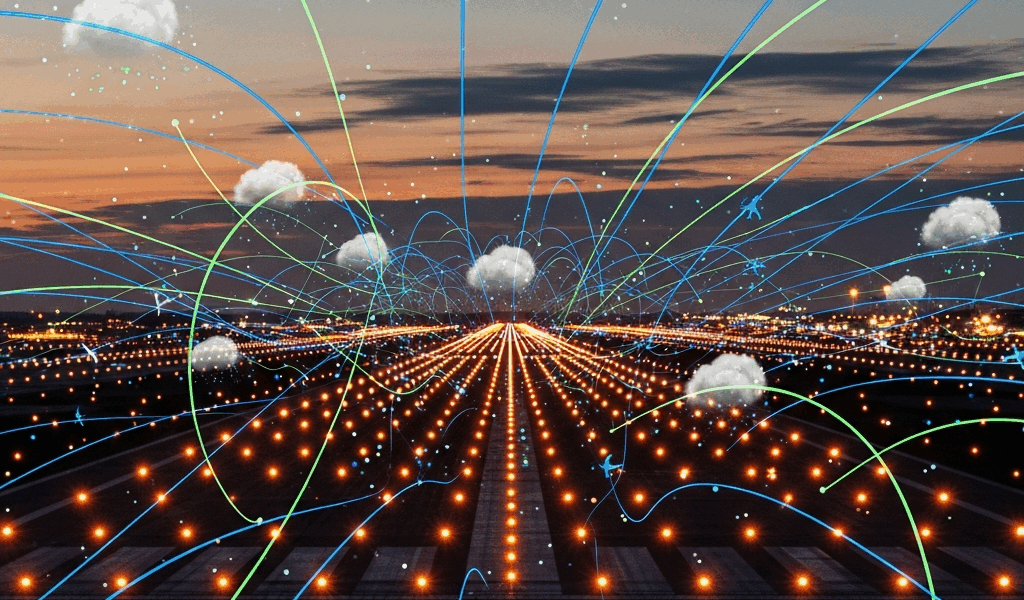
How AI Predicts Flight Delays Before They Happen
Flight delay prediction has gotten complicated with all the competing apps, airline systems, and half-baked explainers flying around. As someone who’s spent seven years in aviation data science, I learned everything there is to know about why planes land late — and more importantly, how algorithms see it coming before anyone at the gate has a clue. People expect some sci-fi answer when they ask me about this. Mystical black-box magic. The reality is messier, more human, and honestly far more interesting than that.
But what is AI flight delay prediction? In essence, it’s pattern recognition applied to an ocean of operational data. But it’s much more than that. A flight delay isn’t random chaos — it’s the mathematical outcome of dozens of variables colliding simultaneously. Weather systems move on trackable paths. Crews follow regulated schedules. Planes carry maintenance histories. Airports hit capacity walls. Feed all of that into the right model and you’re seeing delays three, four, sometimes eight hours before a single passenger notices their departure board has changed.
The Data That Predicts Your Delay — Why It Works
Walk into any airline operations center at 4 AM and you’ll find something resembling a stock exchange floor — except everyone moves slower and there’s a genuinely obscene amount of coffee. Screens everywhere. Weather maps, runway configurations, crew positions, aircraft locations, fuel levels, maintenance schedules, passenger loads stacked against gate assignments. Each major airline collects somewhere between 100 and 300 operational variables every single minute. That’s not hyperbole. That’s Tuesday.
Weather Patterns and Their Predictive Power
Weather is still the single largest cause of flight delays in the US — roughly 29% of all delays, according to FAA data I’ve reviewed personally. But here’s what most people miss entirely: the weather your flight encounters isn’t determined by when you depart. It’s determined by where that weather system will be sitting when your aircraft actually flies through that airspace.
Delta’s prediction model pulls simultaneously from the National Weather Service, the Aviation Weather Center, and three separate commercial weather providers. They’re not just tracking rain. They’re measuring wind shear potential, lightning probability at specific altitudes, crosswind components on individual runways, ceiling and visibility conditions — and something called PIREPs, pilot reports of actual in-flight conditions radioed in from planes already airborne.
Don’t make my mistake. Early in my career I assumed historical weather data mattered most. It doesn’t. Forecasted weather is what matters. A model that only looks backward misses the entire point — you need to know that a thunderstorm system will park itself over Memphis International during your connecting flight’s scheduled arrival window, not that it rained there yesterday afternoon.
Aircraft Routing and Network Complexity
Your 2 PM flight from Denver to Chicago doesn’t exist in isolation. That particular Airbus A320 may have already flown six legs that day. If the 6 AM Boston-to-Denver departure ran 40 minutes late due to a mechanical inspection, your aircraft arrives behind schedule before it’s even your turn. Add a 90-minute turnaround requirement — catering takes 35 minutes, boarding takes 15, cleaning takes 20 — and you’re already 10 minutes over that window before anything else goes sideways.
United Airlines’ OOMDP system — Operations Optimization and Management Deployment Platform, though nobody actually uses that acronym because it’s nonsensical — models the entire daily network as one interconnected graph. One delay ripples forward. A plane stuck at Atlanta gate C12 waiting on ground handling becomes a crew scheduling crisis four hours later in Charlotte. The model sees that chain before it forms.
Crew Scheduling and Regulatory Constraints
Federal Aviation Regulations cap pilots at 8 flight hours within any 24-hour period, with mandatory rest between assignments. Cabin crew operate under slightly different rules. A crew member scheduled for a six-leg day — where the first flight departed 90 minutes behind schedule — might hit their maximum duty time before ever reaching the final destination. That’s a cascading crew shortage problem, and it compounds fast.
The models account for crew positioning down to the individual level: physical location, remaining duty hours, required rest windows, and which aircraft types each crew member is actually certified to operate. A 737-certified pilot can’t simply sub in for an A321 pilot on short notice. These constraints eliminate substitution options quickly — which is exactly why the models need to see them coming hours in advance, not 45 minutes before pushback.
Airport Congestion and Ground Delays
Denver International Airport handles roughly 55 aircraft movements per hour under ideal conditions. That’s theoretical capacity. Real capacity depends on active wind direction, which runways are open, ground vehicle traffic, and how efficiently gate agents are actually moving passengers through jetways. During afternoon storm cycles, that effective capacity drops to around 35 movements per hour — sometimes lower.
When an airport hits 85% of its capacity threshold, delay probability increases sharply. Modern AI models track real-time gate assignments, taxi queue lengths, and controller workload estimates. A flight scheduled to land at 3:47 PM during peak banking hour at a congested hub faces completely different delay odds than the same flight touching down at 3:52 PM after that peak has cleared. Five minutes of scheduled time — meaningfully different outcomes.
Aircraft Maintenance Status and Historical Reliability
Every commercial aircraft carries a detailed maintenance log. That Boeing 737 with tail number N27834 has logged 47,000+ flight hours. Last major inspection was January 2023. Hydraulic line replacement in June 2024. An air conditioning issue flagged in August, resolved same day. All of it feeds into reliability predictions.
Older aircraft — particularly those with recent maintenance events — carry measurably higher delay risk. Airlines don’t necessarily ground these planes outright. They schedule them on shorter routes and earlier slots, where delays carry fewer downstream consequences. A model that ignores aircraft-specific reliability history will systematically underestimate delay risk on certain tail numbers. That’s not a small error over a full network schedule.
How Airlines Like Delta Use AI for Delays — Real Systems at Scale
Frustrated by late arrivals destroying connection possibilities for thousands of passengers daily, Delta began investing heavily in predictive systems around 2012. Their APEX platform — Airline Proprietary Environment for eXchange — was originally designed around fuel optimization. They repurposed it for delay prediction once they realized the data infrastructure was essentially already built. The harder part turned out to be organizational, not technical.
Delta’s APEX System in Practice
I interviewed a Delta operations analyst in Atlanta last year — Tom, 18 years with the airline, works out of their main ops center on a rotating shift schedule. He walked me through exactly how this functions operationally. Six hours before departure, APEX ingests updated weather forecasts, current crew positions, live aircraft location data, and passenger load figures. Runs the prediction. The output isn’t a simple yes-or-no on delay status.
Instead, it produces a probability distribution. Flight 247, Atlanta to San Francisco, Tuesday in March — 8% chance of running 15+ minutes late, 4% chance of 30+ minutes, 2% chance of 60+. Given those probabilities, what operational moves actually make sense? Maybe they pre-position a buffer aircraft at Atlanta. Maybe they push scheduled departure back 15 minutes — passengers don’t love that, but arriving on time beats arriving late every single time from a satisfaction standpoint. Maybe they add catering staffing for a longer turnaround. Maybe they place a maintenance technician at the destination airport just in case.
Tom made a point I’ve heard echoed across every airline I’ve worked with: predictions only matter if operations actually responds to them. A perfect model that nobody uses is worth exactly nothing. Delta’s results came from wiring predictions directly into crew scheduling, maintenance planning, and catering dispatch — automated recommendations, not advisory memos that sit unread in an inbox somewhere.
United Airlines Operations Center Approach
United took a different architectural path. Rather than one centralized prediction engine, they built modular AI components that feed into their Operations Control Center decision workflow — separate models handling weather impact, crew optimization, aircraft routing, and passenger connection risk. Each runs independently. Outputs integrate into a single dispatch recommendation.
That’s what makes United’s approach endearing to us operations people — they measure things most airlines ignore. They explicitly model passenger connection time risk. If someone has 45 minutes between flights and the first leg runs 30 minutes late, that passenger almost certainly misses their connection. Most airlines don’t quantify that feedback loop. United does. A flight that’s operationally on-time but causes 600 connecting passengers to miss their next legs is, from any reasonable perspective, a catastrophic outcome. Their model reflects that priority, which changes what decisions get flagged and when.
American Airlines Real-Time Adjustments
American’s approach centers on continuous model updating rather than single-point predictions. They don’t just run predictions at dispatch. As a flight progresses — pushes back from the gate, climbs, cruises toward destination — the model updates. A flight that looked 22% likely to be delayed at the six-hour prediction window might read 67% probable two hours later once actual weather conditions appear on radar.
That real-time updating is operationally critical. It drives decisions on whether a subsequent connecting flight should hold at the gate for inbound passengers or depart without them. Those calls cascade through the entire network — which is why the accuracy of that updating model matters as much as the accuracy of the initial prediction.
Why Your Flight App Shows Different Predictions — The Data Access Problem
Probably should have opened with this section, honestly. This is where passengers get genuinely confused — staring at three different apps showing three different delay predictions for the same flight. FlightAware says on time. Your airline’s app shows a 22-minute delay. Google Flights says unknown. It’s not that they’re all broken. It’s that they’re pulling from fundamentally different data with fundamentally different methodologies.
FlightAware’s Real-Time Tracking Approach
FlightAware has access to ADS-B data — Automatic Dependent Surveillance-Broadcast — which every commercial aircraft broadcasts publicly. They know exactly where planes are right now, down to altitude and heading. They have historical records showing how often similar aircraft types are delayed on similar routes during similar conditions. What they don’t have is airline operational data — crew scheduling constraints, active maintenance issues, fuel planning decisions, gate staffing levels.
FlightAware’s delay predictions run on pattern matching. When a Boeing 737 flies Denver to Dallas in March with current wind conditions, what was the historical on-time rate? They layer in current FAA ground stop data and basic weather radar. The results are reasonable — probably 65-75% accurate for predictions four-plus hours out — but they’re working with a fundamentally incomplete picture of what’s actually happening inside the airline’s operations center.
Google Flights and Third-Party Integration
Google holds relationships with certain airlines providing proprietary data feeds — not all airlines, and not complete operational data. They incorporate FlightAware tracking alongside their own historical database. The predictions are generally better than FlightAware alone, worse than what airlines see internally. They lack complete operational visibility, which creates a ceiling on how accurate their predictions can realistically get.
Google Flights’ predictions improve noticeably within 24 hours of departure because more operational decisions have solidified by that point. Crew assignments are firmer. Aircraft routing is locked. Gate assignments are confirmed. A five-day-out prediction carries enormous uncertainty compared to the same flight four hours before scheduled departure.
Airline App Predictions Using Complete Data
Your airline’s official app theoretically draws from internal systems with complete data access — actual crew positions, actual aircraft maintenance status, actual passenger loads, actual weather briefings from the ops center, actual gate assignments and ground staffing levels. In theory, that’s a 10-15% accuracy advantage over third-party predictions working only with public data.
In practice — and this part frustrates me — many airlines still surface basic information in their public-facing apps without sophisticated prediction models behind it. The advanced models stay internal. The reason is partly competitive, partly psychological: airlines have found that showing passengers a 31% chance of delay creates anxiety and complaints even when the flight ultimately operates on time. So the detailed probability distributions stay on the operations side, and passengers get a sanitized version.
The honest truth: airline app predictions vary wildly. Some airlines run sophisticated models. Some use rules-based systems that are nearly two decades old. Some just reference historical route averages without real-time adjustment — which is honestly not much better than looking up the route’s Wikipedia page and guessing.
Why the Discrepancies Matter Operationally
For passengers, mismatched predictions create confusion and misplaced planning. For operations professionals, they create genuine information gaps with real consequences. A crew member checking FlightAware sees a flight showing on-time status — while the airline’s internal system is already flagging a 58% delay probability and repositioning backup crews. Two people making separate decisions from opposite ends of the same information problem.
The gap narrows as departure approaches. By two hours before takeoff, most predictions converge because the major operational uncertainties have resolved — crew is confirmed, aircraft is on the ground, weather is visible on radar. But in that six-to-twelve hour window where predictions diverge most dramatically, the difference between acting on accurate internal data and incomplete public data can mean thousands of passengers either making their connections or sleeping on airport benches overnight.



Stay in the loop
Get the latest aviate ai updates delivered to your inbox.