“`html
The Compass Card Lag Problem During Banks
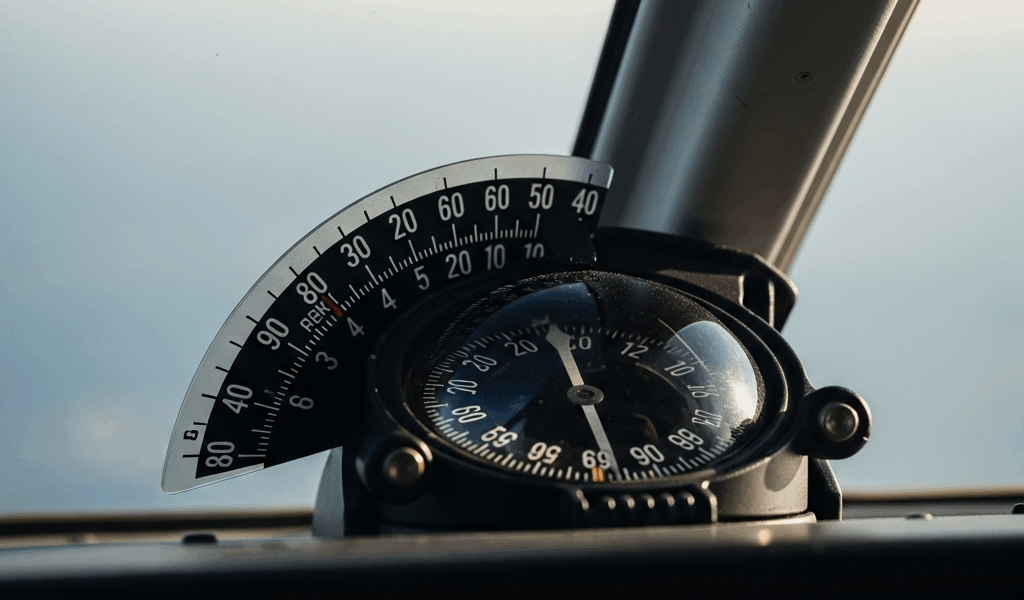
Magnetic compass errors during steep turns have gotten complicated with all the misinformation flying around. I’ve watched pilots struggle with this more times than I can count, and honestly, the problem isn’t usually pilot error—it’s physics. Specifically, it’s the compass card itself fighting against the forces your airplane is creating.
Here’s what’s happening: your magnetic compass relies on a freely suspended card that wants to align with Earth’s magnetic field. That sounds simple until you bank your aircraft hard. The card doesn’t instantly rotate to match your new heading. Instead, it lags — and in shallow turns, you can live with it. But anything beyond 15 degrees of bank? The lag becomes dramatic. You’re looking at 20, 30, even 40 degrees of error in some cases.
The culprit is precession and magnetic dip angle working against each other. When you bank steeply, the vertical component of Earth’s magnetic field becomes significant. Imagine filling a compass bowl with liquid and then tilting it — the liquid sloshes around. Your compass card does the same thing, except the “sloshing” is magnetic energy trying to settle into a stable orientation that your banking aircraft keeps disrupting.
Northerly turning errors are the worst offenders. You’re executing a turn in the Northern Hemisphere, banking north — your compass will initially show you turning faster than you actually are. Banking south? The opposite happens. The compass lags behind your actual turn rate. This asymmetry exists because of how Earth’s magnetic field dips beneath the surface as you move toward the poles. At my home airport in Colorado (about 40 degrees north latitude), that dip angle sits around 65 degrees. Near the equator? Almost zero. Near the poles? Nearly vertical.
Why Your Compass Lags 20–30 Degrees in a Turn
Steepening the bank reveals the real problem with magnetic compass design — and it’s not what most pilots think.
When you initiate a turn, your aircraft accelerates through the horizontal plane while also tilting that vertical magnetic component. The compass card, suspended in dampening fluid, can’t keep up. The fluid’s viscosity prevents instant alignment — this is actually intentional damping to eliminate wild oscillations. But during steep turns, that damping becomes a liability. The card swings lazily behind your actual heading change.
Here’s the specific sequence: you roll into a 30-degree bank heading north. Your actual heading changes immediately. Your compass card? Still pointing northwest. The magnetic field’s vertical component — the dip angle — is now tilting relative to your aircraft’s orientation. This creates a turning error that peaks somewhere between 20 and 30 degrees, depending on latitude and turn rate. Banking south produces the opposite effect: the card initially lags, then appears to catch up faster than reality.
I made a navigation error exactly once because I trusted my compass during a steep turn without cross-referencing my instruments. Over Colorado, executing a practice approach in a Cessna 172, I was banking 25 degrees to intercept a heading. My compass showed I was already there. I wasn’t — actually 15 degrees off. Lost 3 minutes of approach time correcting it. Don’t make my mistake.
Acceleration compounds the problem. As you roll into the turn, your airspeed vector changes. This is separate from the magnetic dip issue but works in parallel. Your compass card’s inertia means it moves sluggishly through the first 10 seconds of the turn. Only after the turn stabilizes does the card settle into something resembling accuracy.
Latitude matters enormously. Near the equator, that vertical dip component is minimal — turning errors shrink. At 60 degrees north (Alaska, northern Canada), the dip angle approaches 75 degrees. Your compass errors intensify. Check your local magnetic variation charts — they often include dip angle information. Knowing the number helps you anticipate how badly your compass will behave in steep turns at your location.
How to Read Compass Corrections Mid-Maneuver
Stop waiting for the compass to settle. Use it differently instead — and your approach vectors will improve immediately.
The 60-degree turn rule is your primary tool. During any turn steeper than 15 degrees of bank, don’t trust the compass until you’ve completed 60 degrees of actual heading change. Starting a turn from north (360 degrees) to east (90 degrees)? Wait until your heading indicator confirms you’re at approximately 030 degrees before glancing at the compass. By then, the card has caught up enough to be useful.
Your heading indicator is the instrument to trust during the turn itself. Unlike the compass, it’s gyro-stabilized and doesn’t care about magnetic dip or acceleration effects. Reference it constantly. Cross-check your compass only after the turn stabilizes — at least if you want reliable approach guidance.
Here’s the practical sequence I use every time: (1) Establish desired bank angle and note your heading indicator. (2) Ignore the compass card’s wild swinging — don’t even look at it for the first 10 seconds. (3) At 60 degrees of turn, glance at the compass. It should be approaching your target heading. (4) Complete the turn to your heading indicator’s target. (5) Roll wings level and give the compass another 5 seconds to settle. Only then should it precisely match your heading indicator and the runway alignment (if you’re on approach).
For approach vectors, this matters critically. You’re cleared to intercept a localizer on heading 210 degrees. Your heading indicator shows 210. Your compass, if you’re in a 25-degree bank during the intercept, might show 195 or 225 — that’s the lagging working against you. Trust the heading indicator. The compass is lagging. Once you stabilize at 210 degrees with wings level, the compass will align within 2–3 degrees.
Practice this on your next dual flight with an instructor present. Intentionally enter steep turns while watching both instruments. Watch the compass lag. Time it. See how long it takes to catch up. This visceral understanding beats any amount of reading — probably should have suggested this first, honestly.
When Compass Errors Signal a Real Problem
Not every compass error is magnetic dip and precession. Sometimes your compass is actually broken — and the distinction matters because flying with a failed compass isn’t safe.
But flying while attributing normal lag to instrument failure is equally unsafe because you’ll lose trust in a perfectly functional instrument.
Normal magnetic dip errors show specific patterns: they appear only during turns (especially steep ones), they correlate with latitude, and they resolve once you level the wings. Actual instrument problems reveal different signatures.
Check these on your next preflight: (1) Bubble position. The compass card is sealed in fluid. A visible air bubble is normal — a large one (bigger than a pea) or a bubble that moves around rapidly suggests the seal is compromised. This causes sluggish card movement and exaggerates normal lag. (2) Card movement smoothness. Tap the instrument gently. The card should swing freely and settle within 5–10 seconds. If it sticks or binds, the card is warped or bearings are worn. (3) Card markings. Severe discoloration, peeling numerals, or a card that doesn’t rotate smoothly in its housing all indicate maintenance is overdue.
The variance card — that small plate showing magnetic declination corrections — is often ignored. Check that your aircraft’s variance card matches your current location. An outdated card showing 12 degrees west when your actual declination is 8 degrees west will introduce constant error, not just during turns. This won’t explain steep-turn lag, but it will explain why you’re consistently off heading even after turns stabilize.
If your compass shows 30 degrees of error at level flight on a heading you know is correct (visually referenced), that’s not lag — that’s deviation. Proceed to maintenance. Lag only appears during dynamic maneuvers. Level-flight error is permanent malfunction.
Testing Compass Accuracy on Your Next Preflight
Ground procedures prevent mid-flight surprises during turns — and they’re straightforward.
Swinging the compass is the formal process. You’ll drive your aircraft (towed by tug, moving under its own power, or positioned on the ramp) through eight cardinal and intercardinal headings while noting compass readings against magnetic variation. Compare each reading to what your heading indicator shows. Differences of more than 10 degrees warrant maintenance. This catches actual deviation — permanent magnetic distortion from avionics, wiring, or structural damage — before you fly.
For a quick preflight check without formal swinging, use landmark alignment. Park your aircraft on a known magnetic heading. Align the fuselage with a distant landmark — a building, power line, road direction — that you’ve verified as a specific magnetic heading using an airport diagram or sectional chart. Your compass should read within 5 degrees of that heading. Repeat on opposite headings (reverse direction). Consistent errors larger than 5 degrees mean the compass needs service.
Compare compass readings to your heading indicator at several headings during taxi, before flight. They won’t match exactly — that’s normal. But they should be within 3–5 degrees at level flight. If they differ by 15 degrees while parked, your compass has real problems unrelated to turning lag.
Knowing your compass’s baseline behavior before you fly prevents misdiagnosis during steep turns. You’ll recognize normal lag instantly. You’ll trust your instruments again — and your approaches will improve immediately.
“`



Stay in the loop
Get the latest aviate ai updates delivered to your inbox.