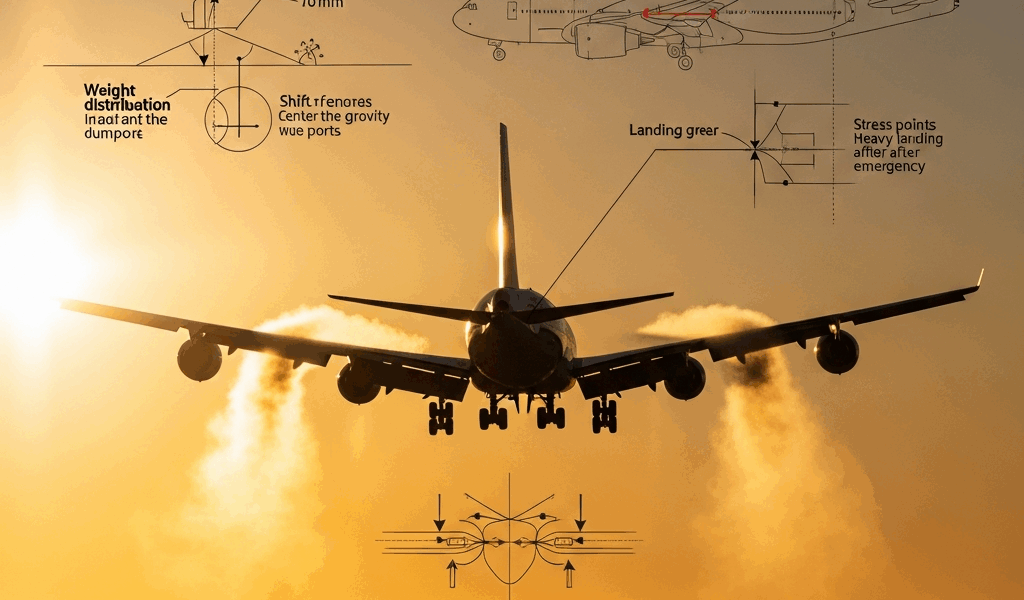
Most Planes Can’t Actually Dump Fuel — And That’s More Interesting Than It Sounds
Fuel dumping has gotten complicated with all the misinformation flying around. I used to assume every commercial jet had this capability — heard a pilot announce a fuel dump once during a diverted flight and figured it was standard equipment across the board. It isn’t. Not even close.
Most commercial aircraft can’t dump fuel at all. The planes you actually fly on — your 737s, your A320s — have no dump system whatsoever. Only the big, long-haul heavies carry that hardware. The Boeing 747. The Airbus A380. Military transports like the C-17. That’s roughly the list. The A320 family, which moves more passengers daily than any other jet in existence, has zero dump capability built in. Engineers simply never included it, because the operating profile of those aircraft never demanded it.
That creates an obvious puzzle. Emergencies happen. Fuel is heavy. What does a 737 crew do when they’re loaded up and need to land right now? The answer tells you more about how aircraft are actually designed than almost anything else in aviation.
Why Landing Too Heavy Is a Genuine Problem
Every aircraft carries two distinct weight limits — maximum takeoff weight and maximum landing weight. They are not the same number. That gap is the entire reason fuel dumping exists as a concept.
Take the 747. Maximum takeoff weight runs around 412,775 kg. Maximum landing weight? Only 317,515 kg. That’s roughly 95,000 kg of difference — call it 127,000 liters of fuel worth of margin. The A380 is even more dramatic: 575,000 kg at takeoff versus 391,000 kg for landing. Those aren’t arbitrary numbers someone picked. They reflect what the airframe, landing gear, and wing roots can actually absorb during touchdown.
Landing hits hard. Vertical stress slams into the gear. Wing roots take horizontal buffeting during rollout. The fuselage flexes. All of it happens inside maybe three seconds. A plane coming down significantly heavier than its design limit risks gear collapse, fractured wing attachment points, or worse — not dramatically, not all at once, but structurally, in ways that may not be visible until inspection.
The gear struts absorb energy through hydraulic compression. Overload them and they bottom out before doing their job properly. Tires rated for specific loads overheat. Brakes hit extreme temperatures on long rollouts — even more extreme if the aircraft weighs more than designed. This isn’t theoretical. Heavy landings have produced cracked frames, compromised fasteners, stress fractures in wing skins. Sometimes repairs are possible. Sometimes the damage just ends the aircraft’s life early.
How the Dump System Actually Works
Probably should have opened with this section, honestly — because understanding how simple the system is explains immediately why smaller aircraft skip it entirely.
The dump chutes sit on the trailing edges of both wings, typically near the winglets or just inboard. Small openings, maybe 15 to 20 centimeters across. A valve, controlled from the flight deck. When the crew activates it, fuel draws from the main wing tanks and sprays out at somewhere between 1,000 and 3,000 gallons per minute depending on which aircraft you’re flying.
Altitude matters — a lot. Below roughly 6,000 feet, fuel droplets don’t atomize properly. They fall as streams. Above that threshold, warmer and lower-density air vaporizes the droplets before they reach ground level. So crews request a holding pattern, circle above an ocean or unpopulated area, and wait while the weight bleeds down to MLW. ATC clears the airspace underneath. The crew watches the fuel gauges and stops the dump when the numbers look right. Modern systems include automatic shutoffs that trigger at the target landing weight.
For a 747 with 100,000 liters to lose, that process takes 30 to 45 minutes at maximum dump rate. That’s the catch. If the emergency demands landing in ten minutes — an engine fire, hydraulic failure, someone going into cardiac arrest in seat 34C — there isn’t time to dump. They land heavy and deal with the consequences later.
When Pilots Skip the Dump and Land Heavy Anyway
Faced with a serious in-flight emergency, flight crews do the math fast. The math is usually simple.
They land heavy.
And the aircraft survives — because engineers built in more margin than the published numbers suggest. A 747 touching down 20,000 kilograms over MLW generates serious stress. The gear compresses harder than designed. The tires and brakes work overtime. The fuselage bends more than intended. But the plane lands, and usually everyone walks off.
What follows is mandatory inspection. Every fastener near the gear attach points. Every rivet, every weld. X-rays and ultrasound imaging looking for cracks that won’t show up visually. Sometimes the aircraft comes back after repairs — expensive ones, but manageable. Sometimes the damage calculation tips the other direction, especially on older airframes where repair costs exceed the remaining value of the plane. A single heavy landing can run an airline several hundred thousand dollars by the time inspection, repair, and downtime are factored in.
That’s the real trade. Spend 30 minutes dumping fuel and protect the structure. Or land immediately, protect the life, and absorb whatever the inspection finds afterward. Most crews, faced with a genuine emergency, make the second call without hesitation.
What Actually Happens to Fuel Dumped at Altitude
The environmental question is fair. Worth taking seriously.
At proper altitude — 6,000 feet and above — jet fuel atomizes into droplets small enough to evaporate before reaching the ground. Jet A-1 has a flash point around 38°C and vaporizes readily in ambient air, more so at altitude where pressure drops and evaporation accelerates. The fuel doesn’t pool somewhere. It disperses. That’s the physics, and it checks out.
But procedure matters. In January 2020, a Delta flight out of Los Angeles dumped fuel during an engine failure shortly after takeoff. The crew didn’t maintain proper dump altitude. Fuel fell on schoolyards in Long Beach. Children reported respiratory irritation. Lawsuits followed. The FAA investigated. What they found was that the landing decision itself was correct — the emergency was real — but the crew failed to follow dump protocol with sufficient precision. That distinction is important.
The system is safe when executed correctly. That 2020 incident wasn’t proof that fuel dumping is dangerous — it was proof that altitude discipline is non-negotiable. Done right, at the right height, with ATC managing the airspace below, dumped fuel never touches the ground. Done sloppily, it does. The difference is about 4,000 feet and a checklist followed all the way through.
Most commercial flights never dump a drop. Most aircraft can’t. But when physics, emergencies, and aircraft design all converge at once, the crews with that option use it carefully — and the ones without it land heavy, accept the inspection bill, and get on with it.



Stay in the loop
Get the latest aviate ai updates delivered to your inbox.