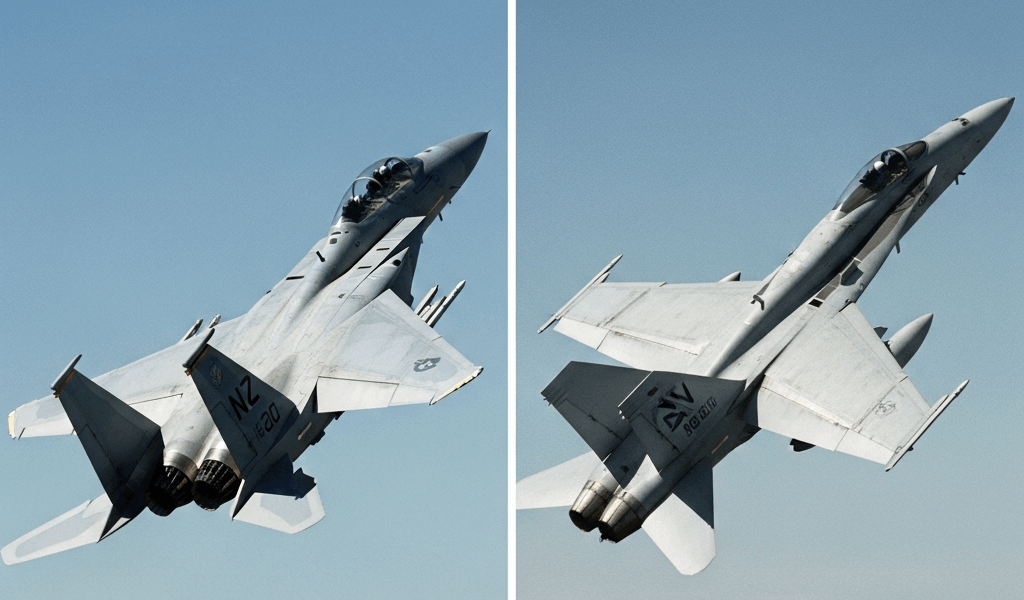
F-15 vs F-18 — How Two Legendary Fighters Compare
The F-15 vs F-18 debate has gotten complicated with all the forum arguments, armchair generals, and recycled Wikipedia summaries flying around. I’ve spent years covering military aviation — airshows, interviews with active-duty pilots, technical manuals that would genuinely put most people to sleep — and these two jets still spark arguments at every level. Pentagon budget meetings. Bar conversations between retired naval aviators and Air Force veterans who’ve had a few too many. Both aircraft are iconic. Both are lethal. And they are fundamentally, almost philosophically, different machines built to solve completely different problems. That’s what most comparison pieces miss entirely.
What I want to do here is give you an honest, current, side-by-side look at both platforms — not the forum-debate version, not the sanitized summary, but the real operational context that explains why the U.S. military still buys both jets heading into 2025. If you want the pilot’s perspective on what it actually felt like to fly the F-4 and lead fighter missions, Fighter Pilot by Robin Olds is the book that started the modern combat aviation memoir genre. Design philosophy, hard performance numbers from the latest variants, production status, and which platform actually wins in specific mission scenarios. Let’s get into it.
This article includes affiliate links. We may earn a commission at no extra cost to you.
F-15 vs F-18 — Core Design Philosophy
Start here. Everything else flows from this. Probably should have opened with this section, honestly — the performance numbers mean almost nothing without understanding what each aircraft was originally built to do.
The F-15 Eagle was born from a very specific, very painful lesson. During Vietnam, American pilots flying F-4 Phantoms posted kill ratios far worse than planners had projected. The culprit was partly doctrine — American fighters had been designed around the assumption that missile technology had rendered dogfighting obsolete. The Phantom didn’t even carry a gun in its original configuration. That assumption turned out to be catastrophically wrong, and pilots paid for it. The Air Force responded by issuing a requirement in the late 1960s for a dedicated air superiority fighter. Not a multirole platform. Not a naval aircraft. A pure air-to-air killing machine.
McDonnell Douglas won that contract, and the F-15 Eagle flew for the first time in 1972. The design philosophy was explicit — brutally so: no pound for air-to-ground capability shall be traded for air-to-air performance. The F-15 was built around a thrust-to-weight ratio exceeding 1:1, meaning it can accelerate while climbing vertically. That’s not marketing language. The jet can point its nose straight up and still gain speed. Twin Pratt & Whitney F100 engines, a massive wing area, and a relatively lightweight airframe all served one purpose: destroy any other aircraft in a turning fight or a straight-line sprint.
The F/A-18 Hornet came from an entirely different set of problems. The Navy needed a carrier-based aircraft capable of replacing both the F-14 Tomcat in the air-to-air role and the A-7 Corsair II in the strike role — and do it from a carrier deck. That’s a brutal design constraint. Carrier operations impose requirements that land-based aircraft never face: folding wings, reinforced landing gear, arrestor hook systems, saltwater corrosion resistance, and the ability to survive what amounts to a controlled crash landing at roughly 145 knots approach speed. Every one of those requirements adds weight.
Weight is the enemy of performance. The F/A-18 accepted that tradeoff consciously. What emerged was a genuinely capable multirole aircraft — the “F/A” designation literally means Fighter/Attack — that could hold its own in air-to-air combat, deliver precision ordnance against ground targets, then trap on a carrier deck afterward. Incredible engineering, honestly. But it was never going to out-climb or out-accelerate a jet that never had to worry about any of that.
This fundamental split — pure air superiority versus carrier-capable multirole — shapes every comparison that follows. Keep it in mind.
Performance Numbers That Actually Matter
Raw specs can mislead. A brochure number is not a combat number. Still, the baseline performance figures tell a real story — especially when you look at the current production variants: the F-15EX Eagle II and the F/A-18E/F Super Hornet.
Speed and Ceiling
The F-15EX has a maximum speed of approximately Mach 2.5 — roughly 1,650 mph at altitude. Service ceiling sits at 65,000 feet. Those are extraordinary numbers by any measure, reflecting a design that prioritizes energy management above everything else. Boeing’s F-15EX refinement maintains that baseline from the original F-15A while adding modern avionics, an open-mission systems architecture, and the ability to carry up to 22 air-to-air missiles simultaneously. Twenty-two. Sit with that number for a second.
The F/A-18E/F Super Hornet — which is a substantially larger and more capable aircraft than the original Hornet variants, not merely an upgrade — tops out around Mach 1.8, approximately 1,190 mph. Service ceiling runs around 50,000 feet. Both figures are meaningfully lower than the Eagle’s. The Super Hornet’s designers accepted that deficit deliberately, trading raw performance for multirole versatility and carrier compatibility.
Range and Payload
Here’s where the comparison gets more interesting. The F-15EX has a combat radius of roughly 1,061 nautical miles in a clean ferry configuration. Add conformal fuel tanks — essentially external fuel structures that conform to the fuselage shape, reducing drag compared to traditional drop tanks — and it extends further. The CFTs on the F-15EX are baked into the baseline design, holding approximately 750 gallons of additional fuel each.
The F/A-18E/F Super Hornet manages a combat radius of around 450 nautical miles in a typical strike configuration, varying significantly with payload and mission profile. The Navy has consistently struggled with the Super Hornet’s range — it’s shorter than the F-14 it replaced, and that’s been a point of real operational friction, particularly in anti-access environments where carriers get pushed further from their targets.
Payload capacity is similarly lopsided. The F-15EX can carry up to 29,500 pounds of ordnance across 23 hardpoints. The Super Hornet manages approximately 17,750 pounds across 11 hardpoints. The Eagle wins decisively on raw payload — which is a big part of why the Air Force leans on the F-15 platform for long-range strike missions requiring heavy precision munitions.
Thrust-to-Weight and Maneuverability
Clean, the F-15EX posts a thrust-to-weight ratio of approximately 1.07:1 with full fuel — running either General Electric F110 engines or Pratt & Whitney F100-PW-229s depending on configuration. The Super Hornet, in a representative combat loadout, comes in around 0.93:1. Below 1.0 means the aircraft cannot accelerate in a vertical climb. Above 1.0 means it can. That gap matters in within-visual-range combat — the F-15’s energy advantage is real and measurable.
Where the Super Hornet partially compensates is through its LERX — Leading Edge Root Extensions — which generate powerful vortices that dramatically improve lift at high angles of attack. The Super Hornet can sustain flight at extreme nose-high attitudes that would leave other aircraft unable to generate meaningful lift. At slow speeds in a close turning fight, it’s genuinely competitive. Just don’t get into a climbing energy fight with an Eagle. That’s a losing proposition.
Avionics — The Modern Picture
Both aircraft have received substantial avionics upgrades that partially close the raw performance gap. The F-15EX features the Eagle Passive/Active Warning and Survivability System (EPAWSS), a new AN/APG-82(V)1 AESA radar, digital fly-by-wire flight controls replacing the original analog system, and a cockpit rebuilt around modern large-area displays. Boeing’s open-mission systems architecture means software updates deploy more like a smartphone OS refresh than a traditional military software cycle — a bigger operational deal than it sounds.
The F/A-18E/F has been modernized under the Block III Super Hornet program. Block III aircraft feature the AN/APG-79(V)4 AESA radar, an Advanced Cockpit System with a 10-by-19-inch touchscreen display replacing the legacy setup, Distributed Targeting Processor — Networked (DTP-N), and an enhanced network interface for integration with F-35s and other networked platforms. Block III also adds a conformal fuel tank option that addresses some — not all — of the range concerns.
Both jets are meaningfully more capable than their 1990s selves. Neither is an F-35. But both are formidable — and that matters for what comes next.
Which One Is Still in Production and Why
Production status isn’t trivia. It determines whether an airframe has a real future, whether spare parts pipelines stay healthy, whether the industrial base supporting it survives, and whether allied nations buying the same platform create genuine interoperability.
The F-15EX is in active production. Boeing delivered the first F-15EX to the Air Force in March 2021 at Eglin Air Force Base, Florida — eight aircraft in the initial contract, with authorization to procure up to 144 F-15EXs to replace aging F-15C/D models across the National Guard and active-duty inventory. As of 2024, production is ongoing at Boeing’s St. Louis facility, with deliveries continuing on a multi-year procurement schedule. Export interest remains strong — Qatar, Singapore, and Saudi Arabia all operate F-15 family variants, keeping the international order book active.
As someone who spent time digging into Boeing’s St. Louis manufacturing operation, I learned everything there is to know about why that production line matters. But what is a military production line, really? In essence, it’s a combination of specialized tooling, trained workforce, and supplier relationships built over decades. But it’s much more than that — once it closes, restoring it costs billions and takes years. The Air Force knows this. It’s a significant part of why F-15EX procurement exists alongside F-35 purchases rather than being replaced by them outright.
The F/A-18E/F Super Hornet situation is more complicated. Boeing delivered its final Super Hornet to the U.S. Navy in 2024, closing out a production run stretching back to 1995. The line is done for American military customers. Foreign military sales discussions continue, but honestly, the prospect of any allied nation’s procurement justifying keeping the line warm at scale looks increasingly unlikely.
This is a significant strategic point. The Navy is transitioning F/A-18 squadrons toward the F-35C — the carrier-capable Joint Strike Fighter variant. The Super Hornet isn’t disappearing immediately; the Navy expects to operate the platform through at least 2040 with service life extension programs. But it’s in managed decline rather than growth. New production isn’t happening for American customers. Spare parts pipelines will eventually thin. That’s not pessimism — it’s basic industrial logic.
The F-15EX, by contrast, is actively growing. A jet being built today gets engineering attention that a jet in managed decline simply does not. Worth noting: this production divergence wasn’t inevitable. For a while, both programs faced sustained pressure from F-35 advocates arguing fifth-generation aircraft should replace everything. The Air Force and Navy both pushed back — correctly — on the grounds that the F-35’s cost per flight hour makes it impractical for every mission type. Sometimes you need affordable hours. Sometimes you need range and payload. Sometimes the F-35’s stealth is genuine overkill for the tasking at hand.
Which Fighter Wins in Different Scenarios
This is the section where I want to resist crowning a single winner. That framing is wrong. These aircraft were built for different problems, and the right question is always: which one wins for this specific mission?
Pure Air-to-Air Combat
Give the edge to the F-15EX. Not a close call in most scenarios.
The Eagle’s combination of raw speed, ceiling, energy management, massive missile capacity — up to 22 AIM-120 AMRAAMs in maximum configuration — and AESA radar makes it one of the most formidable beyond-visual-range fighters operating anywhere. The F-15 has a combat record of 104 aerial kills and zero losses. Zero. That’s not a cherry-picked statistic — that’s the entire operational history of the aircraft across multiple air forces and multiple conflicts.
At within-visual-range distances, the Super Hornet is more competitive than the raw performance numbers suggest. Its high-AOA capability and the AIM-9X Sidewinder’s off-boresight engagement envelope mean a trained Super Hornet pilot isn’t helpless in a close fight. But in the engagement geometry that actually determines air superiority outcomes — controlling altitude, energy, and engagement range — the F-15EX holds structural advantages that are genuinely difficult to overcome.
Strike Missions — Land-Based
For deep strike into contested territory from land bases, the F-15EX wins again. Its range advantage is simply too significant to argue around. A combat radius approaching 1,000 nautical miles with conformal tanks means the F-15E Strike Eagle lineage — which the EX directly inherits — can hit targets the Super Hornet cannot reach without tanker support.
The F-15E Strike Eagle has proven itself in this role repeatedly: Desert Storm, Allied Force, Afghanistan, Iraq. The Strike Eagle variant carries the LANTIRN targeting pod, later the Sniper XR pod (AN/AAQ-33), and can deliver the full spectrum of precision-guided munitions — including the GBU-28 “bunker buster,” a 4,400-pound penetrating bomb that fits exactly one aircraft in the American inventory. That aircraft is not the Super Hornet.
Carrier Operations
The F-15 cannot land on a carrier. Full stop. Not a criticism — it was never designed to. The Super Hornet wins this category by default and by design.
Carrier aviation is its own world, and the Super Hornet excels within it. Projecting power from international waters without relying on basing rights in friendly nations is strategically irreplaceable. During crises when land bases are politically unavailable — operations in the Persian Gulf when regional partners are reluctant to grant overflight, or a Taiwan scenario where Pacific island bases face active threat — carrier aviation matters enormously. The Super Hornet’s entire existence is justified by that reality.
That’s what makes the Super Hornet endearing to naval aviators who’ve operated it. Within carrier aviation, the platform also serves in the electronic attack role — the EA-18G Growler is a dedicated electronic warfare variant of the F/A-18F, and it’s the only carrier-based electronic attack aircraft in the world. The Growler suppresses enemy air defenses, jams radar systems, and fires the AGM-88 HARM anti-radiation missile. No equivalent exists on the F-15 side.
Cost Per Flight Hour and Training Value
Don’t make my mistake — early in my career I dismissed cost-per-flight-hour as a bean-counter concern rather than an operational one. It isn’t. Sustainably affordable flight hours determine how many hours pilots actually log, which determines how skilled they become, which ultimately determines combat outcomes. This matters more than most people want to admit.
The F/A-18E/F Super Hornet’s cost per flight hour runs approximately $24,000 to $27,000 depending on the source and year of the estimate. The F-15EX runs around $27,000. The F-35A, for comparison, has been cited at figures ranging from $33,000 to over $40,000 depending on fleet size and fiscal year. On a per-hour basis, both legacy platforms are cheaper than the F-35 — a genuine operational consideration for training and non-critical tasking where stealth provides no advantage worth paying for.
For adversary training — giving friendly pilots realistic practice against capable opponents — both aircraft serve well, and both appear in aggressor squadron configurations in various forms. The Super Hornet’s high-AOA characteristics make it particularly useful for simulating certain threat aircraft behaviors that pilots are likely to encounter in a real contingency.




Stay in the loop
Get the latest aviate ai updates delivered to your inbox.