Why Flight Crews Ignore Weather Radar Warnings During Descent
I’ve spent the better part of eight years around flight crews — in simulators, in crew lounges, and in actual cockpits as an observer — and I can tell you this much: ignoring weather radar warnings during descent isn’t usually negligence. It’s a rational response to competing demands that peak exactly when the radar matters most. The real question cuts deeper than “pilots aren’t paying attention.” It’s about workload, procedural tunnel vision, and that uncomfortable gap between what the technology can see and what the crew can safely act on.
Probably should have opened with this section, honestly. The descent phase is the only time pilots absolutely have to be descending, so they descend even when the weather radar is screaming.
Why Radar Warnings Feel Like Noise During Descent
Alert fatigue is real. A Boeing 777 captain I flew with — she had about 12,000 hours — told me she gets between 60 and 90 system alerts on a typical transatlantic flight. Engine bleed valve drift. Cabin pressure variance. Fuel flowmeter disagree. None of them require immediate action. By the time descent starts — usually 30 to 45 minutes before landing — the crew has already heard dozens of chimes, bells, and synthetic voices.
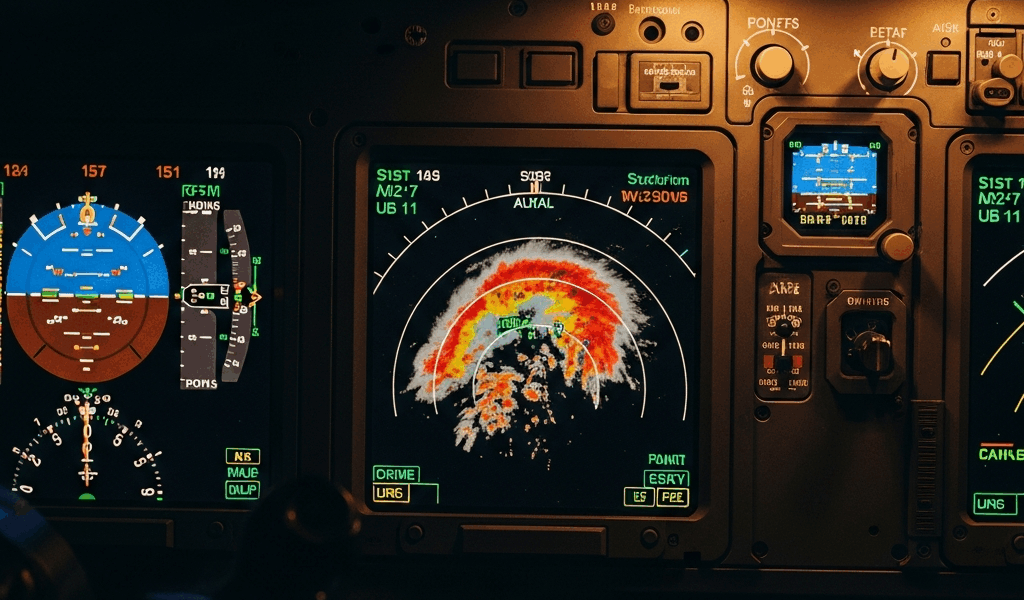
Then the weather radar pings. Yellow. Amber. Red. The brain does rapid triage: Is it blocking the arrival airport? Is it on the current descent path, or three nautical miles to the right? How much time do we have? Can ATC vector around it? This triage happens in a workload environment that resembles a controlled emergency.
During descent, a pilot is managing:
- Descent checklist (landing gear, flaps, pressurization, anti-ice)
- ATC frequency changes (approach, tower, ground)
- Speed transitions (FL350 to FL100 is aggressive descent planning)
- Fuel calculations and approach briefing confirmation
- Traffic separation on final approach (the radar shows other aircraft, not just weather)
- Automation mode selections (vertical speed, flight level change, approach mode)
- Terrain awareness and landing system callouts
A first officer at a major US carrier once told me during a training debrief: “The weather radar isn’t the priority when I’m configuring the airplane for landing. ATC is. The approach briefing is. My captain’s orders are.” That wasn’t recklessness. That was rank-ordering of cognitive load.
The descent checklist itself — found in every airline’s operations manual — doesn’t mention “evaluate weather radar.” It says “descent checklist, complete.” Radar monitoring lives in the “as-needed” category, wedged between mandatory items and traffic avoidance.
Fuel pressure adds another layer. A crew with 45 minutes of reserves facing a go-around isn’t mentally available to spend 15 minutes deviating 20 miles east of the descent path. That trade-off isn’t conscious. It’s automatic.
The Descent Phase Paradox
Here’s the design flaw nobody talks about: weather radar is most operationally useful during descent and approach, but crews are least mentally available during descent and approach.
During cruise — where pilots have genuine downtime — the weather radar gets watched, analyzed, discussed. A crew at FL350 with 4 hours until descent can see a build-up 200 miles ahead and start planning a diversionary airport, a delay, or a routing change. The radar warning lands on a relatively empty cognitive plate. They can think about it. They can discuss it. They can adjust.
During descent, that same radar warning arrives during peak workload. The crew is committed to arriving at a specific airport at a specific time. Changing course takes a request to ATC. Climbing back up requires fuel reserves and solid justification. Diverting requires a new approach briefing, new routing, and possibly a passenger delay or missed connection.
The workload curve sits flat during cruise, then climbs sharply at top-of-descent and peaks on final approach — right when the radar is most likely to show convective weather near the terminal area. The timing is adversarial.
A safety officer at a regional carrier analyzed override data from their fleet’s flight data recorders. Sixty-three percent of weather radar warnings during final approach went unacted. But here’s the thing: most of those warnings were for weather that didn’t block the landing. The crews didn’t override deliberately. They deprioritized in real-time because the weather, while present, wasn’t blocking the approach path.
Common Override Scenarios Crews Actually Face
Override isn’t a single decision. It’s a series of micro-decisions made under constraint.
Scenario 1: Traffic Forces High Arrival
ATC vectors you to remain at FL180 instead of descending to FL100 because of a regional jet ahead. Your descent time budget evaporates. The weather radar shows a moderate build-up 35 miles ahead, directly on the planned descent path. Ideally, you’d deviate left and slow down. But slowing puts you closer to the jet ahead. So you ignore the radar build-up and accept the turbulence rather than create a separation conflict. ATC instruction outranks weather avoidance in the immediate term.
Scenario 2: Descent Clearance Now, Weather In the Way
ATC gives immediate descent clearance because of faster traffic behind you. The weather radar shows red cells 25 miles ahead. A full deviation takes 10 minutes and burns fuel reserves you don’t have. The airport is currently VFR. So you descend through known turbulence, note it in the flight log, brief passengers — but don’t request a route change. The radar warning is real. The response is acceptance and documentation, not avoidance.
Scenario 3: Fuel Reserves vs. Weather Avoidance
You’re approaching minimum reserves. The weather radar shows a build-up that a 20-mile deviation would avoid, but that burns 3 percent more fuel. Your captain decides: the weather isn’t severe enough to justify reserves that low. Descent continues on plan. The weather radar warning gets downweighted against fuel reality.
Scenario 4: Approach Briefing Conflict
The approach briefing specified a straight-in approach from the north. The weather radar now shows moderate build-up to the north. Asking for a different approach requires a new briefing, a new approach plate review, and possible communication delays. The current approach is safe enough — the build-up is offset — so the crew proceeds. Briefing inertia overrides radar adjustment.
In each case, the crew isn’t ignoring the warning. They’re evaluating it within constraints and making a choice. That choice often deprioritizes the weather warning because other factors have harder deadlines.
How to Catch Yourself Ignoring the Warning
Cross-checking the radar against the approach briefing is the first defense. Before descent, mark on the approach chart where the weather radar is showing build-up and whether it intersects the planned descent path. A simple briefing call — “Radar shows moderate cells 20 miles northeast; our approach is southwest” — makes the assessment explicit instead of implicit.
When the radar pings during descent, a structured callout catches override decisions before they become automatic. The standard crew resource management phrase is simple: “Weather radar is showing buildup. Do we need to brief a deviation?” That forces a deliberate decision instead of silent deprioritization.
Automation can force decision points too. Some carriers program their flight management systems to alert when the descent path will pass through radar-detected weather above a certain intensity threshold. It’s not a block; it’s a callout. The crew still decides, but consciously.
Pushing back on ATC is legitimate. If a descent clearance conflicts with known weather, saying “Unable to descend at this rate due to weather avoidance” is a standard response. Most controllers will accommodate — they’re trying to sequence traffic, not push you through a thunderstorm. A brief explanation shifts their understanding.
The practical rule: if you’re ignoring a radar warning, articulate why in a sentence. If you can’t, you’re not deciding. You’re drifting.
What AI Dispatch Systems Miss About This Problem
Machine learning models trained on radar imagery, flight data recorder outputs, and arrival times are getting better at predicting weather impact on operations. But they can’t predict crew override behavior because override isn’t determined by the weather alone. It’s determined by ATC instruction, fuel state, competing safety factors, and crew resource prioritization.
A system that sees “radar warning at 25 miles” and “crew continued descent” can label it as noncompliance. It wasn’t. It was bounded rationality under constraint. The crew evaluated the weather against other pressures and made a choice that was defensible at the time.
Intent-aware dispatch systems — ones that model crew decision-making as well as atmospheric data — can predict which warnings will drive action and which will be managed within current parameters. That’s where human factors research in aviation is heading: not treating override as failure, but understanding when it’s the right call and when it’s not.
The weather radar warning during descent isn’t noise. It’s context. The crew’s job is to integrate that context into a landing that’s safe, efficient, and possible given the constraints they’re actually operating under — not the constraints an algorithm imagines.


Stay in the loop
Get the latest aviate ai updates delivered to your inbox.